If your Solana wallet drained, assume your keys or approvals are compromised and stop signing anything immediately. Disconnect the wallet from every site, and from a separate, clean device, create a brand-new wallet and move any remaining assets there. Then revoke every token approval tied to the compromised address and save copies of the transaction hashes before they scroll out of view.
TL;DR:
- Most Solana wallet drains result from malicious approvals, phishing, or malware, not direct network hacking, emphasizing the importance of revoke permissions promptly.
- Speed is crucial; immediately disconnect the wallet, revoke approvals, and move remaining assets to a new, secure wallet on a different device.
- Forensic tracing can track theft routes through multiple wallets and bridges but cannot reverse confirmed transactions or recover stolen funds directly.
- Reporting stolen funds to exchanges and law enforcement is vital, especially if assets land in centralized accounts that can freeze them.
- Ongoing threats include fake airdrops, cloned interfaces, and device compromises, making hardware wallets and regular permission audits essential for prevention.
Table of Contents
- How Solana Wallets Actually Get Drained
- What to Do Right Now to Limit the Damage
- Tracing the Drain on Solscan and Block Explorers
- Can You Actually Get Your Solana Back? A Reality Check
- Locking Down Your Wallet So It Never Happens Again
- What Forensic Investigators Can and Can’t Do for You
- When Self-Help Tracing Isn’t Enough
- Tools and Pages Worth Bookmarking Now
- Sources
- FAQ
How Solana Wallets Actually Get Drained
Most Solana wallet losses trace back to something the victim approved, not a broken protocol. A drainer rarely “hacks” the Solana network itself. Instead, it convinces you to sign one transaction that hands over broad control of your tokens, and most wallet losses stem from phishing, rushed approvals, or malware rather than direct key theft.
The mechanics are simple once you see them:
- Unlimited or misleading approvals: a dApp asks for permission to move tokens on your behalf, and a vague or oversized approval lets an attacker sweep everything later.
- Fake airdrops: a surprise token shows up in your wallet with a link to “claim” more, and clicking it routes you into a signing prompt built to drain, not reward.
- Cloned dApp interfaces: pixel-perfect copies of Jupiter, Magic Eden, or wallet connect popups trick you into approving a malicious program.
- Device-level compromise: clipboard hijackers swap a copied wallet address, malicious browser extensions log keystrokes, and compromised mobile apps quietly capture seed phrases during setup.
Because Solana confirms transactions in under a second, a single bad signature can trigger a cascade of transfers before you even notice the tab did something unusual. There’s no waiting period, no confirmation window. One signature, and it’s over.
What to Do Right Now to Limit the Damage
Speed matters more than perfection here. Work through these steps in order:
- Stop signing anything. Close every browser tab connected to the wallet and disable the wallet extension. If you’re on mobile, force close the app.
- Revoke token approvals on the compromised address using a revoke tool or a block explorer’s permissions view. This step costs a small amount of SOL in network fees but shuts off any lingering permissions a drainer could still exploit.
- Create a new wallet on a different, clean device. Never import the old seed phrase into the new wallet. Generate fresh keys entirely.
- Move any surviving assets from the compromised address to the new wallet immediately, before an attacker’s bot returns for leftovers.
- Document everything. Screenshot the drain transactions, copy every transaction hash, and note timestamps in UTC.
Pro Tip: Do this documentation before you do anything else emotionally satisfying, like posting on social media. Screenshots taken an hour later often miss transactions that already scrolled off a wallet’s recent activity view, and exchanges want exact tx hashes, not a general description of what happened.
If the compromise involved a stolen seed phrase specifically rather than a malicious approval, the recovery sequence changes slightly since the priority becomes killing every session tied to that seed, not just revoking one approval.
Tracing the Drain on Solscan and Block Explorers
Once the bleeding has stopped, the next job is figuring out exactly what happened and where the funds went. Paste your wallet address into Solscan or another Solana block explorer and pull up the drain transactions themselves.
Look for these specific details:
- The transaction hash and exact program ID the malicious instruction called; this tells you whether it was a token approval exploit, a direct transfer, or a swap-based drain.
- Destination addresses for each hop the stolen assets took after leaving your wallet.
- Any hop that lands on a centralized exchange deposit address, since that’s the only realistic point where funds can be frozen.
- Timestamps and token types for every transaction, recorded exactly as the explorer displays them.
Manual tracing works fine for two or three hops. Past that, attackers often route funds through mixers, cross-chain bridges, or dozens of intermediate wallets specifically to exhaust anyone trying to follow along by hand. That’s the point where SPL token tracing shifts from a weekend project into something that needs proper forensic tooling and cluster analysis.
Can You Actually Get Your Solana Back? A Reality Check
Here’s the uncomfortable truth: a confirmed Solana transaction cannot be undone. There’s no chargeback button, no “cancel transfer” request you can file with the network. Recovery only becomes realistic when the stolen funds land in a centralized exchange account willing to freeze them, which is why speed in reporting matters as much as speed in securing what’s left.
To report the theft effectively:
- Package your transaction hashes, screenshots, and timestamps into one document.
- Contact the compliance team of any exchange that received the stolen funds, not just general support.
- File a report with the FBI’s Internet Crime Complaint Center (IC3) and your local police department.
Watch for a second wave of harm here too. Scammers monitor public complaints about drains and pose as “recovery specialists,” demanding upfront fees or remote access to your device to “retrieve” your funds. No legitimate service needs your device or a wire transfer before doing any work. If the trail runs through multiple bridges or mixers and you’re planning legal action, that’s when engaging a professional forensic investigator starts to make more sense than continuing alone.
Locking Down Your Wallet So It Never Happens Again
Prevention here isn’t complicated, but it does require actually changing habits, not just reading about them.
- Split your holdings. Keep a hardware wallet for anything you’re not actively trading, and a separate hot wallet with limited funds for daily use. Solana’s own guidance recommends running distinct main, hot, and test wallets rather than one wallet doing everything.
- Approve specific amounts, never unlimited. When a dApp requests approval, check the number it’s asking for and edit it down if your wallet interface allows it.
- Audit permissions on a schedule. Once a month, run through every approval your active wallets have granted and revoke anything you no longer recognize or use.
- Keep a dedicated browser profile for crypto activity only, free of unrelated extensions, and update your OS and wallet software as soon as patches drop.
- Use hardware security keys or TOTP apps instead of SMS-based two-factor authentication, add a carrier port-lock on your phone number, and use a separate email address exclusively for crypto accounts.
Newer Solana Mobile devices also carry Seed Vault protections that isolate keys in a secure enclave, and major reported drain incidents consistently show hardware wallets going untouched while hot wallets get emptied. A useful outside checklist for personal device hygiene, including 2FA setup, is available through this digital account protection guide.
Pro Tip: If you’ve ever connected a wallet to a site you can’t remember the name of, that’s probably the approval you should revoke first. Most drains trace back to a permission granted months earlier for something the victim completely forgot about.
What Forensic Investigators Can and Can’t Do for You
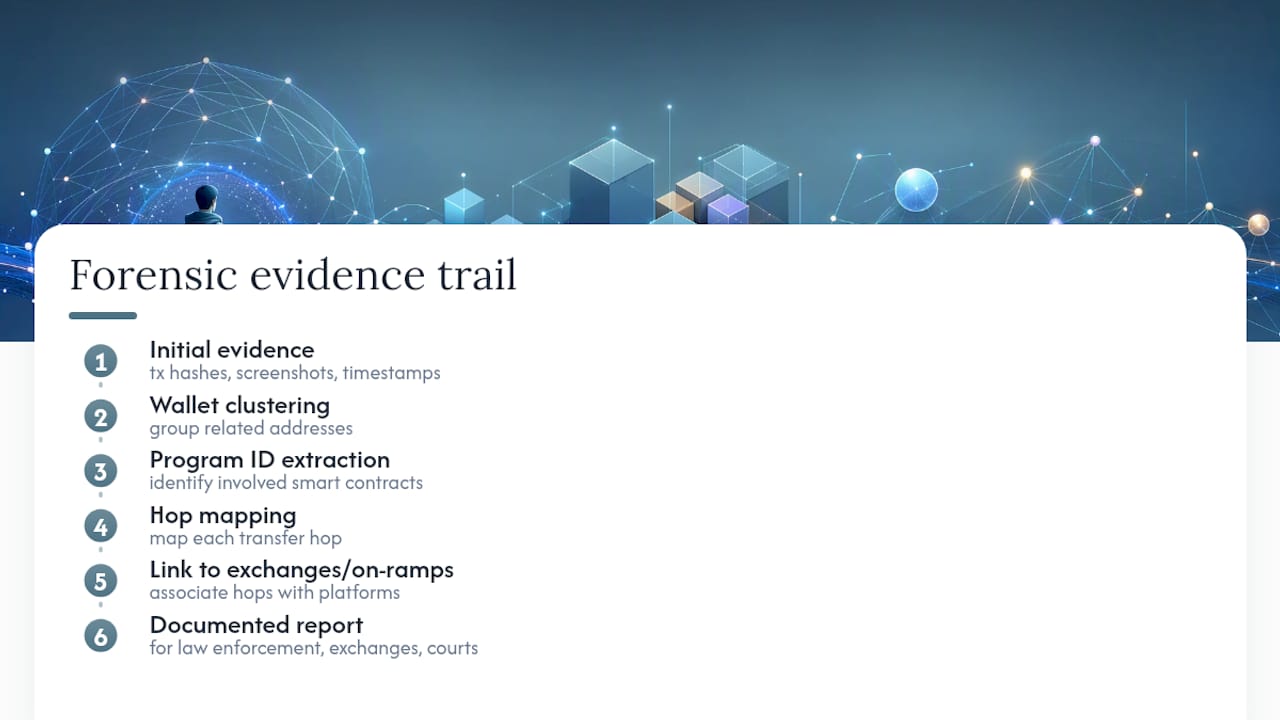
Blockchain forensics can rebuild the entire path your stolen Solana took, clustering wallet addresses, extracting program IDs, and mapping every hop to on-ramps or exchanges. What it can’t do is reverse a confirmed transaction. A forensic report’s value is in giving law enforcement, exchanges, or courts a documented trail they can act on, built from your original transaction hashes, screenshots, and timestamps. Engagements typically run days to a few weeks depending on how many hops the funds took before going cold.
— cristian
When Self-Help Tracing Isn’t Enough
Solscan searches and revoke tools handle the first hour. They don’t handle a drain that hopped through six wallets, a mixer, and a bridge before landing somewhere you can’t identify without cluster analysis and program-level tracing. That’s the gap Recoveraforensics fills: instead of a screenshot and a hope, you get an investigation that reconstructs the full path of your stolen assets and produces a report built to hold up with exchanges, counsel, or a court.
The firm’s cryptocurrency scam investigation and OSINT services trace transaction flows through mixers and bridges, connect wallet activity to real-world entities where possible, and package everything into documentation designed for legal use, not just a personal record.
Before reaching out, gather your transaction hashes, wallet addresses, timestamps, and any screenshots you took during the incident. Then start your case with a crypto fraud investigation to see what a full trace of your specific drain can actually recover.
Tools and Pages Worth Bookmarking Now
Keep Solscan open for tracing any wallet address in seconds, and use a reputable revoke-approvals tool before you do anything else with the compromised wallet. For reporting, prepare your evidence using the same structure exchanges and investigators expect: exported transaction records, screenshots, and approval logs, organized before you make contact.
This article is general information, not a substitute for advice from a qualified financial advisor. Consult a qualified financial professional about your own circumstances before acting on anything here.
Sources
- Solana wallet security — Seed phrases, phishing & safe signing | Solana Garden
- Solana wallet hacked or drained: what to do | SOLANA·HUB
- Staying safe on Solana | Solana Learn
FAQ
What should I do first if my wallet gets drained?
Stop signing transactions immediately, disconnect the wallet from every connected site, and move any remaining assets to a brand-new wallet created on a clean device. Then revoke the compromised wallet’s token approvals and document every transaction hash before contacting an exchange or filing a report.
How can I recover stolen Solana assets?
Recovery is genuinely rare because confirmed Solana transactions can’t be reversed, and your best shot is if the stolen funds landed in a centralized exchange account that can freeze them. Package your tx hashes and screenshots, report to the exchange’s compliance team and to IC3, and consider a professional trace through services like Recovera Forensics if the funds moved through multiple hops or mixers.
Is Solana considered an Ethereum killer?
Solana is frequently discussed as a faster, cheaper alternative to Ethereum because of its sub-second confirmation times and low fees, but neither network has replaced the other. That speed is also part of why Solana drains happen so fast: a single malicious signature clears almost instantly, leaving little time to react.
What is happening with Solana wallet security right now?
Drainer attacks using fake airdrops, cloned dApp interfaces, and malicious approval requests remain the dominant threat on Solana, more than any protocol-level exploit. Community guidance keeps converging on the same fixes: use a hardware wallet for meaningful holdings, approve specific amounts instead of unlimited access, and separate your main wallet from a limited-use hot wallet.
How much does a forensic investigation into a Solana drain cost?
Recovera Forensics does not publish a flat rate, since pricing depends on how complex the fund trail is and how many wallets or exchanges are involved. Current details are available directly through the service page, where you can request a case-specific quote.