If you suspect an NFT scam, stop interacting with the wallet or site right now, and do not sign any further transactions. Screenshot nothing yet, capture everything: the contract address, the transaction hash, and every raw message from the scammer. Then move fast to preserve that evidence and get it in front of a forensic investigator or the right reporting agency before the trail goes cold.
TL;DR:
- Verifying the contract address and URL on official sources is crucial before minting or trading to avoid fake sites and malicious contracts.
- Preserving detailed, metadata-rich evidence such as raw HTML, email exports, and verified logs enhances the chances of successful recovery and legal action.
- Tracking stolen funds involves mapping transaction flows, identifying exchange deposits, and following cross-chain or mixer hops to uncover the scammer’s assets.
- Building a comprehensive, well-organized report with transaction data, chat logs, and chain-of-custody notes is essential for law enforcement and legal proceedings.
- Engaging professional forensic services, like those offered by Recovera, significantly improves the potential for tracing and recovering stolen assets compared to DIY efforts.
Table of Contents
- Common NFT Scam Types and How Each One Works
- How to Spot Red Flags Before You Connect a Wallet
- Practical Investigation Workflow: Preserve, Identify, Trace, Document
- What Evidence Regulators and Law Enforcement Actually Need
- Where to Report an NFT Scam, and What Actually Happens Next
- How Recovera Forensics Investigates an NFT Scam
- Prevention Beats Hopeful Recovery, Every Time
- Get Professional Help Tracing and Reporting an NFT Scam
- Sources
- FAQ
Common NFT Scam Types and How Each One Works
Most NFT fraud falls into a handful of recognizable patterns. Knowing which one you encounter helps you figure out what evidence to grab and who to call next.
Phishing and fake mint pages clone a legitimate project’s website, sometimes down to the pixel, and swap in a malicious contract. You connect your wallet expecting to mint, and instead you sign a transaction that drains it. Academic research analyzing Web3 NFT phishing scams on Ethereum found this attack vector accounts for a large share of reported NFT theft, usually delivered through a fake ad, a compromised Discord link, or a typosquatted domain.
Rug pulls and exit scams happen when a project team sells out a collection, hypes a roadmap, then vanishes with the treasury. The timeline is often brutally short. In the Frosties case, federal prosecutors documented how creators sold out the collection and then rapidly withdrew cryptocurrency worth roughly several hundred ETH, equivalent to over a million dollars at the time, into fraud wallets within hours.
Wash trading and pump-and-dump schemes use circular buying between wallets the scammer controls to fake demand and inflate price, then dump the asset on real buyers who chased the volume.
Other recurring tactics include:
- Counterfeit listings that copy a real artist’s work onto a legitimate marketplace under a near-identical name
- Malicious airdrops and dust attacks, where a small unsolicited token lures you into a swap that grants wallet access
- Fake bid or token-swap prompts that trick you into approving a drain disguised as an offer
- Malware and social engineering through Discord or Telegram DMs, often from a “support” account impersonating project moderators
How to Spot Red Flags Before You Connect a Wallet
A few minutes of checking before you mint or buy saves most people from ever needing an NFT scam investigation at all.
- Verify the contract address character by character. Copy it from the project’s official Twitter or documentation, not from a search result or a DM, and compare it against what your wallet shows before confirming.
- Confirm the URL independently. Type the domain yourself or use a bookmark; never click a link sent to you in a Discord channel or Telegram DM, even from someone who looks like an admin.
- Check the contract’s verification status on a block explorer like Etherscan. Look specifically for hidden or unusual withdrawal functions, mint functions with no supply cap, or ownership that hasn’t been renounced.
- Read the community, not the follower count. Bought followers are cheap. Real engagement looks like specific questions, disagreement, and long-time members who’ve been active for months, not verification badges, which are a weak signal at best.
- Use a separate mint wallet. Keep a low-balance burner wallet for minting and connecting to new sites, and store anything valuable in a hardware wallet that never touches unfamiliar contracts. This single habit is the procedural defense Coinbase’s security guidance points to most often.
Pro Tip: Disable direct messages in every Discord server you join for NFT projects, and bookmark official project pages instead of trusting search results. Most successful phishing attempts start with a DM the victim never should have been able to receive.
Practical Investigation Workflow: Preserve, Identify, Trace, Document
Once you know what happened, the goal shifts from prevention to building a record strong enough to support recovery efforts or a legal filing. Forensic investigators generally work through four stages in order, and skipping the first one weakens everything after it.
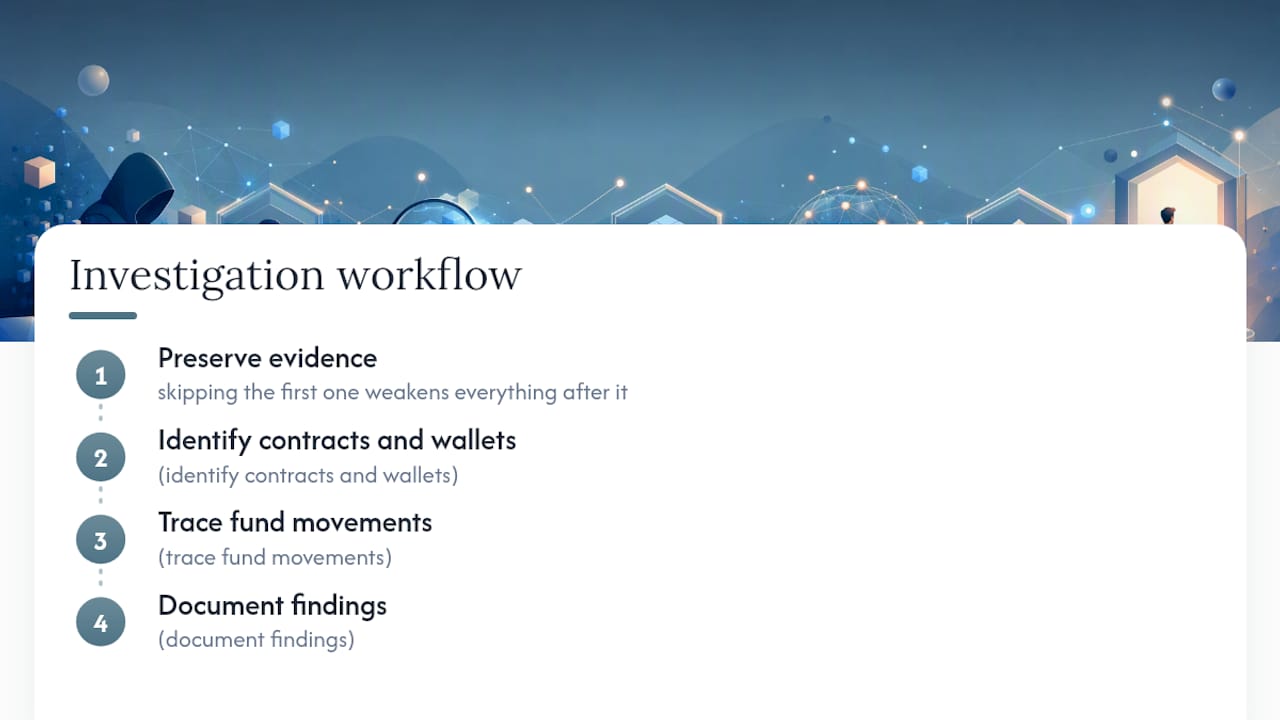
Preserve the evidence first
Screenshots feel like proof, but they carry no metadata and are trivially easy to fake or dispute. Forensic preservation guidance recommends archiving the raw HTML of any scam page, not just a picture of it, and exporting emails in full .eml format rather than forwarding or copying text. Discord and Telegram logs should be exported with timestamps intact using each platform’s export tools, since a plain screenshot of a chat thread strips the very metadata that proves when and from whom a message arrived.
Identify the contract and the wallets involved
Pull the contract address directly from the transaction that hurt you, then cross-reference it against the marketplace listing and any block explorer records. Note every wallet address that touched your funds, including the one you interacted with and any secondary wallets it forwarded assets to within minutes of the theft.
Follow the money
Record every transaction hash tied to the incident and map where funds moved from there. Watch for deposits into centralized exchange wallets, since that is often the point where a legal process like a subpoena can force an identity disclosure. Also flag any hops through mixers or cross-chain bridges, which scammers use specifically to break the trail. The DOJ’s Frosties complaint shows investigators tracing exactly this kind of rapid, split transfer pattern to fraud wallets designed to obscure origin.
Run social OSINT carefully
Cross-reference usernames across platforms, check domain WHOIS records for the scam site, and look for GitHub or Twitter handles reused across projects. The blockchain ledger shows you the hops; it does not hand you a name. As research on blockchain attribution challenges points out, connecting a wallet to a real person requires exactly this kind of external correlation, and it’s where investigators most often get it wrong if they rush. Document your confidence level for every link you draw, and never publish a public accusation based on a guess.
Build the dossier
Compile everything into a single document that separates what’s proven (on-chain transfers, timestamped archives) from what’s inferred (a suspected identity, a probable connection between two wallets). Note chain of custody for every file: when it was captured, by whom, and how. A step-by-step guide to building a crypto fraud case walks through this documentation process in more depth if you’re assembling one yourself.
What Evidence Regulators and Law Enforcement Actually Need
A report with vague descriptions and a folder of screenshots rarely goes anywhere. A report with organized, labeled evidence gets read.
- Core transaction data: every transaction hash involved, the corresponding block explorer links, the contract address, all wallet addresses touched, and exact timestamps for each event.
- Communications and receipts: raw message logs (not paraphrased summaries), purchase receipts, and any confirmation emails tied to the transaction.
- File formatting that speeds review: emails saved as .eml, transaction lists exported as CSV, and preserved web pages saved as PDF with the URL and capture date visible on the page itself.
- Basic chain-of-custody notes: a short log stating when each file was created, who created it, and whether it has been altered since capture.
Different channels want different subsets of this. Marketplace abuse forms usually just need the listing URL and transaction hash. The FBI’s IC3 portal and SEC tip forms want the fuller package, including wallet addresses and a narrative timeline, because they’re building a case file, not issuing a takedown.
Where to Report an NFT Scam, and What Actually Happens Next
Reporting isn’t one action. It’s a sequence, and each step serves a different purpose with a different realistic timeline.
- Marketplace abuse reports move fastest, often within days, and can delist a fraudulent collection or freeze a scammer’s storefront account. They rarely recover funds already transferred out.
- FBI IC3 and local law enforcement build the criminal record. Response times vary widely, and small individual losses are frequently aggregated with other victim reports before an agency acts, which is part of why coordinated documentation matters.
- Specialized units like IRS Criminal Investigation or Homeland Security Investigations sometimes get pulled in for cases involving cross-border transfers or larger sums, particularly when a pattern echoes prior public prosecutions like Frosties.
- SEC reporting applies when the NFT sale looked more like a securities offering than a collectible, complete with promised returns or profit-sharing language. The SEC’s newsroom and tip channels exist specifically for this category of complaint.
- Civil and private recovery options depend almost entirely on having a forensic dossier strong enough to support a subpoena. Without transaction hashes and a documented trace, an attorney has very little to work with; a civil action plan for crypto fraud victims covers what that process typically involves.
How Recovera Forensics Investigates an NFT Scam
Recovera Forensics builds its NFT and crypto fraud investigations around the same preserve-trace-document sequence outlined above, but with deeper tooling than most victims can apply alone. That means:
- Tracing transactions through exchange deposits, mixers, and cross-chain bridges to map the full flow of stolen assets
- Correlating on-chain activity with OSINT findings to connect wallets to real-world identities where the evidence supports it
- Producing court-ready reports with documented chain of custody, suitable for law enforcement referral or civil litigation
- Preserving digital evidence properly from the outset, so nothing gets lost to a deleted Discord server or an expired archive link
Paid forensic work earns its cost when the loss is large, funds have already reached an exchange or mixer, the case spans multiple jurisdictions, or legal action is genuinely on the table.
Prevention Beats Hopeful Recovery, Every Time
Blockchain transparency gives investigators a real trail, but attribution stays hard. A wallet address is not a name, and that gap is where most recovery hopes stall. Forensic work meaningfully raises the odds of a traceable, legally usable case, but victims should walk in with realistic timelines, not expectations of a quick reversal. Burner wallets, hardware wallets, and character-by-character contract checks remain the best defense anyone actually controls.
— cristian
Get Professional Help Tracing and Reporting an NFT Scam
Recovera Forensics gives you something a DIY screenshot folder never will: a court-ready trace map that turns scattered transaction data into evidence a lawyer, exchange, or investigator can actually act on. Where general advice stops at “report it and hope,” Recovera’s cryptocurrency scam investigation and OSINT services pick up the trail, correlating wallet flows with real-world identifiers and packaging the result into a technical report built for legal proceedings.
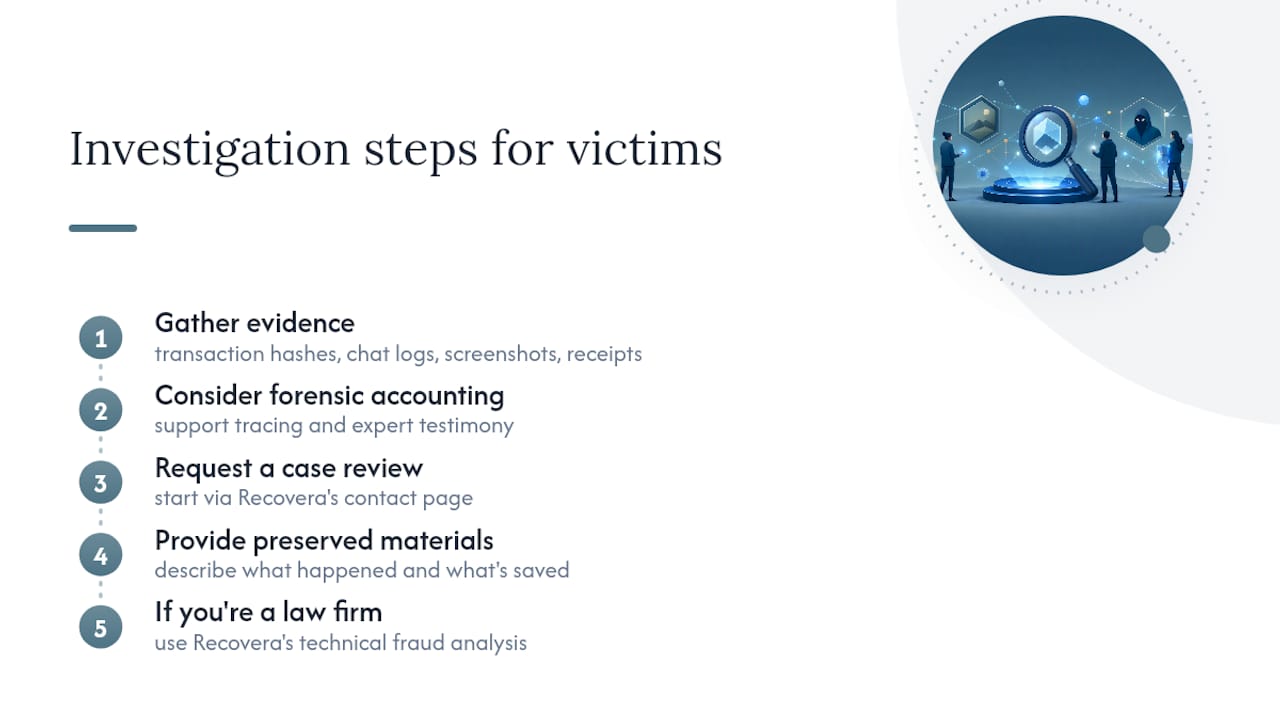
Before reaching out, gather what you can: transaction hashes, any preserved chat logs or emails, screenshots of the scam listing, and purchase receipts, then consider contacting a forensic accounting partner to support financial tracing or expert testimony in legal proceedings. If you’re a law firm supporting a client through this, Recovera’s technical fraud analysis and reporting services are built specifically for that intake. Start by requesting a case review through Recovera’s contact page and describing what happened and what you’ve already preserved.
Sources
- United States Attorney’s Office (SDNY) — complaint/press release on Frosties NFT rug pull
- U.S. Securities and Exchange Commission — newsroom / enforcement guidance
- Coinbase — How to protect yourself from NFT scams
- PMC article on blockchain analysis and attribution challenges
This article is general information, not a substitute for advice from a qualified financial advisor. Consult a qualified financial professional about your own circumstances before acting on anything here.
FAQ
Can a Crypto Scammer Actually Be Traced?
Often, yes, at least up to a point. Blockchain transactions are public and permanent, so investigators can map exactly where stolen funds moved, including through mixers or bridges. Tracing hits a wall at attribution: connecting a wallet address to a real identity requires OSINT correlation like social media links, domain records, or exchange KYC data obtained through legal process.
Is an NFT Real or Fake, and How Do I Check?
An NFT itself is just a token pointing to metadata, but the collection surrounding it can be counterfeit, copied art listed under a fake project name on a legitimate marketplace. Verify by checking the contract address against the official project source and confirming the creator account matches the verified original listing, not just a similar name or logo.
What’s the Biggest NFT Scam Risk Right Now?
Phishing through fake mint pages and Discord impersonation remains the dominant threat, since it requires almost no technical sophistication from the scammer, just a convincing clone site and a well timed link. Rug pulls follow close behind for dollar losses, given how quickly teams can collect sale proceeds and vanish.
Who Has Lost the Most Money to NFT Scams?
Individual losses vary widely, but aggregated reporting on the space has documented over $100 million stolen across a reporting period tied to rug pulls and related NFT fraud patterns. Losses tend to concentrate around high-hype collection launches where large numbers of buyers mint simultaneously.
What Should I Do Immediately After Realizing I Got Scammed?
Stop all interaction with the wallet or site involved, and do not sign any further transactions, even ones that promise to reverse the theft. Capture the contract address, transaction hash, and any raw communications right away, then preserve that evidence before reporting to a marketplace, law enforcement, or a forensic investigator.