U.S. crypto exchanges keep detailed records on their customers and every transaction they process, and federal rules set a five-year floor for much of it. If you lost crypto to a scam, those records are often the bridge between a wallet address on a public blockchain and a real account holder. The records only help if someone requests them in the right form, with the right transaction details, while they still exist. A forensic investigation that traces your funds to the exchange turns a vague complaint into a specific, documented request. That is the work we do at Recovera Forensics.
This guide explains what exchanges retain, what the law requires, what a victim can realistically obtain, and how to use that knowledge in the first days after a loss.
TL;DR
- U.S. exchanges that handle customer funds are money services businesses. They collect identity data and transaction history, and federal rules generally require records to be kept for five years.
- The public blockchain shows where your coins went. The exchange’s records show who controlled the receiving account. You need both to build a case.
- You usually cannot compel an exchange to hand over another customer’s data yourself. Law enforcement uses subpoenas and legal process, and a strong forensic report makes those requests specific.
- Retention periods are not a reason to wait. Write down transaction hashes, addresses, timestamps and screenshots now.
- A trace that ends at a named exchange, with dates and amounts, is the most useful starting point for police, a lawyer or a recovery effort.
Table of Contents
- What exchanges actually keep about customers
- How long exchanges must keep records
- Why the five-year floor is not a reason to wait
- What the blockchain shows and what only the exchange knows
- Who can actually get exchange records
- What a victim should preserve right now
- Be careful with unsolicited KYC requests
- What retention means for the funds you still hold on an exchange
- Do exchanges report to the IRS, and why a victim should care
- Where exchange records stop being enough
- Perspective
- How Recovera Forensics can help
- FAQ
- Sources
What exchanges actually keep about customers
An exchange holds two broad kinds of data: who you are, and what you did.
The U.S. Department of Justice explains in its consolidated bulletin on cryptocurrency investigations that U.S. exchanges are money services businesses. They must register with FinCEN, the Treasury bureau that polices financial crime, and collect know-your-customer (KYC) data. That includes names, dates of birth, identification and financial details, contact information, IP and device information, photographs and transaction history.
Exchanges describe this themselves. Binance.US’s law enforcement guide, updated July 2026, says the records it can produce may include:
- KYC information
- account balance
- linked bank accounts
- trade, deposit and withdrawal history
- IP history and device history
- correspondence with customers
Coinbase’s privacy policy (May 2026) adds transaction details such as sender and recipient names, amount, payment method, date and timestamp, plus biometric data used for identity verification. It says it keeps customer information as needed to provide services and to meet legal obligations, including anti-money-laundering and KYC rules.
For a scam victim, this means two things. Your own account at a U.S. exchange holds a full record of the payments you sent, which is useful evidence. And the account that received your money, if it sits at a regulated exchange, holds identity data about whoever opened it.
How long exchanges must keep records
There is no single “crypto retention period” in U.S. law. Retention comes from the Bank Secrecy Act framework that applies to money services businesses.
The general rule is in federal regulation 31 CFR 1010.430: records required to be retained under that chapter are kept for five years. The Justice Department’s Cryptocurrency Enforcement Framework (January 2021) confirms that FinCEN requires virtual currency money transmitters to register, run anti-money-laundering programs, and meet recordkeeping and reporting duties such as suspicious activity reports. It adds that these duties apply equally to foreign-located businesses serving U.S. customers, even without a physical U.S. presence.
Company policies sit on top of that floor. Circle’s record retention requirements for its digital asset account program, for example, call for transaction receipts, customer communications and account statements to be kept for five years, and KYC records for five years from account closure.
The practical reading:
| Record type | What to expect | Why it matters to a victim |
|---|---|---|
| KYC and identity records | Generally kept for years, in some programs counted from account closure | Links a receiving account to a person |
| Transaction history | Generally a five-year floor under federal rules | Shows deposits, trades and withdrawals after your funds arrived |
| Customer communications | Often kept alongside account records | Can show how the account holder behaved |
| Device and IP logs | Varies by exchange policy | Helps connect accounts to one operator |
The last row is the one to treat carefully. Exchange policy on technical logs differs, and no source we cite sets a universal figure for it. That uncertainty is why speed matters even when a five-year rule exists.
Why the five-year floor is not a reason to wait
Five years sounds generous. In practice, a scam case loses value within days, not years.
Stolen crypto is usually moved quickly through several wallets and sometimes through mixers or cross-chain bridges before it lands at a deposit address. Each hop makes the trail longer and the exchange’s role harder to prove. Records that technically still exist are useless if no one asks for them with the specifics an exchange compliance team needs.
There are also practical reasons to act early:
- Frozen funds depend on timing. Written testimony to a House Banking Committee hearing on April 16, 2024 stated that law enforcement can trace cryptocurrency to cash-out points at exchanges and serve legal process on those businesses to request account information or ask that accounts be frozen. A freeze only helps if the funds are still there.
- Your own evidence can disappear. Scam websites, chat accounts and social profiles are deleted fast. The blockchain does not change, but the surrounding context does.
- Memory fades. Dates, amounts and the sequence of messages are the details a report is built on.
Our guide on what to do in the first 48 hours after a U.S. crypto exchange subpoena covers the exchange side of this timeline, and the 24 to 72 hour investigator checklist covers what to capture early.
What the blockchain shows and what only the exchange knows
The public ledger and the exchange’s records answer different questions.
The FBI’s Law Enforcement Bulletin on virtual currency investigative challenges explains the split. With a transaction time and the victim’s public key, investigators can use the public ledger to find the address the coins were sent to. The best way to identify the person behind it is to link that address to information outside the ledger, and FinCEN-registered exchangers must validate their customers’ identities.
The U.S. Government Accountability Office describes how federal agencies use blockchain analytics tools that apply machine learning to behavioral patterns on public ledgers and build large transaction databases to tie payments to specific wallets.
Put simply:
- The blockchain tells you the path: from your wallet, through intermediate addresses, to a deposit address.
- Clustering and attribution analysis tells you which addresses probably belong to the same operator or a known service.
- The exchange’s records tell you who opened the account that received the funds, and what that account did next.
A trace that only covers step one leaves you with a list of addresses. A trace that reaches step three gives police or a court a named custodian to ask. Our explainer on exchange-to-exchange tracing shows how stolen funds are followed across platforms, and the guide to tracing Ethereum transactions to an exchange walks through that path on one network.
Who can actually get exchange records
This is where many victims get stuck. An exchange will not give you another customer’s identity because you ask politely, and privacy law and its own policies prevent it.
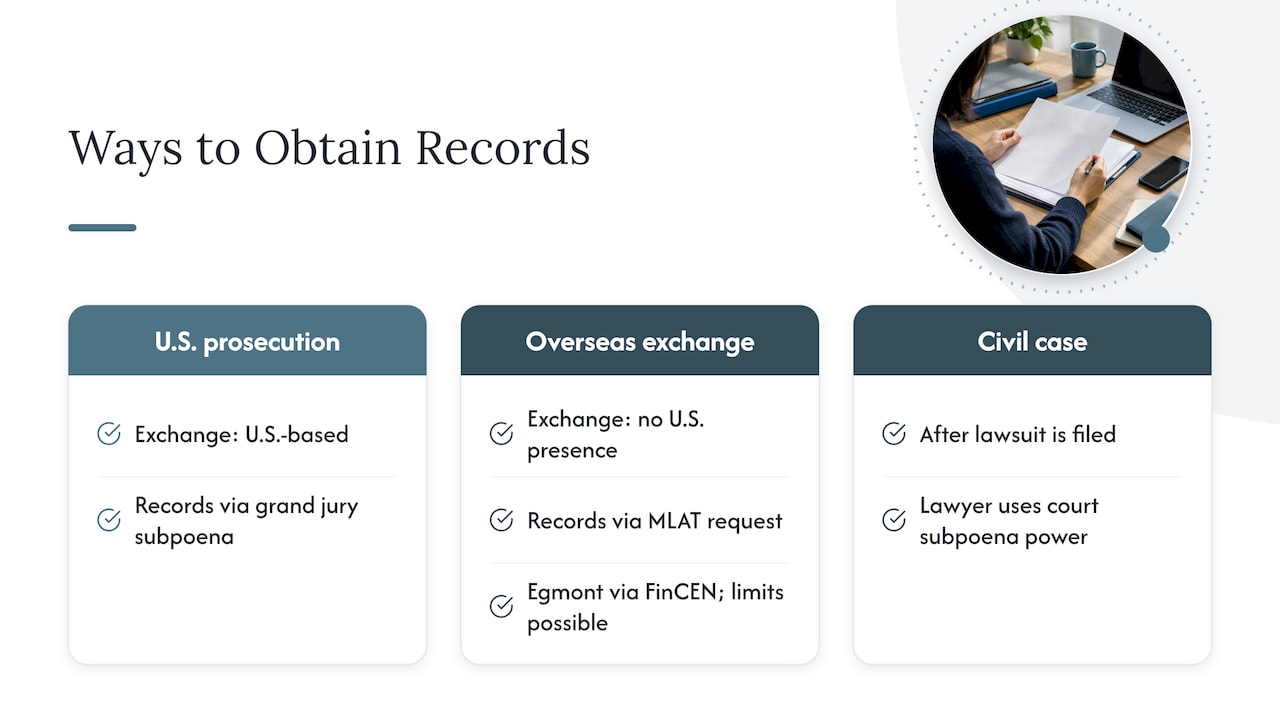
The Justice Department bulletin says prosecutors can obtain records from U.S.-based exchanges with a grand jury subpoena. Records from an overseas exchange without a U.S. presence can be sought through a mutual legal assistance treaty (MLAT) request, and a case agent may also consider an Egmont request through FinCEN, subject to possible limitations.
In a civil case, a lawyer can use the court’s subpoena power once a lawsuit is filed. That is why a report that names the exchange, the deposit address, the amount and the time is so useful: it gives a lawyer what they need to draft a request the exchange can act on.
Exchanges set their own intake rules for law enforcement. Binance.US’s guide requires requests to include all known user identifiers (full name, email, mobile number). For requests based on a transaction hash, it requires the amount, the input and output addresses and a UTC timestamp. Personal data must be sent in a password-protected file, with the password sent in a separate email. A vague request wastes time; a complete one gets processed.
The next section explains why that precision comes from forensic work. For the police side of the process, see what U.S. victims should report to trigger a police investigation.
What a victim should preserve right now
You do not need an exchange’s internal records to start. You need your own.
- Transaction identifiers. For every payment, save the transaction hash (the unique ID of the transfer), the sending and receiving addresses, the amount, the asset and the network.
- Timestamps. Record them in UTC if the platform shows it. Exchanges ask for this format.
- Your exchange account history. Export deposit, withdrawal and trade history from your own account. Your exchange keeps this, but a copy in your hands saves time.
- Communications. Screenshot chats, emails, text messages, websites and social profiles used by the scammer, with the URLs visible.
- Payment trail outside crypto. Bank transfers, card payments and wire confirmations that funded your purchase.
- A written timeline. One page, in order, with who said what and when.
Do not delete anything, and do not message the scammer further. Evidence that is handled carelessly is harder to use later; our guides on digital evidence preservation and crypto chain of custody explain what makes it hold up. Our evidence preservation service is built for this stage and is described on our recovery services page.
Be careful with unsolicited KYC requests
Scam victims are often targeted a second time. Someone claims to be an exchange or an investigator and asks for ID documents, selfies or wallet access in order to “release” funds. Genuine exchange compliance contacts do not ask for your seed phrase or private keys.
The SEC’s investor bulletin on crypto asset custody advises never sharing private keys or seed phrases and using strong passwords with multi-factor authentication on online crypto accounts. Our article on whether an exchange KYC request is real shows what a legitimate request looks like and what is safe to send.
What retention means for the funds you still hold on an exchange
Retention rules cover records, not your balance. When you keep crypto at an exchange, the custodian controls the private keys. The same SEC bulletin warns that if a custodian is hacked, shuts down or goes bankrupt, you may lose access to your assets.
The CFTC’s 14 Digital Asset Risks to Remember notes that platforms often hold funds on their own centralized systems, may commingle them with other customers’ assets, and points users to the FinCEN registrant search at fincen.gov/msb-registrant-search to verify registration. The Michigan Department of Consumer Protection’s consumer alert adds that in a bankruptcy, customers would most likely be unsecured creditors, last in line.
Account takeover is a common route to losses at exchanges, and basic hygiene lowers that risk. A crypto account security guide for beginners covers the habits worth building after a scam. Log-in history, withdrawal whitelists and device records at your exchange also become evidence if an account is compromised, so keep your own copies.
Do exchanges report to the IRS, and why a victim should care
Exchanges do report. The IRS’s final digital asset broker regulations (Internal Revenue Bulletin 2024-31, effective September 9, 2024) require custodial exchanges and other brokers to file Form 1099-DA showing gross proceeds for transactions on or after January 1, 2025. Basis reporting applies to covered assets acquired from the same broker on or after January 1, 2026. The 2026 instructions for Form 1099-DA set out how brokers report.
For a scam victim this matters in two ways. First, these forms add another set of records that show your activity at an exchange, which helps you document what you moved and when. Second, if you are claiming a theft loss on your return, the tax rules are a separate question: talk to a tax professional about how your loss is treated, because a forensic report documents what happened but does not decide tax treatment.
Where exchange records stop being enough
Exchange data is powerful but not complete. The DOJ bulletin cautions that many foreign exchanges, and operators that do not follow U.S. money-laundering rules, collect little more than an email address, and that sophisticated criminals avoid KYC exchanges altogether. The 2021 DOJ framework adds that inconsistent international registration and KYC requirements complicate cross-border cases. So how far a trace can go depends on whether the funds touch a compliant exchange that collects identity data.
That is exactly why the quality of the trace matters. It decides whether you end up with a deposit address at a U.S.-regulated platform, or an unexplained dead end.
Perspective
Victims often ask us the same thing: “How long will the exchange keep my records?” The better question is what you can prove today.
Retention rules give a floor, but nothing guarantees that the specific record you need will be easy to obtain, and a request that lacks the right transaction details goes nowhere. Our approach is to analyze the transaction patterns on the public blockchain, follow the flow of funds through intermediate wallets, mixers and bridges, and connect wallet activity to wider fraud networks. The aim is a report that names where the money landed and can support legal proceedings.
We work with individuals who were scammed and with law firms that need technical support for their clients. We keep the process transparent and centered on the victim, because someone who has just lost money needs clear steps, not jargon.
Take the evidence you have now, preserve it properly and get the trace done while the trail is fresh.
cristian
How Recovera Forensics can help
Our cryptocurrency scam investigation traces stolen funds across the blockchain and documents the path in a technical report. Alongside it we offer OSINT investigations and digital attribution, preservation of evidence and digital footprint, forex and online trading fraud support, and claims involving casinos and online gambling. Details are on our recovery services page. Law firms can find technical analysis and report preparation on our page for professional offices, and the guide to what a usable report contains for law firms explains what counsel needs.
FAQ
How long do crypto exchanges keep my data?
Federal regulation sets a five-year retention period for records that the Bank Secrecy Act chapter requires, and some programs count KYC records from account closure. Individual exchanges set their own policies for items like device logs. Ask your exchange for its policy, and save your own account history now.
Can the FBI track crypto?
Yes. The FBI’s bulletin explains that the public ledger lets investigators find where coins were sent, and that linking an address to a person usually relies on outside information such as exchange identity records. Federal agencies also use blockchain analytics tools to link payments to wallets, as the GAO describes.
Can I get a scammer’s account data from an exchange myself?
Not normally. Exchanges release customer records through legal process such as a subpoena, not on a victim’s request. A forensic report that names the exchange, address, amount and time gives police or your lawyer what they need to ask properly.
Do crypto exchanges report to the IRS?
Yes. Under final regulations effective September 9, 2024, custodial brokers report gross proceeds on Form 1099-DA for transactions on or after January 1, 2025, with basis reporting for certain assets from January 1, 2026. How a theft loss is treated on your return is a question for a tax professional.
Is it safe to keep crypto on an exchange?
The custodian controls your private keys, so a hack, shutdown or bankruptcy can cut off access, according to the SEC’s investor bulletin. Use strong passwords and multi-factor authentication, never share seed phrases, and verify a platform’s FinCEN registration.
Sources
- DOJ consolidated bulletin on cryptocurrency investigations
- Binance.US law enforcement guide
- Coinbase privacy policy
- 31 CFR 1010.430, nature of records and retention period
- DOJ Cryptocurrency Enforcement Framework
- Circle record retention requirements
- House Banking Committee written testimony, April 2024
- FBI Law Enforcement Bulletin on virtual currency investigations
- GAO on blockchain analytics and law enforcement
- SEC investor bulletin on crypto asset custody
- CFTC, 14 Digital Asset Risks to Remember
- Michigan Department of Consumer Protection on crypto exchanges
- IRS Internal Revenue Bulletin 2024-31
- IRS Instructions for Form 1099-DA
- Crypto account security guide for beginners