
Stolen crypto that enters Tornado Cash can still be investigated. Investigators work from the public blockchain, build a timeline of deposits and later withdrawals, score the candidate links, and document the result in a report that law enforcement, an exchange compliance team or a court can evaluate. The result is a set of evidence-backed leads, not a guess. How strong each lead is depends on the method, the data and the care taken in writing it up.
This guide explains, in plain terms, what Tornado Cash tracing involves, what it can establish, how to preserve what your case needs, and where a forensic engagement fits. If you want a specialist to look at your own wallet history, our cryptocurrency scam investigation service starts from the transaction records you already have.
TL;DR
- Tornado Cash is a mixer: it pools deposits so a withdrawal is hard to match with the deposit that funded it. Every deposit and withdrawal is still recorded on the public ledger.
- Tracing uses timing, amounts, gas settings, shared counterparties and the movement of funds before and after the mixer to rank possible links.
- The public ledger shows addresses, not people. A forensic report links activity to real-world identities only with additional evidence.
- Courts apply Rule 702 and the Daubert standard to expert tracing, so the method and the documentation matter as much as the finding.
- Report to the FBI’s IC3 and save transaction hashes, addresses, amounts, dates and communications now. Our investigators start from exactly those items.
Table of Contents
- What Tornado Cash is and why it complicates a trace
- How investigators connect deposits to withdrawals
- What a mixer trace can establish
- Where U.S. law stands on Tornado Cash
- Preserve the evidence a trace needs
- Why the report matters as much as the trace
- What to do if your funds went through Tornado Cash
- Perspective
- Where Recovera fits
- FAQ
- Sources
What Tornado Cash is and why it complicates a trace
Tornado Cash is a set of smart contracts on Ethereum and other EVM networks. A user deposits a fixed amount of a token into a pool. Later, the same or another person withdraws the same amount to a different address. Because many deposits sit in the pool at once, the withdrawal address is not directly tied to the deposit address on the surface.
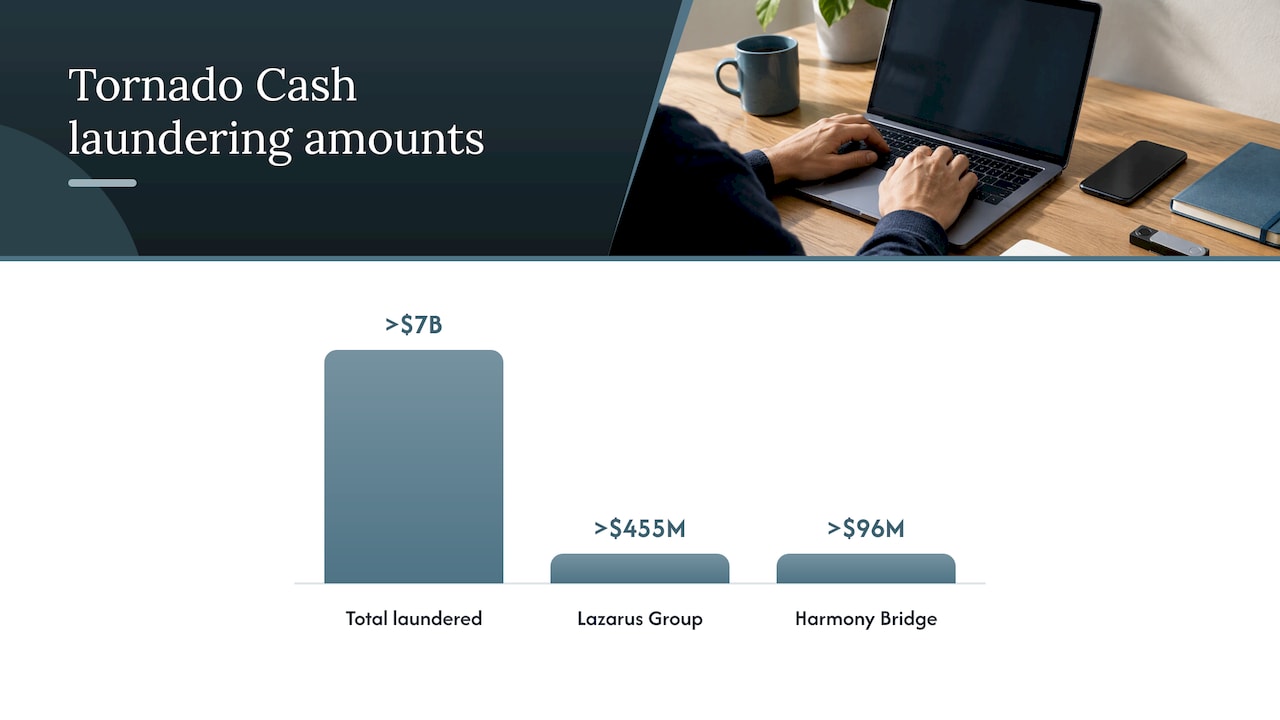
That is why scammers use it. The U.S. Treasury’s August 8, 2022 sanctions announcement said Tornado Cash had laundered more than $7 billion in virtual currency since 2019, including over $455 million stolen by the Lazarus Group and more than $96 million from the Harmony Bridge heist.
What the mixer does not do is remove the record. The federal indictment of the Tornado Cash founders describes the Ethereum blockchain as a public ledger that records every address balance and transaction, so the movement of funds can be traced. The same document notes that the ledger shows anonymous addresses and cannot by itself identify the people behind them. That single sentence defines the whole job: follow the money on-chain, then connect addresses to people with additional evidence.
How investigators connect deposits to withdrawals
A mixer trace is a process of narrowing. No single signal settles it. Investigators combine several, and the strength of the conclusion depends on how many independent signals agree.
Start with where the funds left your wallet
Every trace begins with the victim-side transactions: the transaction hashes, the receiving addresses and the timestamps. From there the analyst follows the funds hop by hop to see whether they reach a Tornado Cash pool. This stage is often where a case is made or lost, because a wrong turn early on carries through every later step. In the Tornado Cash prosecution, the government’s tracing analysis of the Ronin bridge theft showed that most of the stolen funds went into one wallet and then into Tornado Cash in thousands of deposits over more than six weeks, and OFAC designated that wallet as blocked Lazarus Group property on April 14, 2022.
That example shows two useful patterns. Large thefts are often split into many deposits, and deposit behavior itself (frequency, size, spacing) can become evidence of a single actor.
Timing and amount matching
One published method is first-in, first-out matching. A peer-reviewed cross-chain study of Tornado Cash activity, which covered all deposits and withdrawals from deployment to August 2024, applied three heuristics, including one that links each deposit to the earliest withdrawal in the following blocks. The reasoning is that users tend to prefer fast withdrawals to limit their time exposed on-chain.
Timing is a lead, not a verdict. Open-source demixing tooling such as tornado-demix works only from public on-chain data. It reads deposits across registered pools and scores the recipients of matching withdrawals. Its own documentation cautions that amount and timing matches alone can appear by chance, and it asks for a linked address, such as a direct counterparty or a withdrawal sent from the depositor’s side, before it labels evidence as strong or moderate. That is a sound standard for any analyst: a timing match gets a confidence level, and a second independent link raises it.
Signals around the mixer
The most useful evidence is usually just outside the pool:
- Gas and transaction settings. Repeated unusual fee settings across deposit and withdrawal transactions can point to the same operator.
- Funding of the withdrawal address. A fresh address that receives gas from a known address is a link. A fresh address that is funded by a mixer withdrawal and then sends funds straight to an exchange deposit address is another.
- Behavior after withdrawal. Funds that move quickly into bridges, swaps or exchange accounts leave records at each point.
- Off-chain context. The scam website, the messages, the payment instructions and domain registrations can tie an address to a person or network. This is the work of OSINT (open-source intelligence), public-source investigation that connects wallets to real-world activity.
We build our approach around reconstructing complex asset flows, including through mixers and bridges, and connecting wallet activity to the wider fraud network rather than stopping at a single address. If your funds moved across chains, our BEP-20 token tracing page shows how we document a path across networks.
What a mixer trace can establish
A well-built Tornado Cash trace can establish several things a victim and their counsel can use:
- That your funds entered the mixer, with transaction hashes, block times and amounts.
- Which withdrawals are plausible continuations, ranked by the strength and number of linking signals.
- Where funds reached identifiable services, such as an exchange deposit address, which is the point where a compliance team or a legal request can act.
- Which addresses belong to the same cluster, including a wider network behind multiple victims.
The last two matter most for recovery. The FBI notes that exchanges freeze accounts through internal processes or legal process, and that victims may pursue civil litigation and should report to law enforcement with transaction details. A trace that ends at an identifiable service gives those processes something concrete to act on. Our Tracing Crypto Mixers guide goes deeper into what investigators can follow.
Where U.S. law stands on Tornado Cash
You may read that Tornado Cash is sanctioned, or that it is not. Both statements trace back to real events, so here is the sequence.
- On August 8, 2022, OFAC designated Tornado Cash and stated that Tornado Cash property in U.S. persons’ possession or control is blocked.
- On November 26, 2024, the Fifth Circuit held that Tornado Cash’s immutable smart contracts are not property of a foreign national or entity and cannot be blocked under IEEPA, the sanctions statute used for the designation.
- A later court filing states that OFAC would delist Tornado Cash on remand.
For a victim, the practical point is that sanctions status does not change whether a trace is possible. The blockchain record exists either way. What the status changes is how U.S. institutions treat mixer-related funds, which is why a clear, documented trace helps an exchange or investigator understand your case. For current status, check the Treasury’s OFAC pages.
Preserve the evidence a trace needs
The quality of a trace depends on what you save. The FBI’s cryptocurrency guidance asks victims to submit an IC3 complaint with cryptocurrency addresses, amounts and types, transaction hashes, and transaction dates and times. It also asks, where possible, for how you met the scammer, the communication platforms, web domains, and phone numbers or other identifiers.
The CFTC adds a practical method: build a timeline while events are fresh, and collect names used by the fraudsters, social media profiles and chats, website addresses and screenshots, emails with full header information, account statements, and records of other payments such as wire transfers or prepaid cards.
In practice, a good evidence folder holds:
| Item | Why it matters for tracing |
|---|---|
| Transaction hashes for every transfer | The starting point for every trace |
| Sending and receiving addresses | Define the first hops and the scammer’s wallets |
| Amounts, token types and timestamps | Needed for timing and amount matching |
| Chats, emails (with full headers), screenshots | Tie addresses to a person or network |
| Website addresses and payment instructions | Support OSINT attribution |
| Bank or card statements | Show how funds entered crypto in the first place |
Clear records also make a later tax or IRS question easier to answer, and this overview of audit-ready crypto records shows the same hashes, addresses, amounts and dates organized for U.S. reporting.
Our preservation work covers evidence and digital footprint, and our digital evidence preservation guide explains how to keep records in a form that holds up later. For the first days after a theft, the stolen crypto steps and first 72 hours checklist lay out what to save and in what order.
Why the report matters as much as the trace
If your case reaches a courtroom, the tracing is not accepted on trust. In United States v. Storm, the defense’s filing set out the Rule 702 and Daubert standard: expert testimony must rest on sufficient facts or data, reliable methods, and a reliable application of those methods to the case, and the party offering it bears the burden. Rule 702 is the federal rule on expert testimony. Daubert is the Supreme Court decision under which judges act as gatekeepers on whether an expert’s method is reliable.
The July 2025 defense filing in the same case challenged the government’s tracing on specific points: a path of 10 hops across commingled funds, a matching approach the filing said was borrowed from cost-basis accounting, and limited attention to timing and changes of ownership. These are allegations from one side of a case, but they show where scrutiny falls. A court-ready report therefore needs to:
- State the method used at each hop and why it fits the facts.
- Account for timing, ownership changes and commingling instead of assuming a straight line.
- Separate confirmed links from probable links and label the confidence of each.
- Keep a clear chain from raw blockchain data to every conclusion.
This is how we approach report preparation: technical reports and documentation written for legal proceedings, with transparent steps a lawyer can follow. Our guides on admitting blockchain evidence in U.S. court, crypto chain of custody and wallet activity analysis walk through the checks. Law firms can see how we prepare filings in SEC-ready crypto fraud reports for Rule 702 and 901.
What to do if your funds went through Tornado Cash
Work in this order:
- Stop sending crypto. The Ohio Attorney General’s June 2025 advisory tells victims to stop sending funds and gather documentation of conversations, addresses, screenshots and receipts.
- Report to the FBI’s IC3 with the transaction details listed above. Our guide on what to report to trigger a police crypto investigation explains what investigators look for.
- Protect your identity. The same Ohio advisory recommends free fraud alerts or credit freezes with Equifax, Experian and TransUnion.
- Report to your state securities regulator and the CFTC where the scheme involved investments or trading. NASAA’s recovery-room advisory points victims to their state securities regulator.
- Get a forensic trace of the full path so that your report, a lawyer’s letter or an exchange request has specific addresses and hashes to work with.
- Talk to an attorney about civil options. The civil versus criminal guide explains how evidence supports each route.
Be careful about unsolicited contacts. NASAA warns that scammers can pass a victim’s details to a “colleague” who runs a recovery room, and that legitimate firms don’t ask for exorbitant or up-front fees without offering anything in return. Verify who contacted whom before sharing any financial information, and never send crypto to anyone who reaches out first.
Perspective
Tornado Cash is the first place many victims hear the case is over. We see it differently. A mixer breaks the easy visual link between two addresses, but it leaves a complete public record of every deposit and withdrawal, and that record can be analyzed.
Our work is built on analyzing detailed transaction patterns on public blockchains, tracing the flow of lost assets, and connecting wallet activity to the wider fraud network. We reconstruct flows through mixers and bridges, and we write the findings as technical reports suitable for legal proceedings, with a transparent process and a victim-centered approach.
The strongest cases combine three things: early evidence preservation, a method that states its confidence at every step, and a report that a lawyer, an exchange or a judge can follow without a technical background. We also work directly with law firms, so the report is written with the legal use in mind from the start.
cristian
Where Recovera fits
A forensic engagement with us typically combines several services: cryptocurrency scam investigation, OSINT investigations and digital attribution, and preservation of evidence and digital footprint, plus support for Forex, online trading and gambling fraud cases. Each leads to a technical report you can use with law enforcement, a law firm or a civil claim. Details of the services are on our investigation services page. Law firms and professional offices can review our technical analysis and reporting service. For a step-by-step view of how a case runs, read the crypto fraud investigation guide.
FAQ
Can stolen crypto really be traced after Tornado Cash?
Yes. Deposits and withdrawals are public, and investigators rank possible links using timing, amounts, shared counterparties and what happens to the funds afterward. The result is a set of evidence-backed leads with stated confidence, ready to hand to law enforcement or counsel.
Does a trace tell me who stole my crypto?
The blockchain shows addresses, not names. Naming a person takes further evidence, such as exchange records obtained through legal process, communications and public-source investigation. A forensic report organizes the on-chain side so that those other steps have a solid base.
Is Tornado Cash still sanctioned in the U.S.?
The designation was announced in August 2022. The Fifth Circuit ruled in November 2024 that the immutable smart contracts could not be blocked under IEEPA, and a 2025 filing states OFAC would delist on remand. Check the Treasury’s OFAC pages for the current status. Sanctions status does not change whether the on-chain record can be analyzed.
What should I send first to an investigator?
Send transaction hashes, wallet addresses, amounts, token types, timestamps, and any chats, emails, website addresses and phone numbers tied to the scammer. These are the same items the FBI asks for in an IC3 complaint, so one organized folder serves both.
Will a forensic report hold up in court?
Courts judge expert tracing under Rule 702 and Daubert, which look at the data, the method and how it was applied. A report that documents each hop, states its confidence levels and keeps a clear chain from raw data to conclusion is built to meet that standard. Your attorney decides how it is used in your case.
Sources
- U.S. Treasury, OFAC press release on Tornado Cash sanctions, August 8, 2022
- Indictment, United States v. Storm and Semenov (S.D.N.Y.)
- Government trial briefing, United States v. Storm
- Defense filing, July 22, 2025, United States v. Storm
- Defense filing, June 6, 2025, Rule 702 and Daubert standard
- Clustering Deposit and Withdrawal Activity in Tornado Cash (arXiv:2510.09433)
- tornado-demix v2.13.0 documentation
- Fifth Circuit ruling filed in Case 1:23-cv-00312-RP
- Court filing on OFAC delisting on remand
- FBI IC3, Cryptocurrency
- FBI IC3 PSA, August 11, 2023
- CFTC, 6 Steps to Take after Discovering Fraud
- Ohio Attorney General, Cryptocurrency fraud: What to do after a financial loss, June 2025
- NASAA Informed Investor Advisory: Crypto Recovery Room Scams