Law enforcement can trace stolen cryptocurrency, because every transaction sits permanently on a public ledger. What a trace cannot do alone is name the person behind a wallet or return your funds, and that gap is where a victim’s own evidence and a clear technical report make the difference. If you lost crypto to a scam or phishing attack, you can work with a forensic team that turns your transaction records into a report investigators, lawyers and courts can use.
TL;DR
- Police and federal agents can follow stolen crypto across public blockchains, but the hard part is linking an address to a real person, usually through exchange customer records.
- Tracing gets harder when funds move through many addresses, are swapped between coins or reach exchanges abroad, and cases can take months or years.
- Report to the FBI’s IC3 with your transaction hashes, addresses, amounts and dates, and keep every receipt and message.
- A forensic report that documents the flow of funds gives investigators and counsel something concrete to act on.
Table of Contents
- Can police trace cryptocurrency?
- How investigators follow the money
- What a trace can and cannot prove
- Why tracing can take so long
- What happens after the trace
- What to do now
- Where a forensic investigation fits
- FAQ
- Sources
Can police trace cryptocurrency?
Yes. The FBI explains that cryptocurrency transactions are permanently recorded on public blockchains, so law enforcement can follow money in ways that are not possible with many other financial systems. The same page is candid about the limit: U.S. agencies face significant challenges when funds move to exchanges in other countries, especially those with weak anti-money-laundering rules.
Think of a blockchain as a public bank statement where the account holders are shown as long strings of letters and numbers instead of names. Anyone can read the movements. Almost nobody can read the identities.
How investigators follow the money
The basic method is old-fashioned and mechanical. According to the FBI’s Law Enforcement Bulletin, if investigators have the time of a transaction and the victim’s public key, they can use the public ledger to find the address that received the funds. From there they follow each hop.
In practice a trace runs in four stages:
- Start from the victim’s transaction. The hash, the sending wallet, the amount and the timestamp anchor everything. Without them, the trace has nothing to hold.
- Follow the movement. Scammers rarely leave funds where they land. They split them across many addresses and move them quickly.
- Cluster and label addresses. Analysts group addresses that appear to be controlled by the same party and note where clusters touch known services.
- Find the off-ramp. Sooner or later criminals need to cash out, often through an exchange. An exchange that holds identity records is the point where an address can become a name.
What chain hopping looks like
The U.S. Secret Service described this in a 2023 case. Agents traced victim deposits as they were laundered through dozens of addresses and swapped into other cryptocurrencies, a technique called chain hopping. The Justice Department seized nearly $9 million in Tether linked to an organization that targeted more than 70 victims with romance and pig-butchering scams. Victim reports filed with the FBI’s IC3 and the FTC’s Consumer Sentinel Network helped connect the seized funds to the group.
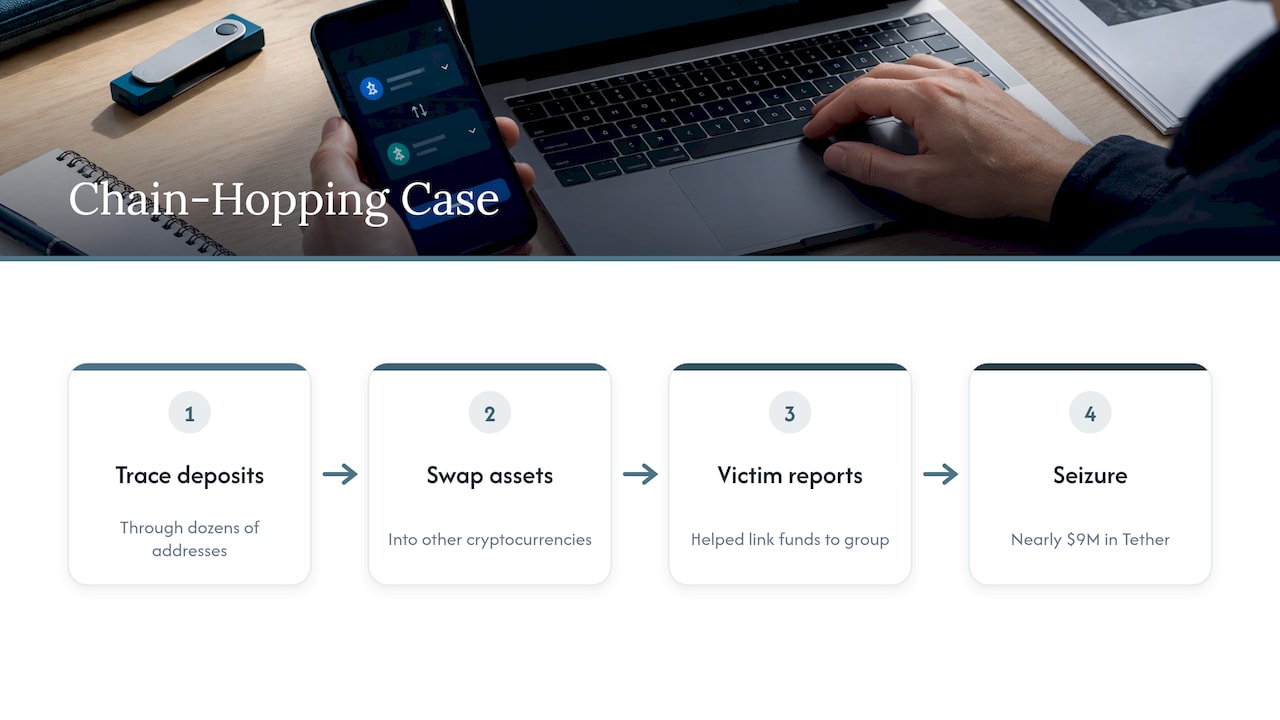
The lesson for victims is practical: reports and transaction details from individual people are what let investigators tie scattered funds to one operation.
Mixers add another layer, and our guide on what investigators can follow through crypto mixers explains how that works.
What a trace can and cannot prove
This is the point most victims are never told. The FBI’s bulletin states that the greatest challenge is linking a Bitcoin address to a real person. The ledger shows where coins went. It does not show who typed the commands. Investigators close that gap by tying an address to information outside the ledger, such as the customer records of a registered exchange.
| A trace can show | A trace cannot show alone |
|---|---|
| Where your funds went, hop by hop | Who controls the receiving wallet |
| Which addresses appear linked together | Whether the holder is the scammer or a mule |
| Whether funds reached an exchange | What the exchange knows about its customer |
| The timing and amounts of each move | Whether the funds can be frozen or returned |
Academic work reaches the same point. A University of Florida law article notes that although every transaction is visible, participants hide behind addresses with no personal identifiers.
That is why a good trace is a starting point for a case, not a verdict. It identifies the exchange to approach, the wallets to name in a legal request and the pattern that shows a scheme.
Why tracing can take so long
Crypto moves fast. The Justice Department’s 2022 report on international cooperation says transactions are fast-moving and often irreversible, and that records held off the blockchain, such as servers and communications, can be deleted quickly. When a request has to go to a foreign government, it may take months or even years to carry out.
A court filing in a 2023 federal case shows what delay looks like. A defense motion noted that 655 days after a warrant for 450 Bitcoin, the government was still preparing its blockchain analysis. That is one case and one side’s account, but it shows why waiting for an agency to finish your trace for you is risky when evidence is perishable.
What affects speed:
- Where the funds ended up. A U.S.-regulated exchange can be served with legal process. A platform overseas may take far longer.
- How many hops. Dozens of addresses and several coin swaps multiply the work.
- Quality of your records. Missing hashes or timestamps slow every step.
- Caseload and technical familiarity. The DOJ lists request volume and the foreign government’s familiarity with the technology as factors.
What happens after the trace
When agents locate funds, the next steps are legal ones. The FBI bulletin explains that seizing bitcoin means taking control of the media where the wallet lives and moving the coins to a government-controlled wallet, because a third party holding a backup could otherwise drain it. Prosecutors can pursue forfeiture of proceeds under existing federal law, and businesses that hold wallets for customers must be served with process like a financial institution.
For a victim, this means recovery usually runs through a formal case, not a quick transfer. If your coins are part of a seizure, you will need to prove they are yours. In a 2024 federal filing, a Bitfinex hack victim documented ownership of 14.994 BTC with exchange receipts, account records, blockchain records, a filed IRS form and a visualization of the Bitcoin flow. Records like these are what turn a loss into a claim.
What to do now
Report to the FBI’s IC3
The FBI encourages the public to file a complaint at ic3.gov and to include cryptocurrency addresses, amounts, types of coin, transaction hashes, and the dates and times of transactions. Add how you met the scammer, the platforms used, web domains and phone numbers. Our guide on what to report to trigger a police investigation goes through this in detail.
IC3 also warns victims to be careful with recovery services that charge up-front fees. Hire only a team that explains its scope and the deliverable before work starts.
Preserve everything
The Justice Department’s Office for Victims of Crime advises victims to keep receipts, bank and investment statements, any correspondence that verifies the scheme, and a record of the amount lost, how payment was made and all account numbers. For crypto, add:
- Transaction hashes and the wallet addresses you sent from and to
- Screenshots of chats, profiles, websites and investment dashboards
- Exchange account statements and email confirmations
- Phone numbers, domains and usernames the scammer used
Our first 72 hours guide lays out the order to do this in. If your case may end up in litigation, a Utah litigation firm’s guide to preserving evidence shows how documentation supports a fraud claim.
Where a forensic investigation fits
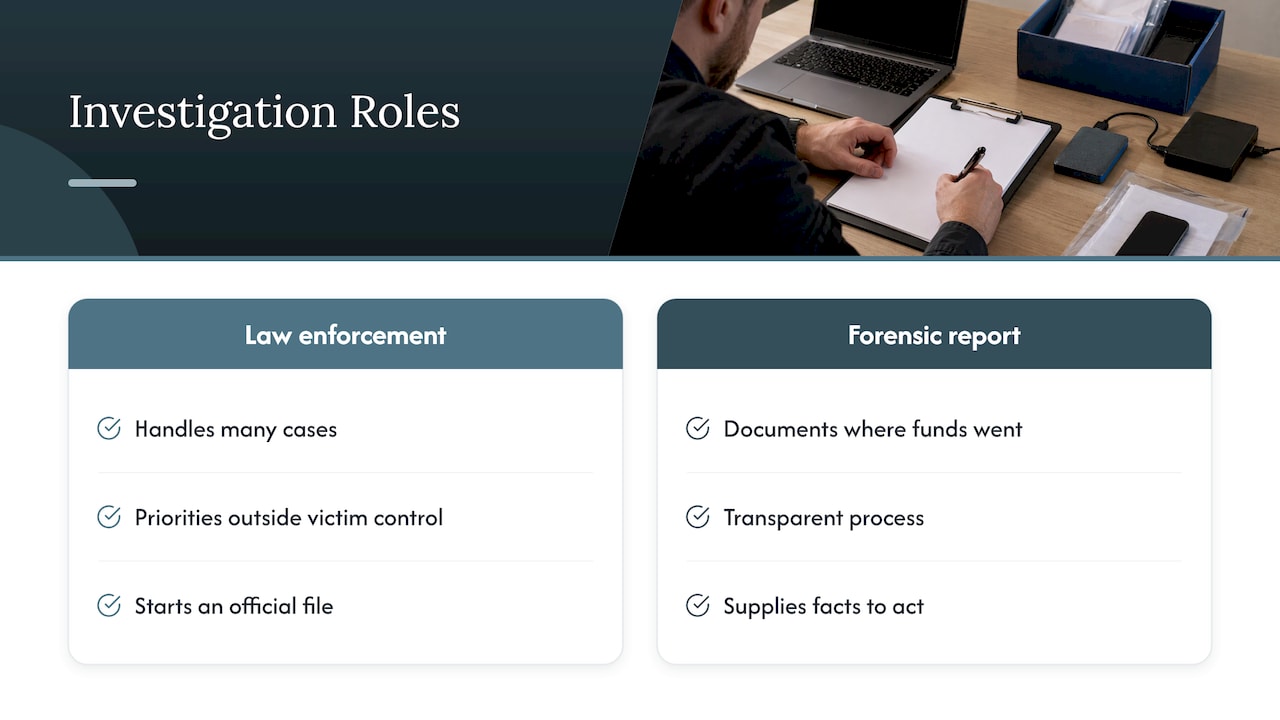
Agencies work on many cases and answer to priorities you cannot control. A private forensic engagement runs alongside them and produces something specific: a structured account of where your funds went.
At Recovera Forensics, we analyze transaction patterns on public blockchains to trace the flow of lost assets and build forensic reports suitable for legal proceedings. Our services include cryptocurrency scam investigation, OSINT and digital attribution, and preservation of evidence. Law firms can use our technical analysis and reporting for professional offices. To see how a report fits a court process, read how to admit blockchain evidence in U.S. court.
Our view
Victims often assume that the blockchain being public means the answer is already visible. It is not. The ledger gives you the movements, and the real work is turning them into a documented, repeatable account that connects your wallet to the wider pattern of a fraud network.
That is how we approach every case. We analyze transaction patterns on public blockchains, reconstruct how funds moved, including through mixers and bridges, and write the findings up as a technical report meant for legal proceedings. We work directly with law firms, and we keep the process transparent so you understand what we are doing and why.
Law enforcement and a forensic report do different jobs, and they strengthen each other. A police report starts an official file. A well-built report gives that file the facts an investigator or attorney needs to act.
cristian
FAQ
Can the FBI get my stolen crypto back?
The FBI and other agencies can trace and seize funds, and seizures have followed victim reports. But recovery runs through a legal process, and results depend on where the funds went and whether they can be reached. File with IC3 and keep your evidence ready for any later claim.
How long does a crypto trace take?
It varies with the number of hops, the exchanges involved and the countries concerned. The Justice Department says requests to foreign governments may take months or even years. Complete records from the start shorten your side of the work.
Can tracing identify the scammer?
Tracing shows where funds went. Naming a person usually needs information from outside the blockchain, such as exchange customer records obtained through legal process. A forensic report helps point investigators to the right exchange and addresses.
What should I give investigators first?
Give your transaction hashes, wallet addresses, amounts, dates and times, plus the scammer’s platforms, domains and phone numbers. Our guide on the first 24 hours after a theft lists what to gather.
Sources
- FBI IC3: Cryptocurrency
- FBI Law Enforcement Bulletin: Virtual Currency Investigative Challenges and Opportunities
- U.S. Secret Service: Cyber Scam Organization Disrupted Through Seizure of Nearly $9M in Crypto
- University of Florida: Crypto Money Laundering
- Department of Justice: How To Strengthen International Law Enforcement Cooperation
- Defense filing, Case 1:23-cr-00166
- Filing, Case 1:23-cr-00239-CKK, Document 200
- DOJ Office for Victims of Crime: Documenting Financial Loss