A U.S. federal court can order stolen cryptocurrency frozen before the case is decided, but only if you ask quickly, claim the right kind of relief, and show the judge exactly where the coins went. The legal request is the easy part to describe. The hard part is the evidence: sworn, transaction-by-transaction proof that identifies the wallets holding your funds and explains why they will vanish if nobody acts. That is the work blockchain forensics does, and it is the reason we build tracing reports that a lawyer can attach to an emergency motion.
This guide explains what an asset freeze injunction is, when courts grant one, what you must prove, how the process works, and what a freeze does and does not do for your recovery. It is general information, not legal advice. A freeze request is filed by a licensed attorney in the court that has jurisdiction over your case.
TL;DR
- An asset freeze injunction is a court order that stops named people, wallets or intermediaries from moving specific assets while your case proceeds. It usually starts as a short-lived temporary restraining order (TRO) and, if granted, continues as a preliminary injunction.
- Federal courts generally cannot freeze a defendant’s assets before judgment in a pure money-damages case. They can when you claim specific stolen property through an equitable claim such as a constructive trust, conversion or unjust enrichment, and crypto’s traceability helps.
- Judges apply four factors: likelihood of success, irreparable harm, balance of equities and the public interest. Sworn, transaction-specific proof is what carries them.
- A TRO can be granted without notice only in narrow circumstances. A preliminary injunction always requires notice and a chance to respond.
- A freeze preserves assets. It does not by itself return them to you.
Table of Contents
- What an asset freeze injunction is
- When a U.S. court can freeze crypto before judgment
- The four factors a judge weighs
- The evidence that persuades a court
- How a TRO request works: notice, service and bond
- Exchanges, private wallets and funds abroad
- A freeze is not a recovery
- Where our work fits
- Start with a trace
- Our view
- FAQ
- Sources
What an asset freeze injunction is
An injunction is a court order telling someone to do or not do something. An asset freeze injunction tells defendants, and often the platforms holding their funds, not to move, sell or hide particular assets until the court decides the case. In a crypto scam, the target is typically the wallet addresses that received your funds and the exchanges or stablecoin issuers that can block them.
Two stages matter:
- Temporary restraining order (TRO). An emergency order, often issued within days and sometimes without telling the other side first. It lasts only a short time while the judge considers a longer order.
- Preliminary injunction. A longer-lasting order that stays in place until trial or further order. A court cannot issue one without notice, and the affected parties must get a reasonable opportunity to object, as a 2026 federal order in the Bybit case spells out when it distinguishes the emergency TRO from the preliminary injunction.
How it differs from an exchange or government freeze
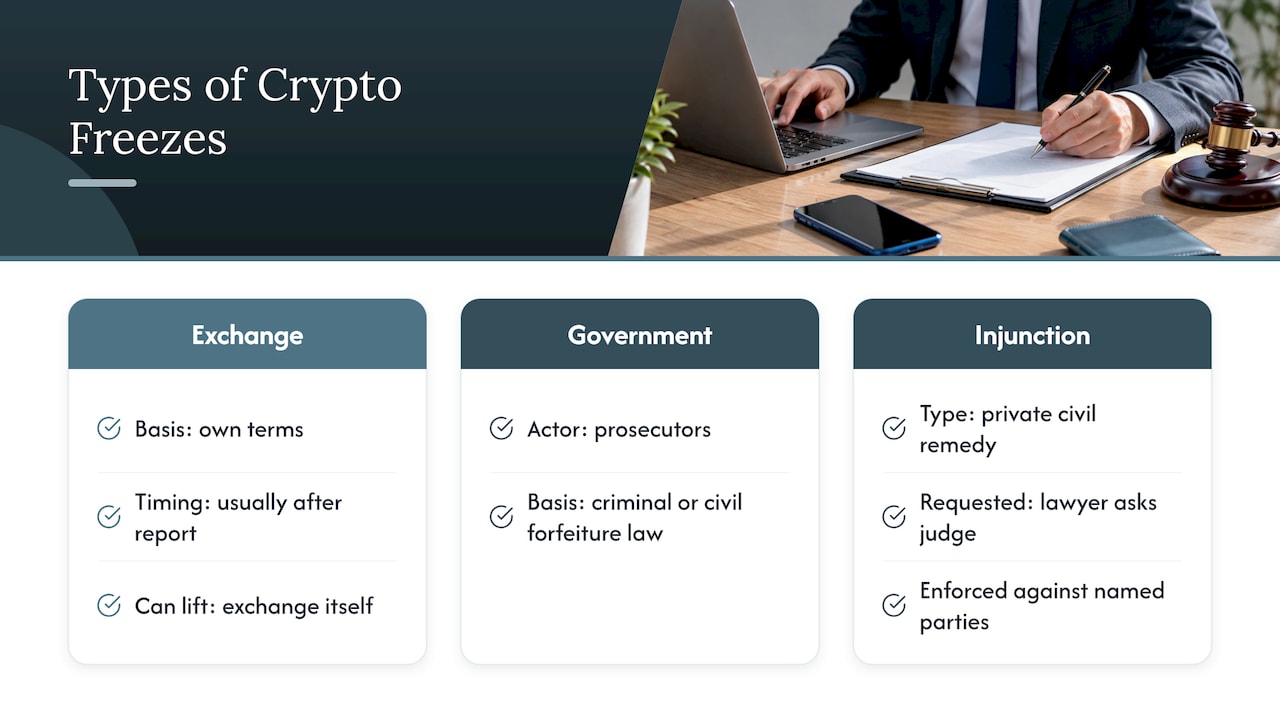
You may hear that an exchange “froze” an account or that the government “seized” funds. Those are different things. An exchange can restrict an account under its own terms, usually after a report, and it can lift the restriction on its own. A government seizure or forfeiture is brought by prosecutors under criminal or civil forfeiture law. An asset freeze injunction is a private civil remedy: you, through your lawyer, ask a judge for an order, and the court enforces it against the people and institutions it names.
A real example shows the mechanics. In a 2025 Southern District of New York case about the $LIBRA token, the court entered a Rule 65 TRO barring interference with roughly $110 million in proceeds and about 57,654,371 USDC in two identified wallets, and ordered the stablecoin issuer Circle to freeze and deny access to that USDC pending the preliminary-injunction ruling. The order worked because it named specific wallets and a company able to act on them.
When a U.S. court can freeze crypto before judgment
The starting point surprises many victims. In Grupo Mexicano de Desarrollo v. Alliance Bond Fund (1999, 527 U.S. 308), the Supreme Court held that federal courts generally lack power to freeze a defendant’s assets before judgment when the plaintiff seeks only money damages. As the Transnational Litigation Blog explains, pre-judgment freezes remain available when they are tied to equitable relief over specific property, such as a constructive trust, conversion or unjust enrichment claim.
In plain terms: a claim that says “this person owes me $50,000” will usually not support a freeze. A claim that says “these identifiable coins are mine, they were taken by fraud, and they are sitting in this wallet” can. The same commentary notes that courts have treated crypto as specific and traceable property in a way ordinary cash is not, which is why federal courts have been willing to freeze it in pig-butchering and similar scam cases. Pig-butchering means a long con in which a scammer builds a relationship, then steers the victim into a fake investment platform.
A California federal court put the baseline this way in 2023: courts typically freeze a defendant’s assets only after judgment, but may do so earlier when equitable relief is sought and preliminary relief is appropriate. It also states what a constructive-trust claimant must show:
- a specific property interest,
- a right to that property, and
- wrongful acquisition or detention by someone not entitled to it.
That third element is where tracing comes in. You cannot show your specific property sits in a specific wallet without following the chain of transfers from your wallet to theirs.
If you want the broader legal picture on how courts weigh freezes and forfeiture-type proceedings, this explanation of asset forfeiture and freeze proceedings is a helpful companion read, though your own case turns on the court where you file.
The four factors a judge weighs
For a preliminary injunction, federal courts apply the four-part Winter test. An Eastern District of Texas order from 2025 applies these requirements to a crypto fraud case:
| Factor | What it means for a crypto victim |
|---|---|
| Likelihood of success | You are likely to win on the merits, for example that the defendants deceived you and took your funds. |
| Irreparable harm | You will suffer harm money damages cannot fix, typically because the coins will be moved beyond reach. |
| Balance of equities | The harm to you if the order is denied outweighs the burden on the defendants if it is granted. |
| Public interest | A freeze is consistent with the public interest, which fraud cases generally support. |
Irreparable harm is often the contested factor, and it is where applicants succeed or fail. The $LIBRA case shows both outcomes. The judge granted the TRO because of the ease of dissipation and the risk that notice would let defendants move assets before Circle could freeze them. A later September 2025 order in the same case denied the plaintiffs’ motions to revise the denial of their preliminary injunction, finding they had not shown irreparable harm and were relitigating dissipation arguments the court had already rejected. The lesson: the emergency order is not the finish line, and the harm evidence has to stay concrete as the case continues.
The evidence that persuades a court
Judges do not freeze wallets on a victim’s story alone. In the Texas case, the court relied on verified filings and hearing evidence describing the alleged deception, the wallet transfers, and the transfer of $490,527 to an address controlled by the defendants. The evidence also showed the assets could be moved to locations from which they could not be retrieved. Verified pleadings, meaning statements made under oath, together with transaction-specific material, let the court assess likelihood of success.
As a practical matter, an urgent freeze package usually needs:
- Transaction hashes and wallet addresses for every transfer, from your wallet to the destination.
- Your own records: exchange statements, chat logs, emails, screenshots of the fake platform, payment confirmations.
- A trace showing the flow of funds and where they sit now, including any deposit to an exchange or stablecoin issuer that could act on an order.
- A sworn explanation of why the funds are likely to move again, tied to the defendants’ behavior.
We cover the preservation side in detail in our guide to digital evidence preservation for U.S. courts and in the 24-hour steps after stolen crypto. If your lawyer needs a report that holds up when the other side challenges it, see what a usable crypto tracing report for law firms contains, and our walkthrough of the five checks for forensic affidavits.
Why forensic depth changes the request
A screenshot of a block explorer shows that coins moved. It does not show who controls the destination, whether the funds passed through a mixer or bridge, or whether they landed at an exchange that can be served with an order. Our approach is to analyze transaction patterns on public blockchains, trace the flow of lost assets and connect wallet activity to potential fraud networks, then write that up as a forensic report suitable for legal proceedings. If you want to understand the difference in method, read blockchain forensics versus wallet tracking and the flow of funds guide for legal recovery.
How a TRO request works: notice, service and bond
Your attorney files the request in a federal or state court with jurisdiction. Here is what the research and recent orders show about each stage.
Notice
Normally the other side is told and can respond. Federal Rule of Civil Procedure 65(b), as quoted in the 2023 California order, allows a TRO without notice only when specific facts show immediate and irreparable injury before the opposing party can be heard, and the attorney certifies in writing the efforts made to give notice and why notice should not be required.
Crypto scams are a natural fit for that exception, because a scammer who learns of a motion can move funds in minutes. The Northern District of California’s October 23, 2025 order allowed an ex parte asset freeze, meaning one granted without the other side present, where the record showed likely immediate dissipation if defendants got advance notice and counsel certified why notice should not be required. The takeaway for victims is that the dissipation risk must be documented, not assumed.
Service
An order only matters if the right parties are served with it. The 2025 Eastern District of Texas order directed service on listed entities and restrained them from disturbing assets tied to identified blockchain addresses. It also prohibited moving, altering or destroying books, records and accounts related to those addresses, and continued the preliminary injunction until trial or further court order. Relief against an exchange or intermediary depends on a specific order naming the addresses and on proper service.
Bond
Courts may require the applicant to post security, a bond, to cover harm if the order turns out to be wrong. Practice varies by case. In the $LIBRA matter the judge imposed only a nominal bond, and the 2025 Texas court declined to require one. A 2019 CFTC enforcement order noted that the Commission, a government applicant, was not required to post security. Do not assume a private plaintiff will get the same treatment: ask your attorney what bond the court is likely to set.
Timing
Speed is the variable you control. The sooner the trace and the affidavit are ready, the more likely the funds are still where the order can reach them. Our piece on the 72-hour window for stolen crypto explains why the first days matter, and triage in the first 24 to 72 hours covers when victims and lawyers should reach out.
Exchanges, private wallets and funds abroad
Where the money sits shapes what a court order can accomplish.
- At a U.S.-reachable exchange or issuer. This is the most promising case. An order naming specific addresses and served on the platform, as in the Texas and $LIBRA orders, gives the platform a legal basis to hold the funds. Tracing that identifies the deposit address is what makes this possible. See tracing Ethereum transactions to an exchange and exchange-to-exchange tracing.
- In a private wallet. Nobody holds the coins for the defendant, so there is no intermediary to serve. An order can bind the defendants personally, but it cannot reach into the wallet. Investigators follow the funds for the point where they move to a service that can be ordered, which is the focus of our cold wallet tracing guide.
- Converted to a bank account. Cash-out to a bank adds a new institution and new records. We explain what can be followed in tracing crypto to a bank account.
- Outside the United States. A U.S. order does not automatically bind foreign platforms or people. Your attorney will advise on whether and how it can be enforced abroad, and the tracing report shows which jurisdictions the funds actually touched.
A freeze is not a recovery
This is the point victims most need to hear plainly. A freeze keeps assets in place. To get money back you still need a judgment or settlement, or a government process that returns funds to victims. The Department of Justice’s Asset Forfeiture Program Guidelines list victim compensation, when authorized by law, as one of the program’s goals, and describe remission and restoration as discretionary authorities rather than automatic payment to victims. If funds are forfeited by the government, your path to repayment runs through those processes.
The practical conclusion is that a freeze is most valuable when it is paired with a clear, court-ready record of who took what from you. That record supports the civil claim, helps law enforcement understand the case, and keeps your options open. For the reporting side, see what U.S. victims should report to trigger a police investigation.
Where our work fits
We are not a law firm and do not file motions. A freeze injunction is requested by your attorney. What we provide is the technical foundation the motion stands on: tracing of stolen cryptocurrency, wallet activity analysis, OSINT investigation and digital attribution, preservation of evidence, and technical reports for legal proceedings. We also work directly with law firms on digital and financial fraud cases.
Here is how that maps to the stages above:
- Preserve. We help capture and preserve the digital footprint and evidence before it disappears.
- Trace. We follow the assets across public blockchains, including through mixers and bridges, to the wallets and platforms where they sit.
- Document. We prepare a technical report designed for legal proceedings, so your attorney can attach it to a sworn filing.
To see how an analyst checks a wallet before a report goes to court, read the six wallet activity checks, and for admissibility, the four crypto forensics steps for U.S. courts.
Start with a trace
If you lost crypto to a scam and your lawyer is weighing an emergency freeze, or you are a law firm that needs a report for one, our cryptocurrency scam investigation services cover tracing, attribution and evidence preservation, and our service for professional offices covers technical analysis and documentation for counsel. Pricing is not published; engagements are billed per case.
Our view
Most victims come to us asking how to freeze their crypto. The better question is what a judge needs to see before signing the order. Courts have shown they will act on crypto, because it is specific and traceable, but only when someone has actually traced it.
That is why we put the investigation first. A forensic report that follows the flow of funds, ties wallet activity to a fraud network and presents the findings in a form lawyers can use gives the freeze request something solid to stand on. A thin trace gives opposing counsel something to attack.
We built our process around victims: a transparent method, clear reports, and close work with the attorneys who file in court. Speed matters, but so does getting the first report right.
cristian
FAQ
Can a court freeze crypto without telling the scammer?
Yes, in narrow cases. Rule 65(b) permits a TRO without notice when specific facts show immediate and irreparable injury before the other side can be heard, and your attorney certifies in writing why notice should not be required. A preliminary injunction, however, cannot be issued without notice and a chance to respond.
Do I need a lawyer to get an asset freeze injunction?
Yes. The request is a court filing with strict requirements, including sworn evidence and, for a no-notice TRO, an attorney’s certification. A lawyer licensed in the right court should file it. A forensic investigator supplies the trace and technical report that lawyer relies on.
Can the government freeze my crypto account?
Authorities can seize or seek forfeiture of assets under criminal or civil forfeiture law, which is separate from a private injunction. Exchanges can also restrict accounts under their own terms. If you are a scam victim, a private injunction is a way for you to seek to hold a defendant’s funds in place, and a government forfeiture may later open a path to compensation.
Will a freeze get my money back?
Not by itself. A freeze preserves the assets while the case continues. Recovery comes through a judgment, a settlement or a government remission process, and the Justice Department’s guidelines describe remission as a discretionary authority.
How fast do I need to act?
As fast as you can. Scammers can move funds in minutes, and courts look for proof that dissipation is likely. Report the fraud, preserve every record and contact an attorney and a forensic team within the first 24 to 72 hours.
Sources
- Case No. 1:25-cv-03891 (JLR) order, S.D.N.Y., May 27, 2025
- Transnational Litigation Blog: Pig-Butchering, Crypto, and Preliminary Injunctions, October 30, 2025
- E.D. Tex. 2025 order applying the Winter factors
- E.D. Cal. No. 2:23-cv-01317 order, 2023
- N.D. Cal. Case 3:25-cv-08800 order, October 23, 2025
- Bybit Technology Limited v. Democratic People’s Republic of Korea order, 2026
- E.D. Tex. preliminary injunction order, May 23, 2025
- CFTC enforcement order, 2019
- Department of Justice Asset Forfeiture Program Guidelines, 2018