Cross-chain entity attribution is the work of showing that wallets on different blockchains belong to the same person or group, and then tying that group to a real-world actor such as an exchange account holder. It goes beyond following your stolen coins from one address to the next. It answers the question that matters in a fraud case: who ended up with the money. If you lost crypto to a scam, attribution is what turns a list of transactions into a lead that a court, an exchange or law enforcement can act on.
This guide explains how attribution works, what evidence supports it, where it stops, and what you can do in the first days to keep it possible.
TL;DR
- Tracing follows funds. Attribution names who controls the wallets the funds reach, even after they hop across chains, bridges and swaps.
- The blockchain alone rarely names a person. The strongest link usually comes from off-chain records, such as exchange account data obtained through a legal process.
- Courts in the U.S. have accepted blockchain tracing as reliable evidence, but the report must show its method and its confidence level.
- Your first job is to preserve transaction hashes, wallet addresses, screenshots, messages and device logs before they disappear.
- A forensic report built for legal use is what lets a lawyer ask a court to compel exchange records.
Table of Contents
- What attribution means, and how it differs from tracing
- Why scammers move funds across chains
- How investigators link activity across blockchains
- What counts as evidence, and how confidence is judged
- Does a court accept this kind of analysis?
- Where attribution stops
- How attribution helps a legal case
- What to preserve right now
- Promo: an investigation built for legal use
- FAQ
- Sources
What attribution means, and how it differs from tracing
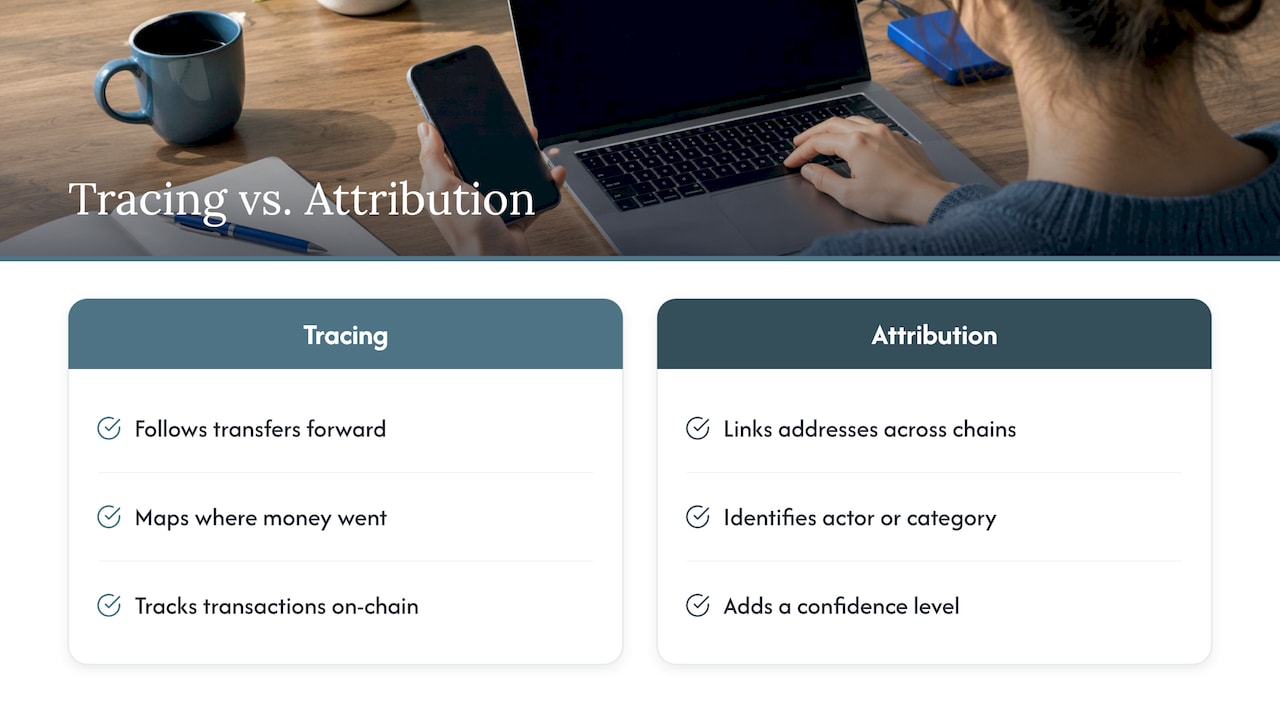
Tracing is mechanical. You start at the address that received your funds and follow each transfer forward. Public blockchains record every transaction, so this is possible in principle.
Attribution is interpretive. It asks whether address A on Ethereum, address B on Tron and address C on Bitcoin are run by the same actor, and whether that actor is a known service, a scam network or a named individual. The result is a conclusion with a confidence level, not a raw data point.
The FBI’s Law Enforcement Bulletin makes the gap clear. It describes the public ledger as necessary but not sufficient: even after you follow a transaction, tying a virtual account to a real-world identity remains difficult, and in decentralized systems no single company holds customer records. Its conclusion is that association with information outside the ledger is the best route to identification.
The New York Department of Financial Services says the same in its April 2022 guidance on blockchain analytics: wallet addresses are typically pseudonymous, and nothing on the face of a transfer ties back to the originator or beneficial owner. Analytics tools may not identify underlying owners without further off-chain verification.
In plain terms: wallet tracking gives you a map of where money went. Attribution gives you a name or a category for the destination. If you want to see how the two differ in practice, our comparison of blockchain forensics and wallet tracking lays out what each produces.
Why scammers move funds across chains
Scam proceeds rarely stay put. A typical pattern after a theft is to swap the stolen token for another, send it over a bridge (a service that moves value from one blockchain to another), split it across many new wallets, and finally cash out through an exchange or an over-the-counter desk.
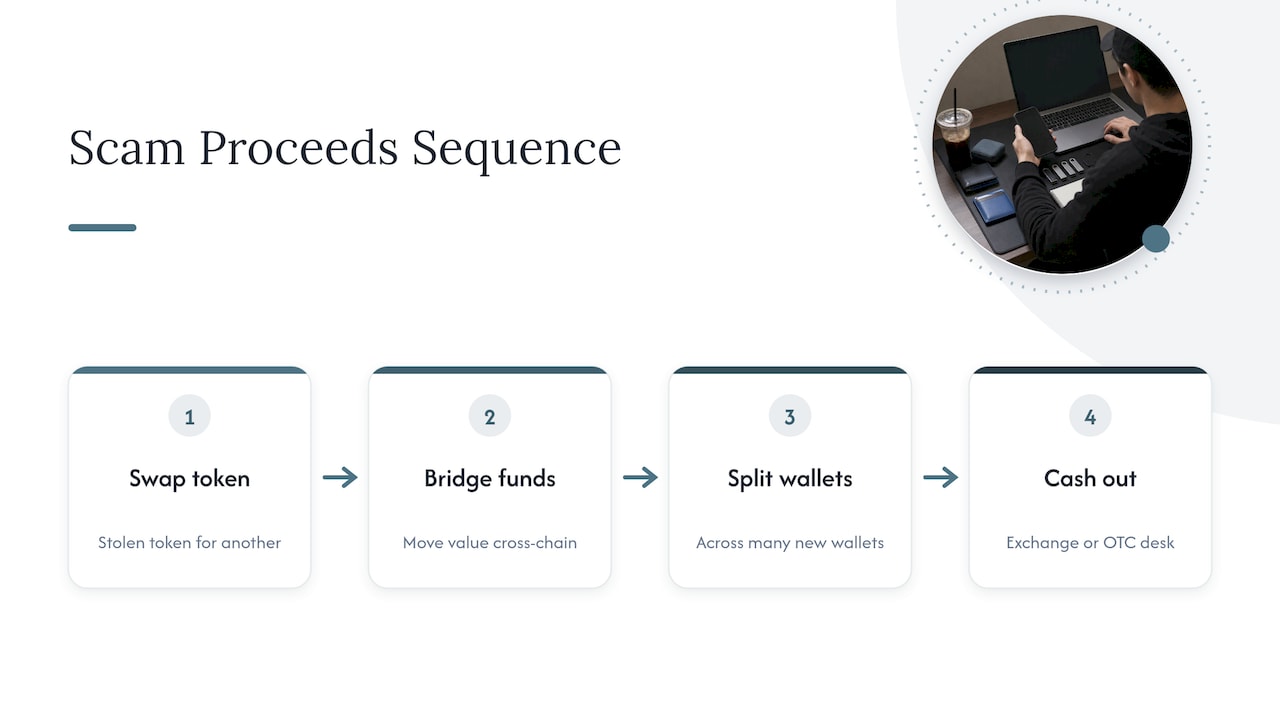
Each hop is meant to break the visible trail. On a single chain, an investigator can follow one thread. Across chains, the thread appears to end at a bridge contract on one side and restart at an unrelated address on the other. Attribution reconnects the two sides.
This is also why the scale of the problem keeps growing. The FBI’s Internet Crime Complaint Center reported a record $16.6 billion in losses for 2024, and its report lists cryptocurrency as the medium in 149,686 complaints. Most victims never see where their money went, because the trail crosses several networks within hours.
How investigators link activity across blockchains
No single trick does it. A careful investigation stacks several lines of evidence and states how strong each one is.
Address clustering
On UTXO chains such as Bitcoin, a transaction that spends coins from several addresses at once suggests those addresses share a controller, because one wallet had to sign for all of them. This is the co-spend heuristic. A federal court looked at it in 2024, and we cover that ruling below.
Behavioral patterns
Actors leave habits. They may fund new wallets with the same amounts, move funds at the same times of day, reuse a deposit address, or batch payouts in a recognizable sequence. When the same pattern shows up on two chains, it supports the case that one operator is behind both.
Bridge and swap matching
When funds enter a bridge or a swap service on one chain, an output appears on another chain. Matching amounts, timing, token pairs and the bridge’s own event logs lets an analyst pair the input and output transactions. This is the step that carries a trace across a chain boundary.
Service and entity labels
An address that receives funds from thousands of unrelated users and sends to known exchange hot wallets is likely a service, not an individual. Labeling these destinations as exchange, mixer, gambling site or scam cluster tells you where a legal request can go.
Off-chain context
This is where attribution gets its identity. Open-source intelligence (OSINT, meaning research from public sources) can connect a wallet to a social media handle, a scam website’s payment page, a forum post or a domain registration. Your own evidence adds to this: the scammer’s wallet address from a chat, the payment instructions in an email, the phone number used in a SIM swap.
What counts as evidence, and how confidence is judged
A useful attribution report separates what is observed from what is inferred.
| Evidence type | Example | What it supports |
|---|---|---|
| On-chain, direct | A transfer from your wallet to the scammer’s address | The destination of your funds |
| On-chain, inferred | Co-spend clustering, matching bridge in and out | That several addresses share a controller |
| Behavioral | Repeated timing and amount patterns across chains | That one operator runs wallets on multiple chains |
| Off-chain, public | A wallet posted on a scam site or social profile | A link between the wallet and a persona |
| Off-chain, compelled | Exchange account-opening and login records | A real-world identity behind a deposit address |
The last row carries the most weight, and it is the one you cannot get on your own. The FBI notes that businesses transferring virtual currency in the U.S. must register with FinCEN and comply with Bank Secrecy Act requirements, including anti-money-laundering programs. That is why a regulated exchange often holds verified customer identities, and why attribution that ends at an exchange deposit address is so valuable.
Confidence is usually expressed in tiers: confirmed (backed by off-chain records), probable (several independent heuristics agree), and possible (one weak signal). A report that treats every link as certain is easier for the other side to attack.
Does a court accept this kind of analysis?
U.S. courts have begun to say yes, with conditions. In United States v. Sterlingov (D.D.C., 2024), the court found that blockchain tracing from proprietary software met the reliability standard by a preponderance of the evidence. It pointed to the co-spend heuristic’s wide academic acceptance, the fact that the program could be tested and had been, and held that the lack of a compiled error rate did not undermine reliability.
The lesson for a victim is practical. The method has to be explainable, repeatable and documented. A screenshot of a tracing dashboard is not a report. Our guide on admitting blockchain evidence in U.S. court covers the steps, and the crypto chain of custody guide explains why every file you hand over needs a recorded history.
Where attribution stops
Be clear-eyed about what a finding does and does not establish.
- A cluster is not a verdict. Showing that wallets are linked tells you they probably share a controller. It does not by itself prove which human holds the keys.
- Identifying a service is not identifying a person. An exchange deposit address points to the exchange. Only the exchange’s records, obtained properly, point to its customer.
- Privacy tools add uncertainty. The NYDFS guidance lists red-flag patterns such as processing through a mixer or tumbler, transfers to darknet markets and association with scams. Mixers are designed to break links. Regulators have targeted them: OFAC designated Sinbad.io in November 2023 as a successor to Blender.io, which was designated in May 2022 as a key laundering tool of the Lazarus Group. Funds that pass through a mixer need more careful handling, and sometimes the confidence level is lower.
- Attribution is not recovery. Naming the entity gives a lawyer something to act on. Whether assets can be frozen or returned depends on where they sit and who holds them.
For the financial-institution side of this, where firms screen transactions for these same risk indicators, pre-transaction crypto fraud checks show the patterns that monitoring looks for before funds move.
How attribution helps a legal case
The value of a good attribution is that it gives a court a reason to order someone to hand over records.
In Bellis v. Kelly, 797 F.Supp.3d 431 (2025), the court granted expedited discovery so the plaintiff could identify the people behind a cryptocurrency theft and locate the stolen assets. It ordered exchanges including Kraken and Coinbase to produce, within fourteen days, account-opening materials, identity and proof-of-identification records, contact information, transaction hashes, and IP, login and device data.
That list shows what a forensic report is for. It identifies which exchanges received the funds and which deposit addresses are involved, so that a lawyer can ask for exactly those records. Without that precision, a subpoena or discovery request is a fishing trip a judge will not grant.
If an exchange is involved early, speed matters too. Our guide to the 24 to 72 hours after a theft explains why a fast, well-documented request improves the odds of a freeze, and the exchange KYC request guide explains what a genuine request looks like.
What to preserve right now
Attribution depends on what you can supply. The FBI’s bulletin notes that investigators can use the transaction time and the victim’s public key to find the destination address on the public ledger, and that imaging the victim’s computer and obtaining ISP logs can help identify where the criminal activity originated.
In practice, save the following before anything is deleted or overwritten:
- Transaction hashes for every transfer you made, and the wallet addresses you sent to and from.
- Exact times and amounts, with your time zone.
- Every message with the scammer: chat exports, emails, call logs, usernames and phone numbers.
- The scam site or app: screenshots with the URL visible, plus any invoices or account statements it showed you.
- Exchange and bank records for the deposit that started the loss, including support tickets.
- Your device and account logs, especially after phishing or a SIM swap. Do not wipe or reset the device.
Do not contact the scammer again, and do not send further payments to unlock supposed recovered funds. Our digital evidence preservation guide goes through how to keep this material admissible. If you are also deciding where to report, see what to file so that police can open a crypto investigation.
Promo: an investigation built for legal use
We handle cryptocurrency scam investigations, OSINT investigations and digital attribution, and preservation of evidence and digital footprint, and we prepare technical reports and documentation for legal proceedings. If you want your trail traced across chains and documented in a form your attorney can use, see our cryptocurrency scam investigation services. Law firms can review our forensic support for professional offices.
Our perspective
We start from a simple view: a trace that ends at an address is not an answer. Victims come to us because they want to know who has their money, and that question lives at the point where the blockchain stops and the real world begins.
That is why we analyze transaction patterns on public blockchains and connect wallet activity to wider fraud networks, including funds that pass through mixers and bridges. Basic wallet tracking shows where coins went. Our approach is built to reconstruct the whole flow and to put it in a forensic report that a legal team can use.
We work directly with law firms, and we write each report with a court reader in mind: what was observed, what was inferred, and how strong each link is. A transparent process matters to a victim who has already been misled once, so we explain what we are doing and why.
If you have lost crypto, the most useful thing you can do is preserve your evidence and get the trail documented while it is still fresh.
cristian
FAQ
Is cross-chain entity attribution the same as crypto tracing?
No. Tracing follows transfers from one address to the next. Attribution decides who controls the addresses along the way, including across different blockchains, and how confident that conclusion is. Tracing is the input and attribution is the conclusion.
Can attribution prove who stole my crypto?
On its own, it usually cannot. Blockchain data shows pseudonymous addresses, and analytics may not reveal the underlying owner without off-chain verification, as the NYDFS guidance notes. A name typically comes from exchange records obtained through legal process.
Does attribution mean I will get my money back?
It does not guarantee recovery, but it gives you something to act on. Once funds are linked to a specific exchange or entity, a lawyer can seek records or a freeze. The outcome depends on where the assets are and how fast you act.
What should I send an investigator first?
Send transaction hashes, wallet addresses, the dates and amounts, and your communications with the scammer. Add screenshots of the scam site and any exchange records. Keep the original files untouched, because their history matters for court use.
Is blockchain tracing accepted as evidence in U.S. courts?
In United States v. Sterlingov, a federal court found blockchain tracing analysis reliable under the preponderance standard. Acceptance depends on a documented, testable method, so the report matters as much as the data.
Sources
- Virtual Currency: Investigative Challenges and Opportunities, FBI Law Enforcement Bulletin (2015)
- NYDFS Industry Letter, Guidance on Use of Blockchain Analytics (April 28, 2022)
- United States v. Sterlingov (D.D.C. 2024)
- Bellis v. Kelly, 797 F.Supp.3d 431 (2025)
- OFAC sanctions on crypto mixers and FinCEN proposed rule (2023)
- FBI IC3 2024 Annual Report
- Pre-transaction checks against crypto fraud