An exchange KYC request (“know your customer”) is a demand to prove who you are, usually with a government ID, proof of address and a selfie. Real ones exist and are routine. Fake ones are a common way scammers steal identities and empty accounts. The safe rule is the same for both: never act on the message that reached you. Sign in to the exchange yourself, check whether the request appears there, and submit documents only inside that signed-in flow. If the request comes after a theft, the paperwork you keep matters as much as the paperwork you send.
This guide is for people who got a verification request and are unsure about it, and for people who lost crypto to a scam and are now dealing with an exchange.
TL;DR
- A genuine request shows up inside your signed-in account. Coinbase, for example, says its verification runs only on coinbase.com and identification.coinbase.com and that it does not take documents by email.
- U.S. exchanges typically ask for a photo ID, proof of address from the last three months, and often a Social Security number (SSN) or ITIN and a face photo.
- Scammers pose as exchange staff and push urgency. The FBI advises hanging up and calling the exchange’s official number.
- If you were scammed, keep transaction hashes, wallet addresses, screenshots and messages before you do anything else. Time matters for freezes.
- When a trace has to stand up in a legal proceeding, a forensic report built on that evidence is what we prepare at Recovera Forensics.
Table of Contents
- What an exchange KYC request actually is
- What U.S. exchanges ask for
- How to tell a real request from a fake
- Exchange KYC after a scam
- Which records to keep
- What a forensic investigation adds
- How Recovera Forensics can help
- FAQ
- Sources
What an exchange KYC request actually is
KYC is the identity check a platform runs before it lets you trade or withdraw. Coinbase’s help page states that it requires identity verification at account creation and periodically for recordkeeping, for legal, compliance and fraud-prevention purposes, and that accounts have limited functionality until it is complete.
The legal background is U.S. anti-money-laundering law. FinCEN, the Treasury bureau that polices financial crime, said in its 2013 guidance that an administrator or exchanger of virtual currency is a money transmitter, a type of money services business (MSB), unless an exemption applies. A person who only uses virtual currency is not an MSB. Such businesses must run anti-money-laundering programs, and that includes KYC and counterparty procedures.
One exchange describes the full program it runs under U.S. law: verifying identity, collecting the purpose of the account, enhanced checks for higher-risk users, transaction monitoring, suspicious activity reports to FinCEN and sanctions screening. This is why a request can arrive later, not only at sign-up. Exchanges review activity, and a review can trigger a request for more information.
Why you might get one
Common triggers are opening an account, reaching a higher limit, a large or unusual deposit or withdrawal, expired documents, or a periodic refresh. For suspicious activity, FinCEN’s rule for money services businesses covers transactions of at least $2,000 that look like illegal funds, evasion of reporting rules or have no apparent lawful purpose. A request after unusual activity does not mean you did something wrong, but it does mean you should answer it carefully.
What U.S. exchanges ask for
Requirements differ by platform, but the published lists are similar. Here is what the exchanges’ own help pages say.
| Item | What the exchange states |
|---|---|
| Photo ID | Coinbase accepts a driving license, passport or passport card for U.S. customers. Kraken lists passport, driver’s license or national ID, front and back. |
| Proof of address | A bank statement, credit card statement or utility bill issued within the last three months. Kraken requires your name and address and rejects P.O. boxes. |
| SSN or ITIN | Kraken says U.S. residents must provide a valid SSN or ITIN and a face photo. |
| Personal details | Gemini collects name, SSN, date of birth, phone, email and a home address that is not a mailing address or P.O. box. |
| Selfie and facial scan | Gate US asks for a facial scan through a QR code after you enter details that match your legal documents. |
| Source of funds | Some exchanges ask for pay stubs, bank statements, statements from other exchanges and evidence of source of funds or wealth when they need more information. |
Business accounts face a longer list. One U.S. exchange asks entities for formation documents, a list of officers and directors, beneficial ownership information and an EIN or TIN.
Why submissions get rejected
Most rejections are about mismatches, not suspicion. Binance.US states that personal information entered at sign-up must completely match the documents, and that expired documents, or ones not fully visible corner to corner, are invalid. It also requires SMS two-factor authentication before verification. Before you upload anything, check that:
- The name and date of birth are identical to your account details.
- The ID has not expired.
- All four corners are in the photo, with no glare.
- The proof of address is under three months old and shows your name.
How to tell a real request from a fake
This is the part that protects you. The FBI’s Internet Crime Complaint Center (IC3) warned in August 2024 that scammers impersonate cryptocurrency exchange employees through unsolicited calls or messages. They create urgency, claim there is a problem with your account, and ask for log-in details, a link click or identification. The FBI’s advice is to hang up, call the exchange’s official phone number, not click links the caller sends, and never give out log-in information.
Apply this to any request you receive:
- Do not use the link or number in the message. Open the exchange’s app or type its address yourself.
- Look for the request inside your account. Coinbase advises signing in and checking your account before opening email links.
- Check the domain. A real exchange will not ask for ID on a domain it does not own, and Coinbase says it will not accept documents by email.
- Treat urgency as a warning. A threat to close or freeze the account within hours is the usual script.
- Never share a seed phrase or password. KYC never needs either.
If you already uploaded documents to a fake page, change your passwords, enable two-factor authentication, contact the real exchange through its official channels and report the incident (see below). Your ID and SSN can be reused for identity theft, so tell your bank too.
Exchange KYC after a scam
A second kind of KYC request catches victims off guard. You report stolen funds to an exchange, and it asks you to verify. Gate US, for instance, states that a victim reporting stolen currency entering its platform must complete KYC identity verification, that information must be true, that false or malicious reports can lead to account review, and that victims are advised to inform the police within 24 hours and give Gate the police receipt.
The practical lessons apply well beyond one exchange:
- Expect to prove who you are before anyone acts for you. Have your ID ready.
- Report fast. The window to ask an exchange to hold funds is short. Our guide on the 24 to 72 hours to seek an exchange freeze explains the timing.
- Get a police or agency report number. Exchanges often want one.
- Be accurate. Everything you submit may later be read by an investigator or a court.
Why do exchanges move cautiously? Their compliance teams answer to law enforcement and regulators, and they cannot reverse a transfer on a stranger’s word. If you want to understand where that leaves you, read what to do when your exchange won’t help after a scam.
Which records to keep
Whether you are answering a KYC request or preparing to get legal help, gather the same material. The FBI’s page on cryptocurrency investment fraud says transaction details are the most important information you can give: cryptocurrency addresses, the amount and type of coin, the date and time, and the transaction ID (hash). It also asks for how the scammer first contacted you, and identifiers such as names, phone numbers, emails and usernames.
In practice, build a folder with:
- Transaction hashes and wallet addresses, both yours and the receiving ones, copied as text, not retyped.
- Screenshots with dates: chats, emails, the fake site, your exchange’s withdrawal confirmation.
- Exchange correspondence: every KYC request, ticket number and reply, with the sender address visible.
- Bank records of any transfer used to buy crypto.
- Report numbers from the police and from the agencies below.
Do not delete chats or close accounts, even out of embarrassment. Original files can matter in court, so see how digital evidence preservation works in a U.S. case and what chain of custody means for crypto.
Where to report
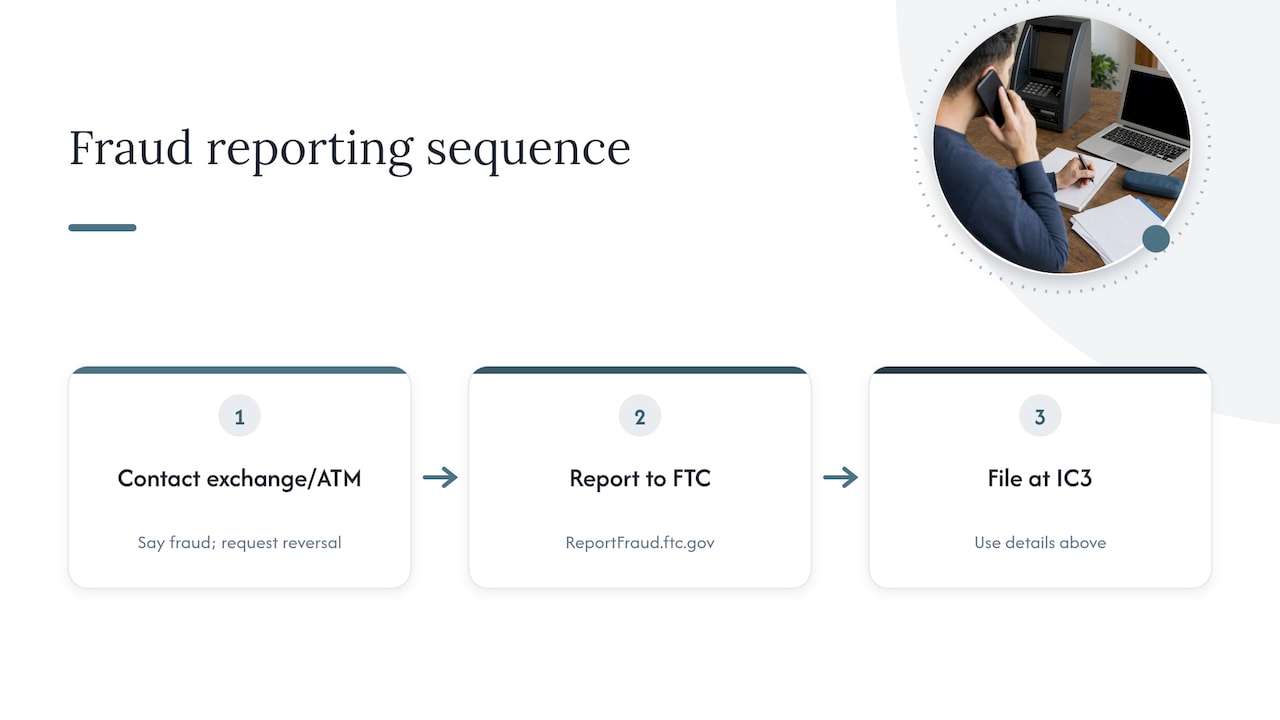
The FTC says that if you paid a scammer with crypto, you should contact the exchange or ATM operator right away, say it was fraudulent, ask for a reversal, then report to the FTC at ReportFraud.ftc.gov. It also notes that crypto payments lack the legal protections of cards, so recovery can be hard. Also file at ic3.gov using the details above. To see what happens after a report, read what to report to trigger a police crypto investigation.
What a forensic investigation adds
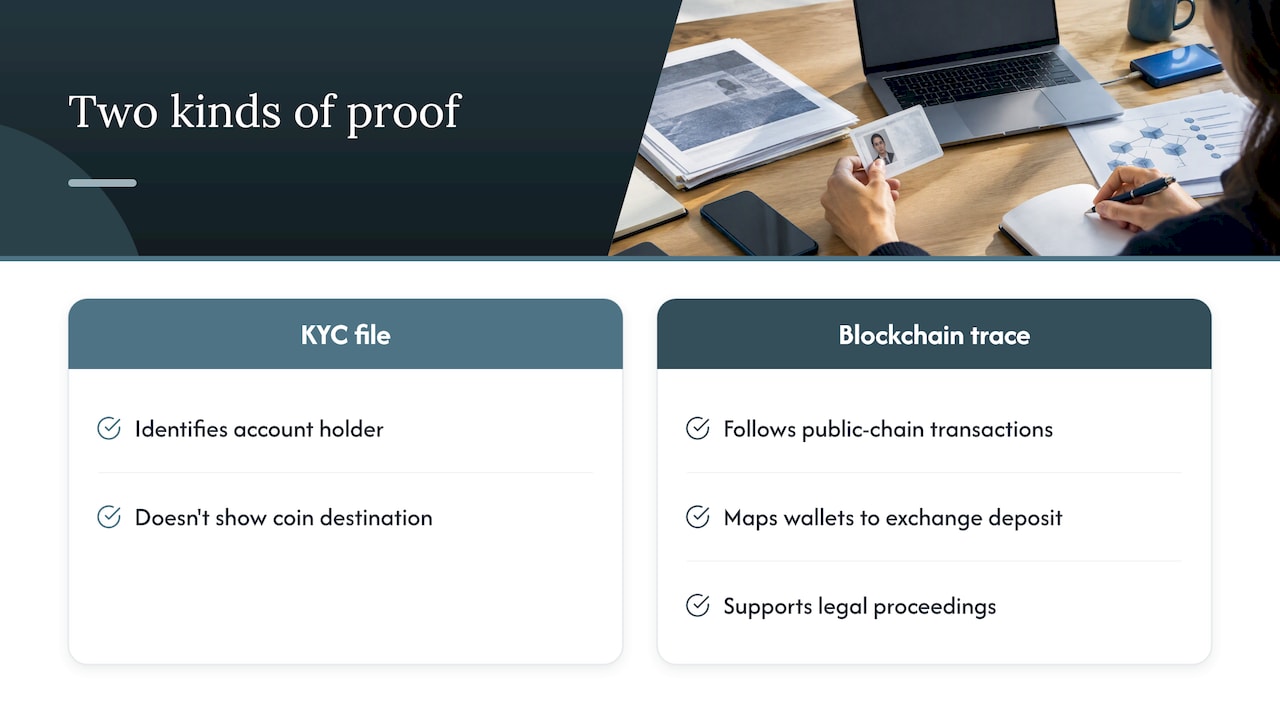
An exchange’s KYC file shows who holds an account. It does not show where your coins went. That is a different question, answered by following transactions across public blockchains. Stolen funds often pass through several wallets, then land at an exchange deposit address. Tracing that route is what turns a loss into something an exchange, a lawyer or a court can act on. For more detail, see exchange-to-exchange tracing and how to trace Ethereum transactions to an exchange.
A trace is also the basis for legal steps. If a lawyer pursues records from an exchange, you may want to know what to do in the first 48 hours after a U.S. crypto exchange subpoena. Law firms can see what a usable tracing report contains.
Our view
People tend to treat a KYC request as a hurdle, and a scam as a separate event. We see them as one problem: proof. An exchange needs proof of who you are. A lawyer, an investigator or a court needs proof of what happened to your funds.
Our approach is to analyze transaction patterns on public blockchains, follow lost assets, including through mixers and bridges, and connect wallet activity to wider fraud networks. We then put the findings in a technical report written for legal proceedings. We work with law firms directly, and our process is transparent and victim-centered.
The best thing a victim can do before they reach us is simple: keep every hash, address and message exactly as it is. A clean record lets the investigation start from facts rather than memory.
cristian
How Recovera Forensics can help
If you lost crypto to a scam and an exchange is now asking you for documents, we can take the investigative side off your hands. Our cryptocurrency scam investigation and evidence preservation services cover stolen cryptocurrency tracing, wallet activity analysis, OSINT investigations, forensic evidence preservation and technical reports for legal proceedings. We also support Forex, online trading and gambling fraud cases. Law firms can use our technical analysis and reporting for professional offices. Fees are set per engagement, and we do not publish a price list.
FAQ
Is an exchange KYC request legitimate?
It can be, but verify it yourself. Sign in through the app or a web address you type, and see whether the request appears in your account. If an email or call pushed you to a link or asked for documents by email, treat it as suspect, as the FBI’s IC3 alert advises.
What documents does a U.S. exchange ask for?
Most ask for a government photo ID, proof of address dated within the last three months, and an SSN or ITIN. Many add a selfie or facial scan. Some add source-of-funds evidence such as pay stubs or bank statements. Check your exchange’s own help page for its exact list.
Can I send KYC documents by email?
Not to Coinbase, which states it does not accept documents by email and uses a signed-in verification flow. Other exchanges also use in-account uploads. If someone asks you to email your ID, assume it is a scam and contact the exchange through its official channels.
I was scammed and the exchange wants KYC from me. Should I comply?
Yes, through the exchange’s real channels, with accurate information. Gate US, for example, requires verification from victims reporting stolen funds and recommends a police report within 24 hours. Report quickly and keep copies of everything you send.
Does completing KYC get my stolen crypto back?
No. KYC confirms your identity to the exchange. Recovery depends on tracing where the funds went and on timely reports, which is where a forensic report helps. Our crypto fraud legal options guide lays out the next steps.
Sources
- Verify your identity on Coinbase, Coinbase Help
- CoinJar’s regulatory obligations, CoinJar Support US
- Document Requirements for Verification, Kraken Support
- BSA/AML program, Gemini
- Keys to success for verifying your account, Binance.US
- Account Verification and KYC, CoinFLEX.US
- How to Complete Identity Verification on Gate US
- Solutions for Stolen Currencies Entering Gate, Gate US
- FBI IC3 PSA, August 1, 2024
- FinCEN guidance on virtual currency, 2013
- FinCEN Statement of Facts and Violations
- Cryptocurrency Investment Fraud, FBI
- What To Do if You Were Scammed, FTC