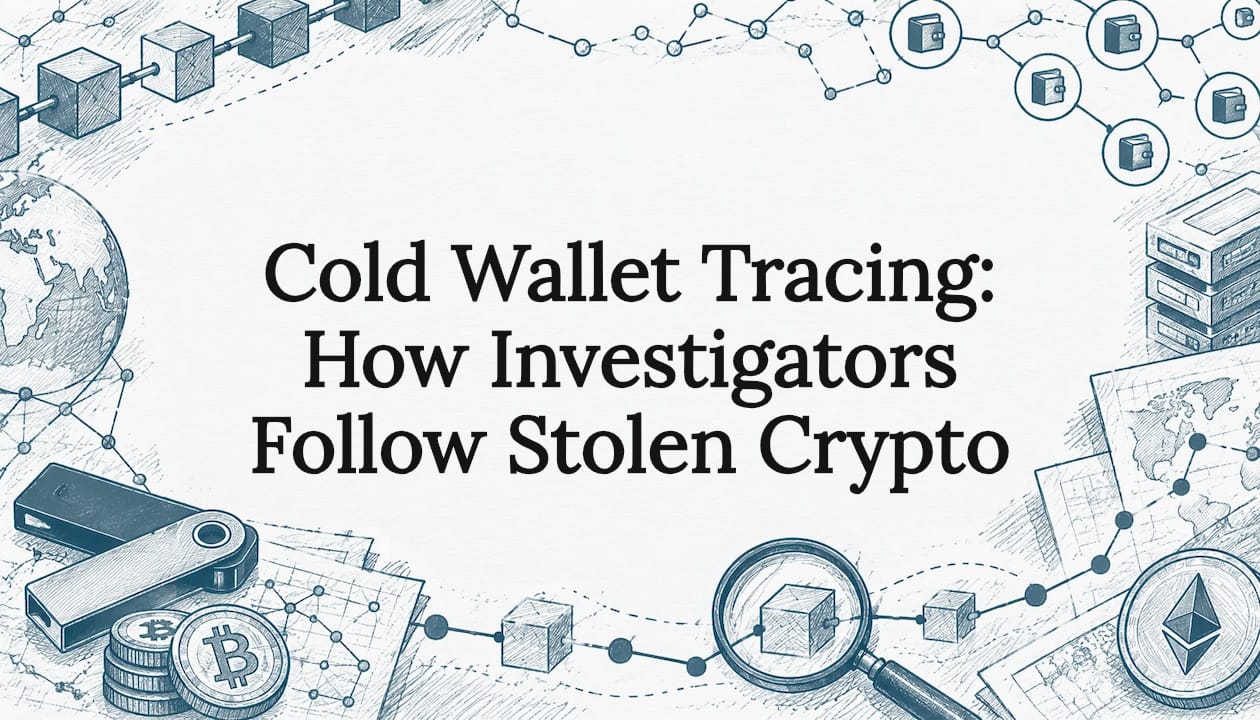
Cold wallet tracing is the work of following cryptocurrency that left an offline wallet, through every hop on the public blockchain, until it reaches a point where someone can act on it. The ledger shows every transfer. What it does not show is who controls each address. Closing that gap takes clustering, attribution and, usually, a legal request to an exchange. This guide explains each step in plain terms, so you know what a credible trace looks like and what to save before anyone starts one.
TL;DR
- A cold wallet keeps keys offline, but once coins move, every transfer is public on the blockchain and can be followed.
- Tracing shows where value went. It does not by itself name the person behind an address.
- Address clustering and attribution tags link addresses together. Their reliability varies, so a good report states its confidence.
- Exchange deposit addresses are usually where a trace meets real-world identity, and only legal process gets those records.
- Save transaction hashes, addresses, timestamps and communications now. Speed matters.
Table of Contents
- What cold wallet tracing actually means
- How a trace starts: the transaction hash
- Wallet attribution methods and address clustering
- How to identify an exchange deposit address
- If you still hold the hardware wallet, do not experiment with it
- What to preserve before the trace begins
- What tracing can and cannot do
- Reporting the theft in the United States
- Work with a forensic investigator
- FAQ
- Sources
What cold wallet tracing actually means
A cold wallet is one whose private keys are kept offline: a hardware device, a paper backup or a memorized seed phrase. Law enforcement guidance describes cold storage as by far the most secure way to store Bitcoin, and notes that such wallets are hard to identify because the key may sit on a USB drive, on paper or in someone’s head.
That offline security protects the keys. It does not hide the movement of funds. With Bitcoin, anyone can view transactions back to the beginning by downloading the blockchain or using a public explorer. So “tracing a cold wallet” really means two different jobs:
- If your own cold wallet was drained (a leaked seed phrase, a malicious signing request, a phishing site), you trace where the funds went after they left.
- If a scammer’s cold wallet received your funds, you trace into it, see whether the coins sit there or keep moving, and look for links to other addresses.
In both cases the starting point is a transaction, not a name.
How a trace starts: the transaction hash
Every transfer has a transaction ID, also called a hash. It is the thread an analyst pulls. From one hash you can see the sending address, the receiving address, the amount and the time.
From there, an analyst works outward:
- Follow each output. On Bitcoin, one transaction can split value across several outputs, so the trace branches.
- Note timing and amounts. Funds that move in seconds, in round chunks or in a repeating pattern often point to automation or a practiced laundering routine.
- Mark the hops. Intermediate wallets that receive and immediately forward funds are staging points, not destinations.
- Record everything. Each step needs a hash, a timestamp and a screenshot or export, so another expert can repeat it.
That last point is what separates a useful trace from a guess. Our guide to wallet activity analysis lists the checks analysts run so the work holds up when someone challenges it, and our overview of blockchain forensics covers the wider method.
Wallet attribution methods and address clustering
A raw trace gives you addresses. Attribution turns addresses into entities. Two ideas do most of the work.
Clustering heuristics
Clustering groups addresses that probably belong to one controller.
- Common-input (co-spend) analysis. If several addresses are spent together as inputs in one Bitcoin transaction, they were likely controlled by the same party, because the signer needed all the keys. The DOJ’s own journal calls this highly reliable and the most-used metric in commercial analysis tools.
- Change address detection. When a transaction returns leftover value to the sender, spotting that “change” output links the new address to the old cluster.
- Deposit and event-based patterns. On account-based chains such as Ethereum, and on smart contract protocols, analysts use different signals, since there is no input-merging behavior to rely on.
Attribution tags
A tag is a label attached to an address from outside the blockchain: an exchange’s published address, a scammer’s wallet posted on a forum, a ransom note, a victim report. The DOJ article explains that owners can be identified through off-chain information such as social media and forum posts, a process called tagging.
Researchers describe the strength of cryptocurrency forensics as the combination of clustering and tags. One tag on one address inside a large cluster can label hundreds of thousands of addresses at once. That leverage is also why the quality of each tag matters.
How reliable is clustering?
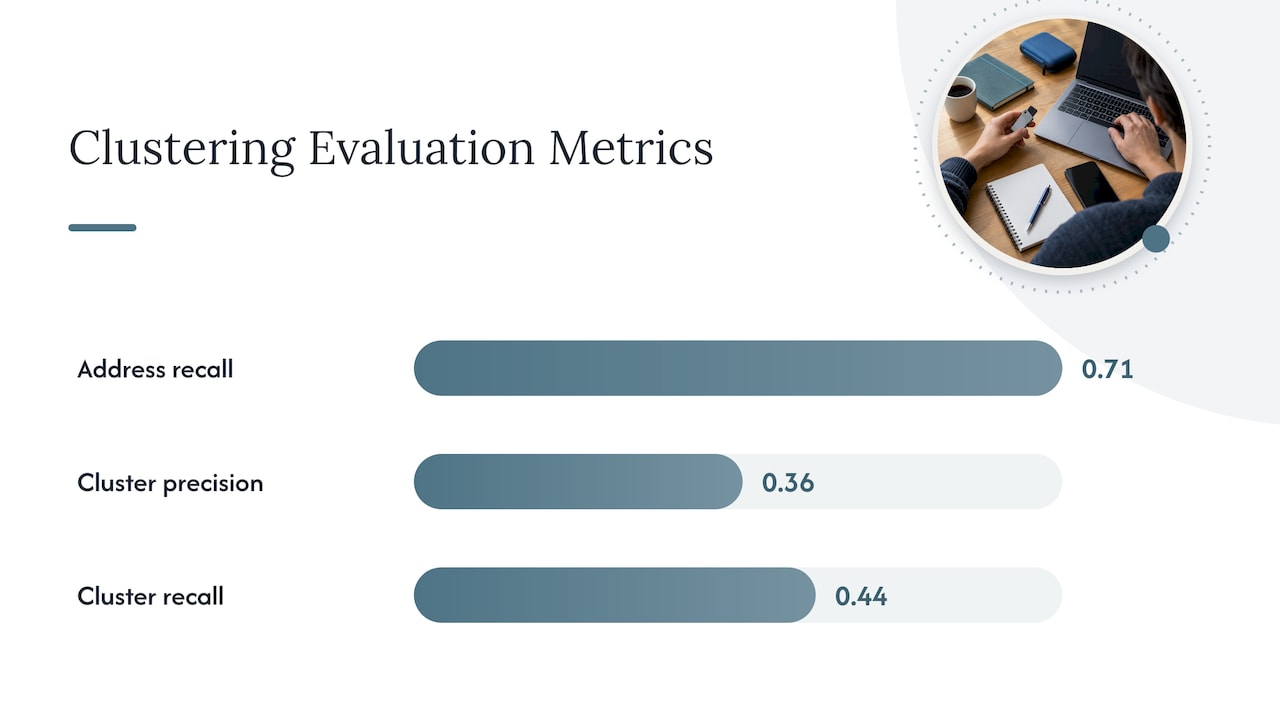
Honestly, it depends on the heuristic and on what you ask of it. A 2026 academic evaluation of the multi-input heuristic against ground-truth data from European service providers found recall of 0.71 for reported addresses, but full-cluster precision and recall of 0.36 and 0.44. The authors caution that when such clusters support seizure or trial evidence, prosecutors and judges must account for reliability that depends on the metric and the entity.
A separate USENIX Security 2025 study of illicit-service attribution used three checks, address overlap, money flows and address roles, and reported accuracy bounds ranging from 24.54 to 94.85 percent across three services. A 2020 paper in Digital Investigation notes that the evidential value of such findings in court remains largely unclear.
What this means for you: a trustworthy investigator separates what is observed on-chain from what is inferred, and says how confident each inference is. Conclusions built on one heuristic alone deserve a second look. Our approach is to corroborate clustering with money-flow patterns and independent evidence before it goes into a report.
How to identify an exchange deposit address
This is the step most victims care about, because exchanges are where crypto meets a bank account and a verified identity.
Analysts look for several signals:
- Known tags. The address, or the cluster it belongs to, is labeled to a specific exchange.
- Consolidation behavior. Many separate customer deposit addresses sweep their balances into one larger wallet. A fan-in of small deposits into a big hot wallet is a typical exchange pattern.
- Withdrawal batches. Exchanges send out many payments in a single transaction, from one source to many recipients.
- Pass-through shape. A run of deposits followed by a similar run of withdrawals within minutes, all to one destination, suggests the exchange was inserted into the path as a hop.
Here is the catch. Funds sent to a deposit address generally do not stay there. An exchange moves them internally, pools them with other customers’ funds and often keeps part of its holdings in cold wallets. Deposits and withdrawals are not linked on the public ledger, so the connection can be re-established only from the exchange’s own records.
So recognizing an exchange means two things. The on-chain trail pauses there, and the next step is legal process or a formal request to the exchange. Our explainer on exchange-to-exchange tracing shows how analysts pick the trail back up on the other side, and identifying scam wallets covers the first hours of that work.
If you still hold the hardware wallet, do not experiment with it
Victims often want to plug in the device and poke around. Resist that. The Scientific Working Group on Digital Evidence notes that hardware wallets may have anti-forensic features, and some reset when connected to read-only devices such as write-blockers. Examiners are told not to image them like ordinary USB storage.
In practice: leave the device as it is, photograph it, write down the model and how it was last used, and hand questions about it to a qualified examiner before connecting it to anything. Do not type your recovery phrase into any website, including one that claims to help trace funds.
What to preserve before the trace begins
The FBI’s guidance to crypto fraud victims is specific. When you report, it asks for cryptocurrency addresses, the amount and type, the date and time, and the transaction hash, plus how you met the scammer, your communications, the domains or apps used, any two-factor authentication details, the exchanges involved and a timeline.
A practical checklist:
- Every transaction hash and both addresses, copied from your wallet or explorer, not retyped.
- Screenshots of chats, profiles, websites and app screens, with dates visible.
- Exchange account statements and withdrawal confirmations.
- Email headers and phone numbers used by the other side.
- A timeline written the same day, while memory is fresh.
- A record of what you hold and where, including seed backup locations. A guide to inventorying crypto holdings and naming executors shows a tidy way to document wallets so nothing is lost or exposed when you reorganize storage after an incident.
If evidence may end up in court, how you preserve it matters as much as what you preserve. See our guides to digital evidence preservation and crypto chain of custody.
Our perspective on cold wallet tracing
We see the same misunderstanding often: people assume that because a wallet was “cold” or the thief “anonymous,” nothing can be learned. Public blockchains are the opposite. Every hop is recorded, and the question is whether the person reading the ledger can turn it into something a lawyer, an exchange compliance team or an investigator can use.
That is why we build reports around reproducibility. Each claim lists the transactions behind it, separates observation from inference, and shows how wallet activity connects to wider fraud networks. We reconstruct flows through mixers and bridges, not just straight wallet-to-wallet transfers, because that is where simple tracking tools stop. We also work directly with law firms, so the output is written for legal proceedings from the first page.
Our process is transparent and victim-centered. You see what we found, how we found it and what the next step would be. If you are weighing whether to start, begin by saving your hashes and screenshots, then talk to us.
cristian
What tracing can and cannot do
Tracing establishes where stolen value has gone. Recovery needs one more thing: the assets must reach a point where a court or a cooperating institution can act. The most important such point is a regulated exchange. Assets that stay in self-hosted wallets, or that move only through offshore venues, are much harder to reach even when traced.
The FBI states plainly that cryptocurrency exchanges freeze accounts only through internal processes or in response to legal process, and that private firms cannot issue seizure orders. A forensic report is therefore the evidence package that supports a request from you, your counsel or law enforcement, not a substitute for one. It also means anyone who promises guaranteed recovery, or asks for repeated up-front fees for an incomplete report, is not describing how this works. The same FBI alert flags recovery schemes that charge an up-front fee and then go silent or ask for more money. We make no guarantees about outcomes. What we promise is a documented, repeatable investigation.
The asset itself shapes the odds. Stablecoins make up most of the roughly $2.85 billion that blockchain analytics firm Elliptic counts as frozen or seized, because their issuers can act. No company can freeze bitcoin or ether, so the opportunity comes where those coins are converted to cash through a centralized exchange. Real cases show the pattern: in June 2025 federal agents obtained an order to seize about $225 million in crypto from alleged fraudsters, with an exchange assisting.
When funds are mixed with other money, the law has its own tracing tools. A constructive trust can treat a wrongdoer holding fraud proceeds as holding them for the victim, and the lowest intermediate balance rule caps a claim in a commingled account. Where funds are hopelessly commingled and the wrongdoer is insolvent, courts turn to pro rata distribution among victims. Your lawyer will decide which doctrine applies. A clear trace is what lets them make the argument.
Why the first hours matter
Speed is the one variable you control. Assets reported within hours can sometimes be frozen at an exchange before they are cashed out, while the same funds discovered weeks later have usually been moved and dispersed. Our guide to the 24 to 72 hour window for an exchange freeze explains what to do in that period.
Reporting the theft in the United States
Tracing and reporting run in parallel. The Consumer Financial Protection Bureau tells victims to contact the FBI, the FTC, their state attorney general or local police, and to report fraud at reportfraud.ftc.gov or ic3.gov. The Justice Department’s Criminal Division sends internet fraud to IC3, and state and local fraud to local police or the state attorney general.
If you are 60 or older, the IC3 cryptocurrency page lists the National Elder Fraud Hotline at 833-372-8311 for help filing a complaint. Also notify every exchange the funds touched, with the transaction hashes in hand. Our guide on what to report so police open an investigation and our practical U.S. recovery guide walk through the sequence.
Work with a forensic investigator
If you have lost crypto from or to a cold wallet and need a trace you can hand to counsel, an exchange or investigators, we can help. Our cryptocurrency scam investigation and evidence preservation services cover tracing, wallet analysis, OSINT attribution and technical reports built for legal use. Law firms can see how we support cases on our professional offices page. Pricing is set per engagement, so contact us with your case details.
FAQ
Can a cold wallet be traced?
Yes, in the sense that matters. Offline storage protects the keys, not the transaction history, and every transfer from or to the address is public. What cannot be read from the ledger alone is the owner’s identity, which needs clustering, tags or exchange records.
Does tracing tell me who stole my crypto?
Not by itself. The DOJ’s own journal says tracing funds does not necessarily identify an address owner. Identification usually comes from off-chain information, such as exchange customer records obtained through legal process, or from tags and other investigative evidence.
How accurate is address clustering?
It varies by method. Co-spend analysis is considered highly reliable, but a 2026 study found full-cluster accuracy much lower when tested against ground truth. A good report states which heuristic supports each link and how much weight it deserves.
What should I do first after a wallet is drained?
Stop using the compromised seed phrase and move any remaining assets to a new wallet created on a clean device. Then record every hash and address, report to IC3 and the FTC, and notify any exchange involved. Do not give your seed phrase to anyone offering to recover funds.
Can my trace result in funds being frozen?
Sometimes. A freeze depends on the funds reaching a cooperating exchange or a stablecoin issuer, and on a timely request backed by evidence. Nobody can guarantee that outcome, and a firm that does should be treated with caution.
Sources
- Using Blockchain Analysis From Investigation to Trial (DOJ Journal of Federal Law and Practice)
- Bitcoin Investigation Field Guide (IACP Cyber Center)
- How Reliable Is the Multi-Input Heuristic for Bitcoin (arXiv)
- Safeguarding the Evidential Value of Forensic Cryptocurrency Investigations (arXiv)
- Safeguarding the evidential value of forensic cryptocurrency investigations (Digital Investigation)
- Ghost Clusters: Evaluating Attribution of Illicit Services through Cryptocurrency Tracing (USENIX Security 2025)
- Tech Notes on Cryptocurrency (SWGDE)
- FBI IC3 guidance for cryptocurrency fraud victims (PSA230824)
- FBI IC3 alert on cryptocurrency recovery schemes (PSA230811)
- Cryptocurrency (FBI Internet Crime Complaint Center)
- Crypto Fraud & Asset Recovery (Digital Asset Law)
- $6.4 billion Binance heist leaves banks off the hook (American Banker)
- Coinbase aids federal agents in seizing $225 million (The Block)
- Who do I contact for help with a scam or fraud? (CFPB)
- Report Fraud (DOJ Criminal Division)
- Crypto inventory and digital executor guide