Monero is built so that its blockchain does not show who paid whom or how much. Tracing it on-chain alone is extremely difficult today. But Monero is rarely used in a vacuum, and cases have been solved through the points where it touches the rest of the world: exchanges, other blockchains, devices, network data and ordinary human mistakes. If you lost money to a scam and the funds moved into Monero, the case is not necessarily over. It just changes shape.
This guide explains how Monero hides transactions, where that protection has failed in the past, what real cases show, and what you should preserve if you are a victim.
TL;DR
- Monero hides sender, recipient and amount on every transaction, so following the coins hop by hop on the public ledger is not a realistic method today.
- Older transactions were weaker: research found many early Monero inputs could be linked, but protocol upgrades closed most of those gaps.
- Law enforcement cases usually succeed through off-chain evidence: exchange records, Bitcoin trails, device seizures and operational errors.
- For scam victims, the strongest leads are usually where the money entered Monero and where it left, so preserving transaction hashes, addresses and platform records early matters.
- A forensic report can document what is knowable and support legal action, even when the Monero leg itself stays opaque.
Table of Contents
- Short answer: traceable in some ways, not in the way Bitcoin is
- How Monero hides a transaction
- Where Monero’s privacy has failed before
- What real cases show
- What investigators actually use to trace Monero
- Is the transaction on-chain evidence worthless, then?
- If your stolen funds went into Monero: what to do now
- Monero compared with other privacy tools
- Perspective
- Get a forensic review of your case
- FAQ
- Sources
Short answer: traceable in some ways, not in the way Bitcoin is
Bitcoin is pseudonymous but public. Anyone can follow a payment from address to address. Monero is designed differently. According to the Monero project’s own documentation, the sender, receiver and amount of every transaction are hidden by three technologies: stealth addresses, ring signatures and RingCT. Because privacy is mandatory, there is no way to accidentally send a transparent transaction.
So the honest answer to “can you trace Monero” has three parts:
- On-chain, today: very hard. Recent transactions give an analyst almost nothing to follow.
- On-chain, historically: partly. Early Monero had weaknesses that researchers exploited.
- Off-chain: often. The people and platforms around a transaction leave records.
That third point is where most real investigations are won.
How Monero hides a transaction
Each layer protects a different piece of information.
| Technology | What it hides | How it works in plain terms |
|---|---|---|
| Ring signatures | The sender | Your real input is mixed with decoys. The Monero Technical Specification lists a ring size of 16, meaning 15 decoys alongside the real one. |
| Stealth addresses | The recipient | Each payment goes to a one-time address, so the recipient’s public address never appears on the chain. |
| RingCT | The amount | Amounts are cryptographically concealed while the network can still verify no coins were created from nothing. |
On Bitcoin, an analyst can cluster addresses, follow change outputs and watch funds arrive at an exchange deposit address. With Monero, the ring hides which input is real, the stealth address breaks the link to the recipient, and the amount can’t be used to match one transaction’s output to another’s input.
Network privacy is a separate layer
The blockchain is not the only place information lives. The same technical specification explains that Dandelion++ makes the spread of a new transaction across the network harder to trace. It also notes that this does not protect against an ISP, a VPN provider or the very first remote node you connect to. For full protection, a user must manually route their node through Tor. In practice many users do not, and that leaves a thread an investigator may pull.
Where Monero’s privacy has failed before
Monero today is not Monero of 2015. Understanding the history explains why some old transactions are traceable and new ones mostly are not.
Zero-mixin inputs and deducible rings
A 2017 empirical analysis by Möser and colleagues found that 64.04% of Monero transaction inputs before February 2017 contained no mixins at all. Among inputs that did have mixins, 63% were deducible, meaning the real input could be identified with certainty. Once a real input is known, it can be excluded from other rings, which creates a chain reaction.
Temporal and origin analysis
A Microsoft Research paper by Kumar and colleagues found that in 88% of cases the origin of funds could be determined with certainty using three attack routines. It also reported that a simple temporal analysis produced over 98% of the results. The point is that people tend to spend recently received coins, and that habit leaks information when decoy selection does not mimic it.
What changed afterward
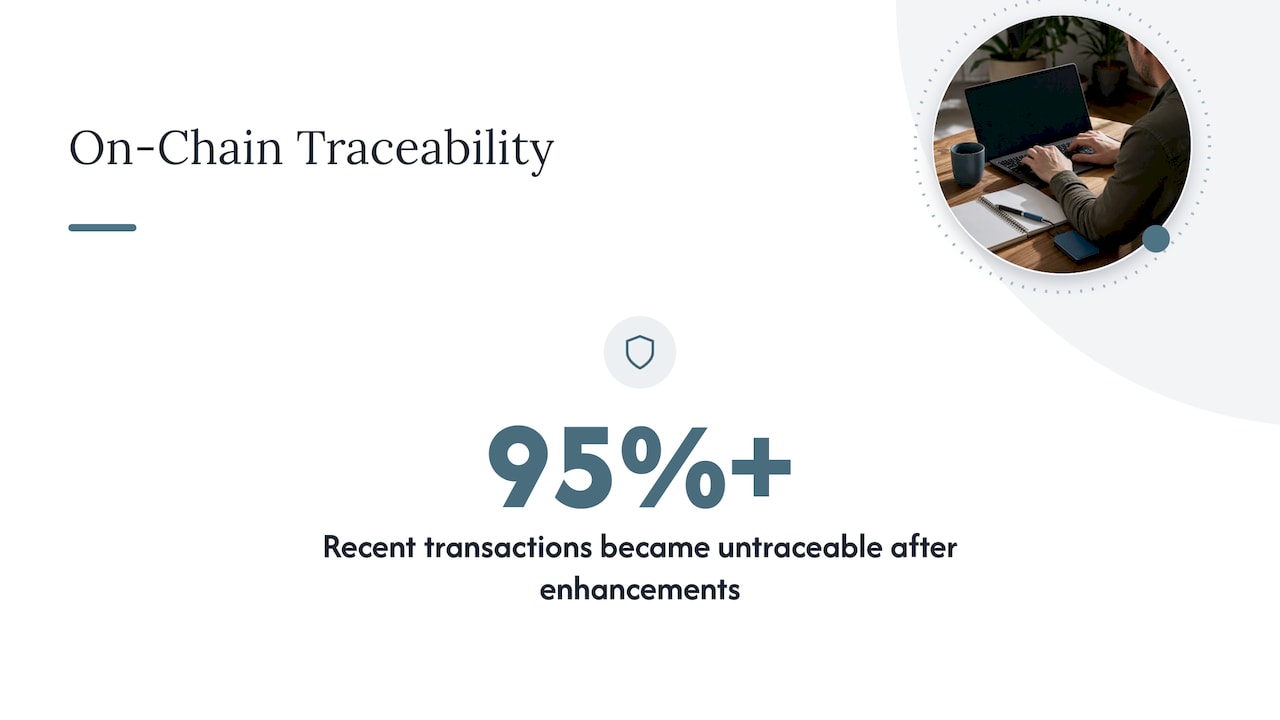
The protocol responded with mandatory minimum ring sizes, RingCT for hidden amounts and better decoy selection. A 2025 DFRWS paper on Monero wallet forensics notes that Hinteregger and Haslhofer (2019) showed over 95% of recent transactions became untraceable after these enhancements. Its authors conclude that on-chain data alone makes practical tracing nearly impossible, and that a strategy built on off-chain data has become imperative.
The lesson for victims is not that old research solves your case. It is that on-chain analysis has a ceiling, and good investigators plan around it.
What real cases show
The Steam malware case: the privacy failure was human
In a case reported in July 2026, investigators linked a suspect to a Monero wallet without breaking Monero. According to coverage of the Steam malware case, they followed a Bitcoin address through gift card purchases, browser cookies and food delivery records, then obtained seed phrases through a physical search warrant. The analysis of the case put it this way: the failure was operational, not cryptographic.
The Vastaamo case in Finland
Finland’s National Bureau of Investigation reported tracing Monero transactions tied to the hacker behind the Vastaamo extortion. As BleepingComputer reported, police described heuristic analysis based on patterns and probabilities, with help from an exchange, and did not disclose the exact mechanism. That is worth noticing: even a successful result was described as probabilistic, not as a clean ledger trail.
The $3.6 billion Bitcoin seizure
In the U.S. Department of Justice case, IRS Criminal Investigation tied funds to a suspect by following both Bitcoin and Monero branches to exchange accounts registered in his name and in the names of companies he owned. WIRED’s reporting quotes cryptographer Matt Green saying investigators may not have traced Monero directly, and that they may also have capabilities they did not disclose. Either way, the identification came from exchange accounts, the kind of off-chain record a forensic investigator looks for.
Node-level monitoring claims
In 2024 a blockchain analytics firm presented a video claiming it could trace Monero transactions back to 2021 by running its own nodes and logging the IP addresses that connected. Decrypt reported that a Monero community figure disputed the framing, calling these essentially fake proxy nodes. The claims are contested, but the underlying idea, using network metadata instead of ledger data, is exactly the off-chain direction the research points to.
What investigators actually use to trace Monero
When the ledger gives little, experienced analysts look at what surrounds it.
1. The entry point
Most scam proceeds do not start as Monero. Victims send Bitcoin, Ethereum or USDT, and the scammer converts. The conversion is often visible on the originating chain: a swap service, an exchange deposit or a series of transfers ending at a known service. Recording that moment is the most valuable thing a victim can help with. Our guide to exchange-to-exchange tracing covers how those handoffs are followed, and Ethereum tracing to an exchange shows the same logic on another chain.
2. The exit point
Someone who wants to spend or cash out Monero usually has to convert it back into something else, often through an exchange or a service with identity checks. A deposit or withdrawal on a regulated platform can be requested through legal process. Timing, amounts and the platform’s records can narrow down the match.
3. Wallet and device artifacts
The DFRWS research describes a memory-scanning algorithm that identifies key-related data structures in Monero wallets, plus methods to decrypt wallet-key and wallet-cache files protected by a passphrase. A forensic analysis of privacy-oriented cryptocurrencies describes how a Monero wallet is made of a wallet file, a key file and a public-address text file, and how the key file and passphrase allow a wallet to be recovered. If a device is lawfully seized, those artifacts can matter more than any blockchain analysis.
4. Network and account records
IP addresses, VPN logs, email accounts, phone records and delivery or purchase histories can connect a person to an action. This is the same kind of digital evidence work described in this overview of financial investigation methods that connect people to Monero activity, where case files, devices and records are combined into one picture.
5. OSINT and attribution
Scammers reuse usernames, wallet addresses, domains, Telegram handles and payment instructions across victims. Open-source investigation can link a Monero-receiving address given to a victim to other complaints, websites and social profiles. This does not need the Monero ledger at all.
Is the transaction on-chain evidence worthless, then?
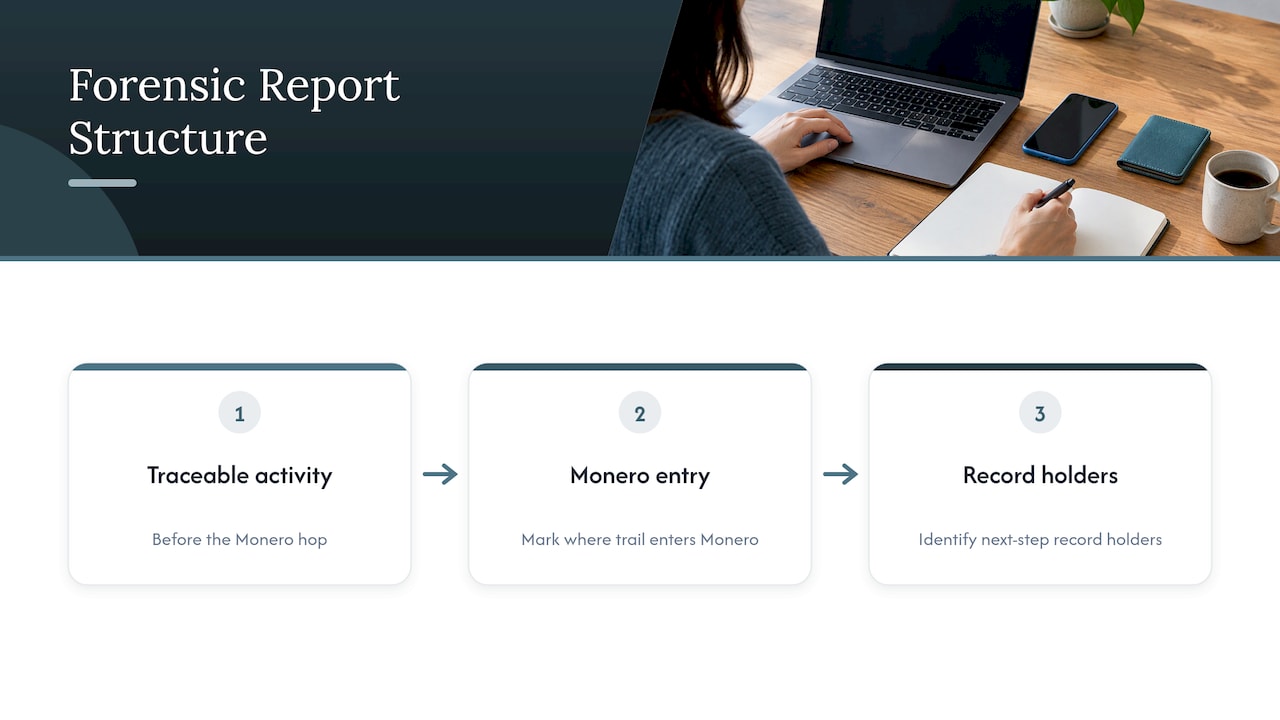
No. Even a Monero hop leaves facts that matter in a case: that a transfer occurred, its approximate time, and what happened before and after it. A forensic report can document the traceable segment, state clearly where the trail enters Monero, and identify who may hold records about the next step. That structure is what lawyers, banks and law enforcement can act on. See our overview of blockchain forensics and how crypto fraud is proven.
If your stolen funds went into Monero: what to do now
The first hours matter because platforms keep records for limited periods and funds move quickly.
- Save every transaction hash and address. Copy the transaction IDs, the receiving addresses and screenshots from your wallet or exchange history.
- Record how the contact started. Keep chats, emails, ads, website URLs, usernames and payment instructions in their original form.
- Do not delete the wallet or app you used. Device artifacts can be evidence. Our guide to digital evidence preservation explains what to keep and why.
- Identify the conversion point. If you sent Bitcoin or USDT and it was swapped to Monero, note which service or address received it. The 24 to 72 hour checklist lays out the sequence.
- Report it. Understand what police need to see before they act in what to report to trigger a police investigation.
- Keep a chain of custody. If the case may go to court, how evidence was collected matters. See crypto chain of custody.
Be wary of anyone who promises to reverse or instantly recover a Monero transfer. A credible investigator talks about what is documented, what is probable, and what legal steps could follow.
Monero compared with other privacy tools
Privacy features vary, and so does what investigators can see. Monero hides by default. Some other systems offer optional mixing, which leaves more of the ledger exposed. For a comparison, see what investigators can see in Dash PrivateSend tracing. Chains with transparent ledgers, such as TRON, are different again: our guide to following stolen USDT on TRON shows how much visibility a transparent chain gives.
Perspective
Victims often hear that once funds touch Monero, the case is finished. We do not see it that way. Monero’s design makes the on-chain leg difficult, and we say so plainly. But the funds had a life before Monero, and almost always have one after it.
Our approach is to analyze transaction patterns on the public blockchains where the money first moved, trace the flow of lost assets, and connect wallet activity to wider fraud networks. We then build a forensic report suitable for legal proceedings, one that shows what can be established, how it was established, and what a lawyer or agency can request next.
That is where we believe forensic depth makes the difference: reconstructing asset flows through mixers and bridges, preserving evidence correctly from the first day, and working directly with law firms so the report is usable. Victims deserve a transparent process, not a promise.
cristian
Get a forensic review of your case
If your funds ended up in Monero, we can examine the transaction history before the conversion, document the trail, preserve the evidence and prepare a technical report for legal proceedings. See our cryptocurrency scam investigation services, or if you are a law firm, our services for professional offices. For a step-by-step view of the process, read our crypto fraud investigation action guide.
FAQ
Can Monero be traced like Bitcoin?
No. Bitcoin’s ledger shows senders, recipients and amounts, so analysts can follow it directly. Monero hides all three on every transaction, so investigators rely on the points before and after the Monero step, plus off-chain records.
Can you trace Monero if it was stolen in a scam?
Often you can trace the part of the journey that happened on a transparent chain, such as the Bitcoin or USDT you sent and where it was swapped. The Monero hop itself is hard to follow, but exchange records, addresses reused across victims and device evidence can still support a case.
Has law enforcement ever traced Monero?
Agencies have reported results, including in the Finnish Vastaamo case and in U.S. cases that involved Monero branches. Details are usually undisclosed, and outside experts have questioned whether the link came from the Monero ledger or from exchange records and other evidence.
Were older Monero transactions easier to trace?
Yes. Academic studies of early Monero found many inputs with no mixins or with deducible rings. Later protocol changes, including larger mandatory rings and hidden amounts, greatly reduced that exposure.
What should I save if my funds were converted to Monero?
Save transaction hashes, receiving addresses, screenshots of your wallet and exchange history, all communications with the scammer, and the device you used. Early preservation gives an investigator more to work with and keeps the evidence usable.
Sources
- What is Monero (XMR)? Monero project
- Monero Technical Specification
- An Empirical Analysis of Traceability in the Monero Blockchain
- A Traceability Analysis of Monero’s Blockchain
- Advanced Monero wallet forensics: Demystifying off-chain data
- Forensic Analysis of Privacy-Oriented Cryptocurrencies
- Steam Malware Case: Bitcoin Trail Led to Monero Seeds
- Vastaamo hacker traced via Monero transactions, police says
- The DOJ’s $3.6B Bitcoin Seizure Shows How Hard It Is to Hide
- Monero Expert Fact Checks Video Claiming XMR Transactions Can Be Traced