Yes, blockchain forensics can usually identify scam wallets and trace where stolen funds landed. Investigators follow the money through public ledgers until it reaches a regulated exchange, where know-your-customer records can unmask a real identity. The catch: your odds drop fast with every day you wait, and mixers or chain-hopping can bury the trail. Save the transaction hash, preserve every screenshot, and contact an exchange or attorney before you touch anything else.
TL;DR:
- Forensic tracing is faster and more effective if conducted within hours of the theft before funds scatter across multiple wallets or chains.
- Clustering techniques rely on heuristics like common-input ownership, change-address detection, and behavioral patterns, but these are never definitive and carry confidence levels.
- Crossing chains, mixers, and peel chains significantly complicate tracking efforts, often requiring expert analysis to accurately interpret anomalous patterns.
- Funds deposited into regulated exchanges can be linked to real identities using KYC data, forming the basis for court-admissible evidence.
- Hiring a professional forensic service yields a detailed, legally valid report with documented methodology, confidence ratings, and chain-of-custody, essential for legal or insurance claims.
Table of Contents
- What Blockchain Forensics Actually Does
- What Should Victims and Counsel Do Right Now?
- How Do Investigators Trace Wallets Across Chains?
- When Does Tracing Lead to a Real Identity?
- When Should You Hire a Paid Forensic Investigator?
- Why Confidence Labeling Separates Real Forensics From Guesswork
- Start a Forensic Investigation With Recovera Forensics
- Sources
- FAQ
What Blockchain Forensics Actually Does
Blockchain forensics turns raw, anonymous-looking ledger entries into evidence tied to a real actor. Every Bitcoin, Ethereum, or Tron transaction is permanently recorded, but a wallet address by itself tells you nothing about who controls it. Forensic work closes that gap through a repeatable process: data collection from full nodes and analytics databases, transaction graphing that maps every hop of the funds, address clustering to group wallets under one likely owner, attribution to link a cluster to a real entity, and cross-chain tracing when funds jump networks.
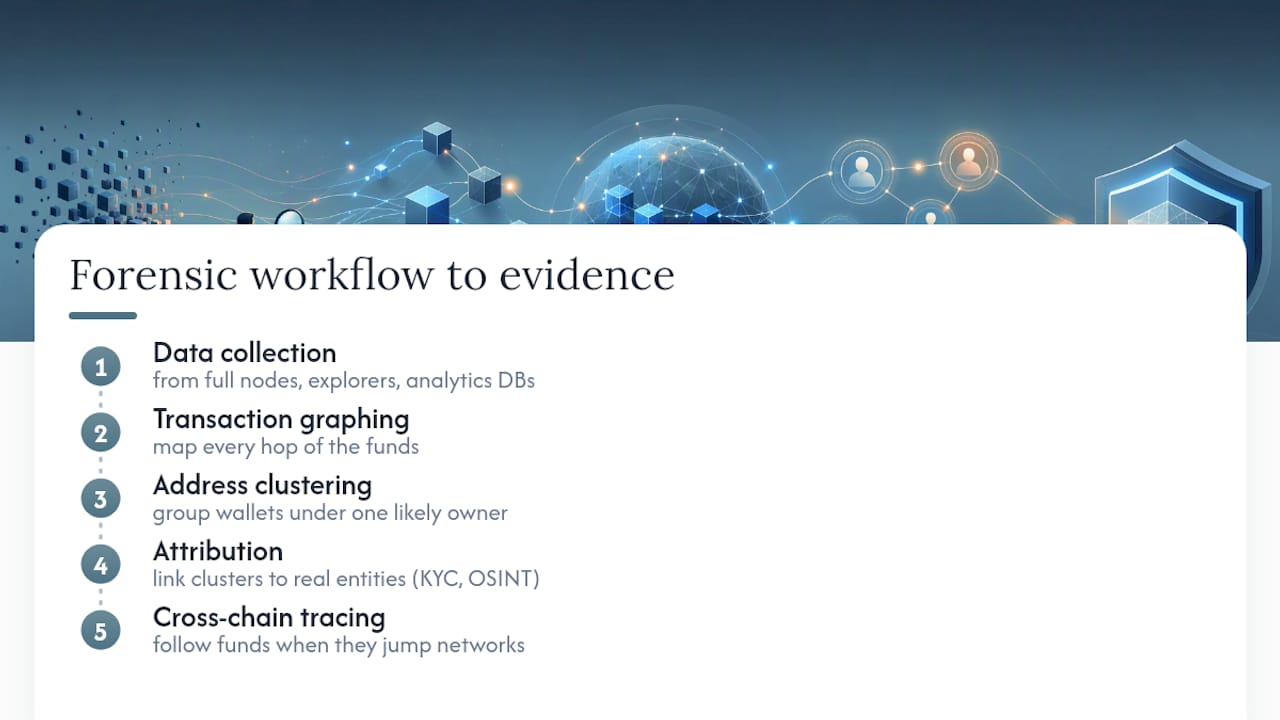
The Chainalysis glossary on blockchain forensics describes this as a defined methodology, not guesswork, and courts increasingly expect it to meet that bar. Investigators pull from on-chain sources like block explorers and full nodes, then cross-reference off-chain intelligence: exchange KYC data, OSINT from social media and leaked databases, sanctions lists, and prior law enforcement seizures. A detailed forensic report documents each step so a lawyer, judge, or insurer can follow the logic without taking anyone’s word for it. That documentation is the actual product. The tracing is just how you get there.
What Should Victims and Counsel Do Right Now?
Speed determines almost everything. The Onchain Diary guide to tracking stolen crypto notes that acting within hours, not weeks, meaningfully raises the odds funds are still sitting somewhere traceable before they scatter across dozens of wallets.
- Record the exact theft transaction hash and screenshot every transfer, including timestamps and block numbers.
- Do not move any remaining funds in the affected wallet unless a forensic advisor tells you to.
- Monitor outgoing transactions from the thief’s address using a block explorer, and revoke any token approvals still active if it’s safe to do so.
- File a report with IC3 and your local police department to get an official case number.
- Notify major exchanges directly with the receiving wallet address, and preserve device images for OSINT review.
Pro Tip: Take a full screenshot that includes the address, transaction hash, and timestamp in one frame. A cropped image that only shows the amount is far harder to authenticate later.
If your seed phrase was compromised rather than a single wallet drained, the order of operations changes slightly. Our step-by-step guide for stolen seed phrases covers that scenario specifically.
How Do Investigators Trace Wallets Across Chains?
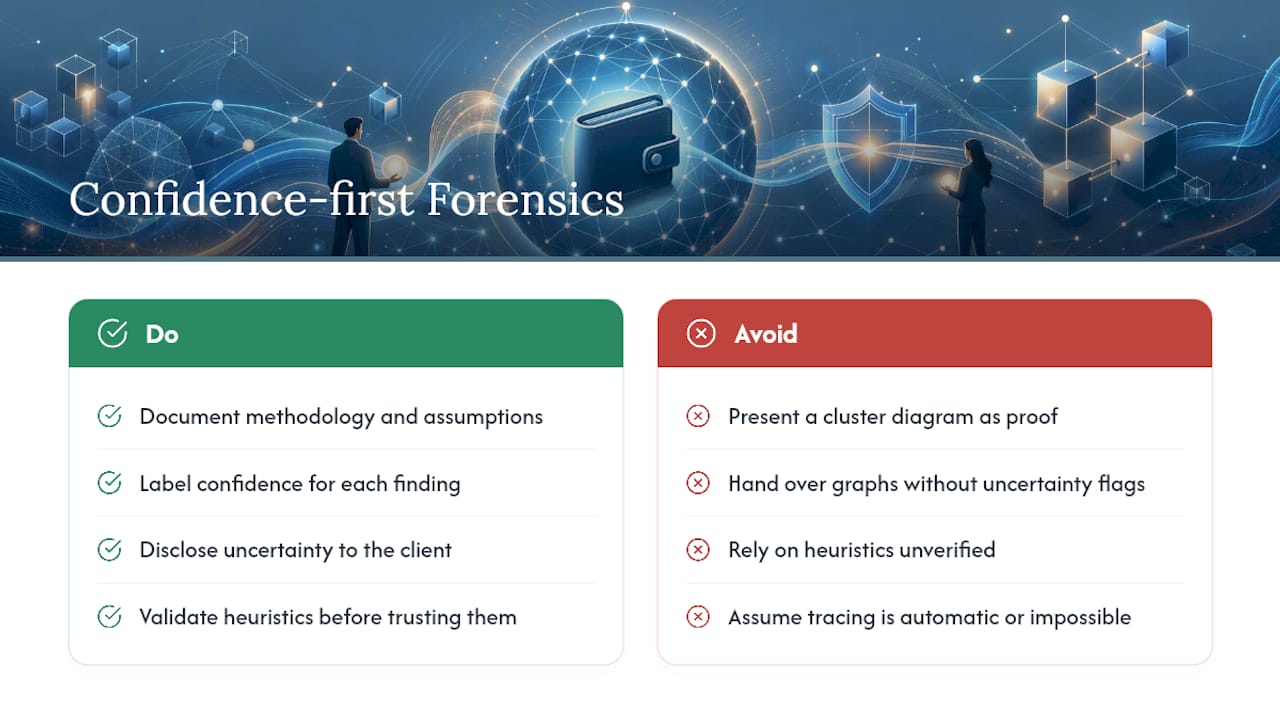
Clustering is the backbone of wallet identification, but it rests on heuristics, not certainty. Common-input-ownership assumes that when a transaction spends from multiple addresses at once, one entity controls them all. Change-address detection flags the “leftover” output in a transaction as belonging to the sender. Behavioral patterning looks at timing, amounts, and gas habits to link wallets that act like the same operator. Every one of these methods produces a probability, not a fact, which is why a competent report labels confidence levels instead of presenting a cluster as proven ownership.
Token movement adds another layer investigators can’t skip. ERC-20 transfers don’t always show up in a wallet’s native value field. They fire a smart contract Transfer event instead, and missing that event log means missing the actual movement of stolen tokens entirely.
Cross-chain tracing is where cases get genuinely hard:
- Bridges and wrapped tokens let stolen assets change form and chain in a single transaction, breaking simple address-matching tools.
- Chain-hopping spreads funds across three or four networks specifically to exhaust unsophisticated tracing attempts.
- Mixers and CoinJoin services are built to defeat naive clustering, and courts have seen cases collapse when investigators treated a mixer output as a clean match.
- Peel chains, where small amounts are peeled off a larger balance repeatedly, and sudden consolidation spikes are two patterns skilled analysts watch for even when a thief thinks they’ve covered their tracks.
Roughly every serious forensics explainer converges on the same warning: heuristics that look convincing on a dashboard can fall apart under cross-examination if nobody explains how they were derived.
When Does Tracing Lead to a Real Identity?
Tracing becomes actionable the moment funds land in a wallet controlled by a regulated exchange. That’s the chokepoint where an anonymous string of characters becomes a name, an address, and a government ID on file. Case histories from Bitfinex to Colonial Pipeline show the same pattern: investigators traced stolen funds to an exchange deposit, and that deposit’s KYC data drove the identification and, eventually, the freeze order.
Getting from a traced wallet to a usable court exhibit requires more than a spreadsheet of addresses. A report needs:
- A documented methodology explaining every clustering and attribution decision made.
- An unbroken chain of custody showing exactly who touched the data and when.
- Reproducible steps another analyst could follow to reach the same conclusion.
- Labeled confidence levels for every attribution, addressing Daubert-style admissibility concerns before a judge raises them.
Not every trail ends cleanly. Funds routed through noncooperative jurisdictions, converted to privacy coins like Monero, or run through a well-designed mixer can stall an investigation regardless of skill. Poor clustering work makes things worse, not neutral. It can hand the defense an easy target to discredit the entire case.
When Should You Hire a Paid Forensic Investigator?
Paid forensic investigation makes sense for anyone facing a loss large enough to justify the cost of a proper report, and for law firms building a civil claim, a criminal referral, or an insurance filing that needs technical backing to hold up. A do-it-yourself look at a block explorer can tell you funds moved. It cannot produce a document a judge will accept as evidence.
A competent forensic engagement should produce detailed transaction graph visualizations, annotated timelines, cluster analyses, chain-of-custody documentation, and a final report suitable for legal contexts. Before reaching out, gather the theft transaction hash, screenshots of every relevant transfer, and any police report number you already have. Timelines vary by case complexity, and most firms discuss fees and confidentiality terms during an initial intake before any work begins. Our step-by-step crypto fraud investigation guide walks through what that intake typically covers.
Why Confidence Labeling Separates Real Forensics From Guesswork
Most people assume tracing crypto is either impossible or automatic. Neither is true. It’s a discipline that lives entirely in the gap between “the data suggests” and “the data proves,” and how an investigator handles that gap is the real test of competence.
The industry’s dirty secret is that clustering tools produce a confident-looking graph even when the underlying assumption is wrong. A change-address heuristic misfires more often than most dashboards admit, and a report that hands over a cluster diagram without flagging its uncertainty is doing the client a disservice, not a favor. Professional forensic reports are built around documented methodology and labeled confidence levels precisely because a case that looks airtight on screen can fall apart the moment a defense attorney asks how a conclusion was reached.
— cristian
Start a Forensic Investigation With Recovera Forensics
Specialized forensic services provide a direct route to a court-ready forensic report instead of piecing together a case from block explorer screenshots on your own. Such services offer documented transaction graphs, timelines of fund movements, cluster attributions with confidence ratings, and support preparing subpoenas for exchanges once tracing points to a cash-out point. Before reaching out, have your theft transaction hash, screenshots of the transfers, and a police report number ready if you have one. If your loss involves a stolen seed phrase specifically, review the immediate action order for that scenario first so nothing gets moved before it should. When you’re ready, start an intake with Recovera Forensics and get your case evaluated by someone who documents every step instead of handing you a guess.
Sources
Counsel and victims evaluating a forensic claim should check it against primary technical sources rather than take a vendor’s word for it. The Chainalysis blockchain forensics glossary covers methodology and Daubert-related admissibility. Onchain Diary’s tracing guide explains clustering and chokepoints in plain terms. For phishing-specific evidence collection, SmishAlert’s guide to crypto wallet phishing is a useful companion resource.
- What Is Blockchain Forensics? Definition, Process & Daubert Standard – Chainalysis
- How to Track Stolen Crypto: A Guide to Blockchain Forensics — Onchain Diary
FAQ
Can You Really Identify Who Owns a Scam Wallet?
Often, yes, but only once funds tied to that wallet reach a regulated exchange with KYC records. Without that step, a wallet address alone rarely reveals a name.
How Long Does a Forensic Wallet Investigation Take?
Timelines vary by case complexity, how many hops the funds took, and whether a mixer was involved. Ask a provider for a case-specific estimate during intake rather than relying on a general figure.
What’s the First Thing I Should Do After a Crypto Theft?
Record the theft transaction hash, screenshot every transfer with its timestamp, and avoid moving any remaining funds until you’ve spoken with an exchange or a forensic advisor.
Can Stolen Crypto Be Traced Through a Mixer?
Mixers and CoinJoin services are specifically designed to defeat basic clustering, so tracing through one is difficult and sometimes impossible. Analysts still watch for anomalous patterns like peel chains, but a mixer meaningfully lowers the odds of a clean identification.
Does Recovera Forensics Prepare Reports for Court Use?
Yes. Recovera Forensics builds reports around documented methodology, chain of custody, and labeled confidence levels so they hold up to legal scrutiny, and current service details are available on its site.