
A peel chain is a sequence of Bitcoin transactions where a large sum is repeatedly split into a small “peeled” payment and a larger change output sent to a fresh address, over and over, until the funds land somewhere final. Peel chain analysis matters because tracing that sequence link by link is often the fastest route to a consolidation point, an exchange, mixer, or wallet where legal recovery becomes possible. The sections below break down the mechanics, the algorithms investigators rely on, and the steps that turn a chain graph into evidence.
TL;DR:
- Automated peel chains often reuse address formats, SegWit flags, and show consistent timing and transaction patterns, making them identifiable.
- The most effective detection uses heuristics like findNext and findPrev, with forward-only expansion reducing false positives to about 0.62 percent.
- Cross-chain transfers or mixing services break the linking pattern, limiting the ability to trace peel chains to their final destination.
- Focusing on the last consolidation point at a known exchange or service is crucial for successful recovery actions.
- Proper documentation, including TxIDs, timestamps, and chain-of-custody notes, is essential before requesting legal or law enforcement intervention.
Table of Contents
- What Is a Peel Chain and How Does It Actually Work?
- How Do You Trace a Peel Chain Step by Step?
- Which Algorithms Detect and Validate Peel Chains?
- What Red Flags Signal an Automated Peel Chain?
- Where Does Peel Chain Analysis Break Down?
- How Do You Turn a Peel Chain Into a Recovery Action?
- How Recovera Forensics Approaches Peel Chain Cases
- What Ethical Standards Should Govern Peel Chain Reporting?
- Ready to Trace Your Stolen Funds? Here’s Where to Start
- Sources
- FAQ
What Is a Peel Chain and How Does It Actually Work?
Every peel chain starts with Bitcoin’s UTXO (unspent transaction output) system. When you spend Bitcoin, you’re not spending a “balance.” You’re consuming a whole output and generating new ones, one of which typically returns leftover value to you as change. A peel chain exploits this mechanic deliberately: someone repeatedly moves a large UTXO forward, each time sending a small peeled amount to another address (a cash-out point, a payment, a distraction) while parking the remainder in a brand-new change address.
That pattern, described in detail by blockchain analytics researchers, produces a long, thin chain of linked transactions rather than a wide, branching cluster. Key traits investigators look for:
- One dominant “change” output per hop, carrying most of the remaining value forward
- A smaller peeled output diverging to a separate address each time
- Occasional branching, where a chain splits into two or more sub-chains to obscure the trail
- A visible endpoint where peeling stops, usually at a service deposit address
How Do You Trace a Peel Chain Step by Step?
Tracing a suspected peel chain is not a single click in a block explorer. It’s an iterative process, and skipping steps produces weak conclusions that won’t hold up with an exchange’s compliance team or in court.
- Confirm the starting transaction. Pin down the TxID, verify the inputs actually belong to the victim’s wallet, and note the exact timestamp and amount.
- Expand forward (followFwd). Follow the change output hop by hop toward its eventual destination, logging each new address.
- Expand backward (followBkwd) when relevant. If the origin of funds is in question, trace inputs backward to establish provenance before the theft.
- Separate peeled outputs from change outputs at every hop. This is where branching happens. Some peeled outputs are dead ends (exchange deposits, gambling sites); others spawn their own sub-chains.
- Prioritize hops that look like consolidation points. Not every hop deserves equal attention. Rank them by proximity to a known exchange or service wallet.
Pro Tip: Log every hop’s address, timestamp, and amount in a structured spreadsheet or graph tool as you go. Reconstructing a 40-hop chain from memory a week later is how good leads get lost.
Which Algorithms Detect and Validate Peel Chains?
Forensic tooling doesn’t eyeball chains one hop at a time anymore. Researchers formalized two heuristics, findNext and findPrev, that automate exactly the forward and backward expansion described above. findNext looks at a transaction’s outputs and picks the one most likely to be the “real” change continuing the chain, based on output structure, address reuse patterns, and script type. findPrev runs the same logic in reverse to reconstruct where a chain originated.
The team behind this approach validated it against ground-truth datasets and reported very low false-positive rates for findNext when the expansion stayed forward-only.
Statistic callout: Limiting expansion to forward-only findNext hops kept the false discovery rate near 0.62% in that same evaluation. Push the heuristic into more aggressive clustering and expansion, and coverage rises but so does the error rate.
Practical trade-offs to weigh:
- Forward-only expansion: highest confidence, narrower coverage
- Clustering plus expansion: broader coverage, more false positives to manually review
- Combining both with manual verification at branch points is the standard practitioners actually use
What Red Flags Signal an Automated Peel Chain?
Peel chains generated by scripts, rather than a person manually spending funds, tend to leave fingerprints. Large-scale analysis of Bitcoin peeling patterns found consistent chain-parameter signatures that separate automated laundering chains from ordinary spending behavior.
- Repeated address-format and SegWit flags. Automated chains often reuse the same script type and SegWit signaling across every hop.
- Round-number peeled amounts. A human paying rent looks different from a script peeling off exactly 0.5 BTC every time.
- Zero or near-zero block-interval timing. Hops that land in consecutive blocks, seconds apart, point to a script rather than manual activity.
- Identical lock_time and sequence numbers. These are transaction-format details most wallets set automatically, and scripts tend to leave the same values, hop after hop, according to the same dataset analysis.
- Consistent funding sources for fees. If every hop pulls transaction fees from the same small pool of addresses, that’s a sign of centralized control.
Where Does Peel Chain Analysis Break Down?
No heuristic survives contact with a determined launderer forever. Peel chain analysis has real limits, and pretending otherwise is how weak cases get thrown out.
- CoinJoin and mixing services sever the chain. Once funds enter a mixer, the one-to-one output linkage a peel chain depends on disappears.
- Cross-chain bridges and token swaps hide the final destination. Funds that hop from Bitcoin to an ERC-20 token or a different chain entirely require a separate multi-chain tracing effort, not a simple continuation of the same graph.
- Change-output heuristics can misfire. Some legitimate wallets and services generate transaction patterns that mimic peeling, producing false positives.
- On-chain patterns alone don’t prove identity. An address cluster is not a person. Confident attribution needs off-chain corroboration, such as exchange KYC records or subpoena responses, before anyone states a conclusion as fact.
How Do You Turn a Peel Chain Into a Recovery Action?
The graph itself doesn’t recover anything. What matters is converting it into something an exchange, a court, or law enforcement can act on.
- Identify the consolidation endpoint. Rather than chasing every micro-hop, focus on where peeled funds reconverge at a known service address. Prioritizing these endpoints is consistently the highest-value move in a peel chain investigation.
- Preserve the raw evidence. TxIDs, full chain-of-custody notes, screenshots with timestamps, and the wallet’s original private key exposure details all need documentation before anything else.
- Build a clean transaction graph. A compact, machine-readable graph with timestamped nodes and edges lets an exchange’s compliance team match deposit windows fast, which materially raises the odds of a freeze.
- Draft a targeted exchange request. Include exact TxIDs, deposit addresses, timestamps, and amounts. Vague requests get deprioritized.
- Loop in counsel or law enforcement early if the amount justifies civil recovery or a subpoena. Timing matters more than most victims realize; funds sitting at an exchange today can move tomorrow.
Pro Tip: File a report with law enforcement even if you plan to pursue civil recovery. Exchanges respond faster to requests backed by an active case number.
How Recovera Forensics Approaches Peel Chain Cases
Forensic tracing can be built around the same algorithmic detection methods described above, then layered with OSINT and legal documentation so findings hold up outside a spreadsheet. The goal isn’t just a chain graph. Reports aim to be suitable for exchange compliance desks or courts.
- Transaction-level tracing that follows peeled outputs to consolidation points
- Legal-ready reports formatted for law firms and civil recovery filings
- Direct exchange outreach built around the same targeted-request approach outlined above
- Chain-of-custody documentation that keeps evidence admissible if the case escalates
Every case starts with the raw graph and ends with a decision point: freeze request, subpoena, or negotiated recovery. Learn more about the forensic methods behind these reports.
What Ethical Standards Should Govern Peel Chain Reporting?
Every peel chain finding should be labeled probable or definitive, never blurred together. Algorithmic confidence isn’t legal proof, and treating a findNext match as identity is how good investigations lose credibility in court. Share structured graphs with peers for review, but strip victim identifiers first. Transparency helps the field. It should never come at the cost of a victim’s privacy or the case’s legal standing.
— cristian
Ready to Trace Your Stolen Funds? Here’s Where to Start
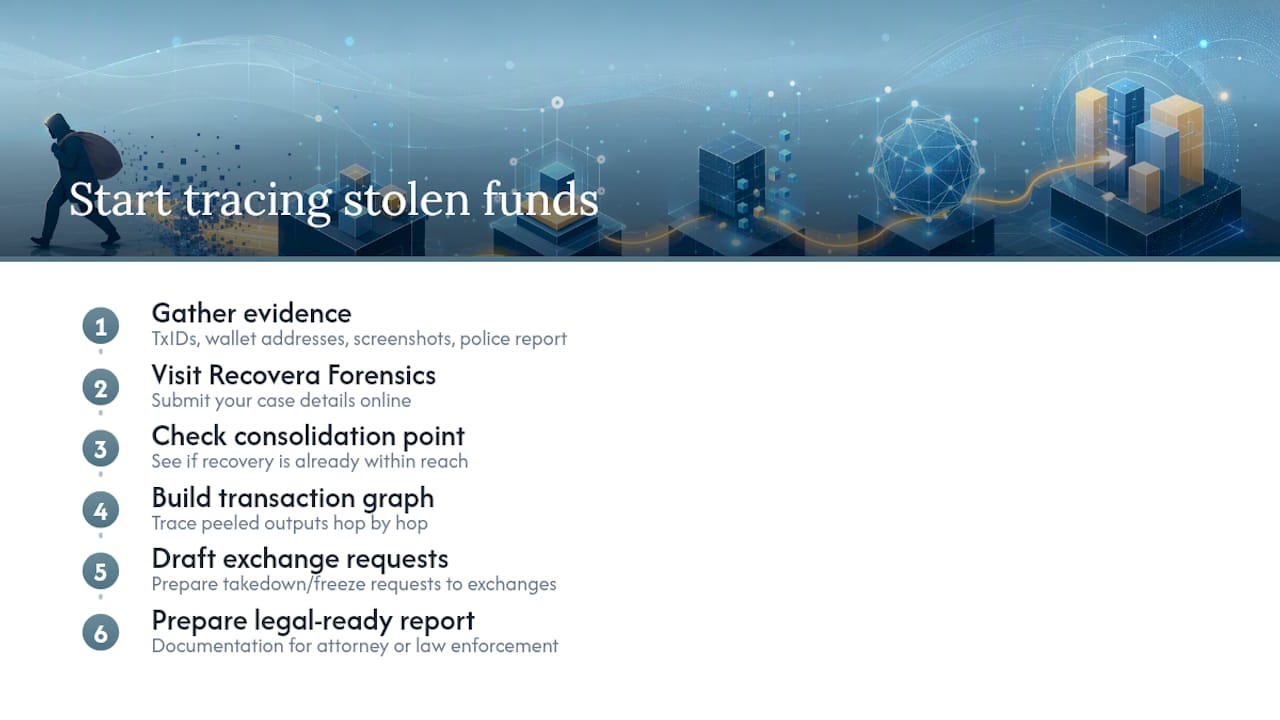
Recovera Forensics maps its investigation process directly onto the peel chain mechanics covered above: tracing peeled outputs hop by hop to the consolidation point where recovery actually becomes possible, then documenting every step so the findings hold up with an exchange or in court. Before reaching out, gather what you have: TxIDs, the wallet addresses involved, screenshots of the theft, and a copy of any police report you’ve filed. That paperwork shortens the intake process considerably. Recovera’s team then builds the transaction graph, drafts exchange requests, and prepares the legal-ready report your attorney or a law enforcement contact will need. Start by visiting Recovera Forensics to walk through your case details and see whether a consolidation point is already within reach.
Sources
The findNext and findPrev heuristics and their validation come from How to Peel a Million, presented at USENIX Security. Chain-parameter fingerprinting research appears in Forensic Science International’s analysis of Bitcoin peeling patterns. Practitioner case patterns are covered in SlowMist’s peel chain explainer, and multi-stage laundering routes are outlined in this analysis of privacy tools and bridges.
This article is general information, not a substitute for advice from a qualified financial advisor. Consult a qualified financial professional about your own circumstances before acting on anything here.
- How to Peel a Million: Validating and Expanding Bitcoin Clusters
- Analyzing the peeling chain patterns on the Bitcoin blockchain
- MITRE ADAPT technique: tracking consolidation endpoints
FAQ
What Is the Difference Between a Peel Chain and a Mixer?
A peel chain keeps funds traceable through a linked sequence of change outputs on a single chain, while a mixer (like CoinJoin) breaks that one-to-one linkage by combining multiple users’ funds into a single transaction with many indistinguishable outputs.
Can Peel Chains Be Traced Across Different Cryptocurrencies?
Not directly. Once funds cross into a different chain through a bridge or token swap, investigators need a separate cross-chain tracing effort rather than an extension of the original peel chain graph.
How Accurate Are Algorithmic Peel Chain Detection Tools?
The findNext heuristic, when limited to forward-only expansion, showed a false discovery rate near 0.62% in academic validation, though broader clustering approaches trade some of that accuracy for wider coverage.
What Should I Do First if I Think My Stolen Crypto Went Through a Peel Chain?
Preserve every TxID, wallet address, and timestamp you have, file a police report, and contact a forensic investigation service like Recovera Forensics before the funds move further or reach a mixer.
Does a Peel Chain Always Lead to an Exchange?
Not always. Many peel chains terminate at exchange deposit addresses, but others end at darknet markets, gambling platforms, or privacy wallets, which is why identifying the actual endpoint matters more than assuming one.