Lightning payments do not leave a public trail the way on-chain Bitcoin transactions do, so tracing depends on correlation, not direct observation. Investigators anchor a case to on-chain channel funding and closing transactions, then reconstruct network topology from gossip snapshots to build circumstantial but often defensible leads. Tracing can link a suspect wallet to a channel and identify likely routing hubs; it cannot reveal the exact path, amount, or destination of a specific payment.
TL;DR:
- Investigators rely on on-chain funding and closing transactions, combined with archived gossip snapshots, to narrow down the likely nodes involved in Lightning payments.
- Public data sources reveal node identities and channel capacities but do not disclose private balances or specific payment paths, limiting traceability.
- Effective tracing emphasizes starting from anchor transactions, building a timeline, and using graph metrics to identify high-centrality nodes for focused investigation.
- Onion routing, private channels, and multi-path payments create significant hurdles, resulting in leads rather than definitive proof, especially without exchange cooperation.
- Legal attribution requires documentation, corroboration, and often outside inquiries, making full case building contingent on timely monitoring and verified on-chain evidence.
Table of Contents
- How Lightning’s Data Model Differs From On-Chain Bitcoin
- Where Analysts Find Public Lightning Data
- What Methods Actually Trace Value Into Lightning?
- Where Tracing Hits a Wall
- How a Forensic Team Approaches a Lightning Case
- What Real Lightning Tracing Investigations Look Like
- Legal and Ethical Ground Rules for Lightning Investigations
- An Investigator’s Priority List for Lightning Cases
- When DIY Tracing Stalls, Recoveraforensics Picks Up Where It Ends
- Sources
- FAQ
How Lightning’s Data Model Differs From On-Chain Bitcoin
On-chain Bitcoin analysis works because every transaction is permanently visible. Lightning inverts that. The only parts of a Lightning payment that touch the blockchain are the channel’s opening and closing transactions, which act as fixed anchors before and after an unknown volume of off-chain activity.
Between those two anchors, nodes exchange gossip protocol messages that build the network’s public map: node_announcements (identity and IP hints), channel_announcements (which two nodes connected), and channel_updates (fee policy and routing terms). Capacity gets announced too, but capacity is not the same as spendable liquidity on either side of a channel.
Privacy features close the rest of the gap. Payments travel through encrypted onion routing, so no intermediary node sees the full path, and private channels never appear in gossip data at all. Only the two participants in a channel know its real balance and payment history. Because Lightning is largely opaque to standard blockchain forensics tools, any credible trace has to start from what is verifiable off the network.
That means intake work matters more here than in a typical on-chain case. At minimum, an analyst should record:
- The exact funding transaction ID that opened the suspect channel
- Any suspected withdrawal or settlement transaction IDs tied to the case
- A precise timeline of when funds moved, matched against known exchange withdrawal windows
Where Analysts Find Public Lightning Data
No single source gives a complete view of the network, so investigators typically stack three kinds of data.
- Live explorers and APIs. These surface current node lists, channel lists, announced capacity, and fee policies in near real time, which is useful for confirming a node is still active or checking its current routing terms.
- Gossip crawlers and archived snapshots. Dedicated crawling nodes capture raw gossip messages over time and replay them to reconstruct the network as it existed at a past timestamp, an approach researchers call TimeMachine-style reconstruction. This retrospective view matters because a channel that closed six months ago will not show up in a live query.
- Downloadable research datasets. Academic groups publish periodic snapshots used for centrality and topology studies, which analysts can mine without running their own crawler infrastructure.
Building a snapshot from scratch is genuinely heavy engineering work. It requires running nodes like C-Lightning that log node_announcements, channel_announcements, and channel_updates into a gossip_store, then deduplicating millions of messages before anything usable comes out. That is why most investigators query an existing explorer for quick lookups and reserve raw gossip log requests for cases where the timing of a channel’s creation or closure is the whole point.
Whatever the source, explorers and crawls expose node and channel metadata but cannot reveal private balances or per-payment routes. Announced capacity also overstates what is actually usable, and Tor-only or unannounced nodes create permanent blind spots no crawler fixes.
What Methods Actually Trace Value Into Lightning?
Tracing Lightning activity is less about following a payment and more about narrowing down where it probably went. The method works backward from hard on-chain facts toward a bounded set of likely nodes.
- Start from the anchor. Pull the channel funding and closing transaction IDs and use them to identify the pubkeys and channel IDs tied to that specific on-chain activity.
- Rebuild the timeline. Layer archived gossip snapshots against the case timeline to see exactly when a channel opened or closed relative to a suspected withdrawal, since historic snapshots often reveal alignment a live query misses.
- Run a watchlist. Flag known exchange withdrawal transaction IDs and automate detection whenever a new channel funding transaction spends from one of them, a technique already used by outflow-monitoring intelligence platforms.
- Prioritize with graph metrics. Betweenness centrality, node degree, and Gini coefficient calculations identify the small set of hub nodes that carry disproportionate routing traffic, letting an analyst focus effort instead of chasing every node equally.
- Corroborate before naming names. Cross-reference node aliases, hosting IPs, and known exchange deposit patterns with outside OSINT before treating a topology match as an identification.
Pro Tip: Treat every centrality-based lead as a starting point, not a conclusion. A high-betweenness node is a good place to focus resources, but it only becomes evidence once it lines up with an independent, on-chain or OSINT-based fact.
Graph-based prioritization works because the network itself is lopsided. Research on Lightning’s topology and network dynamics consistently finds a small number of high-centrality nodes handling a disproportionate share of routing volume, which is exactly why hub-first prioritization beats trying to trace every hop of every payment.
Where Tracing Hits a Wall
Every method above produces leads, not proof, and it helps to be honest about why. Onion routing hides individual payment paths from everyone but the sender and receiver, private channels never surface in public gossip data, and multi-path payments split a single transfer across several routes with success determined probabilistically rather than through any visible balance check.
Data gaps compound the problem. Snapshots are only as good as the crawler that built them, Tor-only nodes stay largely invisible, and unannounced channels simply never enter the public gossip stream at all.
There’s also a hard legal ceiling on what tracing alone can prove. Linking a channel to a real-world identity almost always requires cooperation from an exchange or custodian, or a formal legal process such as a subpoena, since no public dataset ties a pubkey to a name.
Given all that, disciplined case work means:
- Label every finding by confidence level (confirmed, probable, speculative) rather than treating a topology match as settled fact
- Collect corroborating material, such as KYC records or exchange transaction logs, before escalating a claim
- Document how each anchor transaction was identified, so the reasoning holds up outside the investigation
How a Forensic Team Approaches a Lightning Case
A structured investigation moves through five stages: intake of the on-chain facts, identification of funding and closing anchors, topology reconstruction across the relevant time window, watchlist monitoring for related outflows, and correlation against OSINT before any attribution claim gets made.
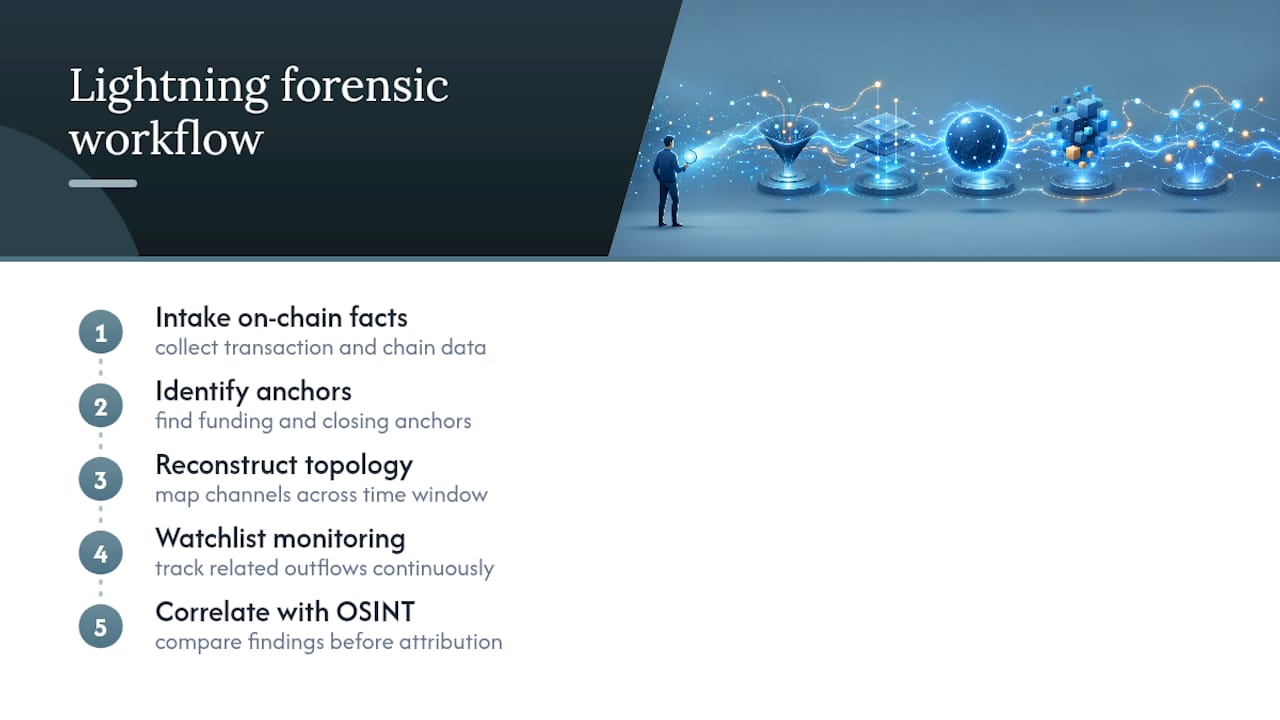
Recoveraforensics builds its Lightning-related casework around this same anchor-first logic, drawing on transaction graph analysis and broader flow-of-funds methodology rather than simple wallet lookups. A completed engagement typically produces a trace narrative, a confidence grading for each finding, and chain-of-custody documentation formatted for legal proceedings.
DIY monitoring works fine for tracking a known channel or watching a public node’s activity. Once a case needs exchange escalation, subpoena-ready documentation, or attribution strong enough to survive legal scrutiny, that’s where a dedicated forensic team earns its place.
What Real Lightning Tracing Investigations Look Like
Most documented Lightning tracing successes follow the same shape: stolen or misappropriated funds move through an exchange withdrawal, land in a wallet that opens a Lightning channel almost immediately, and investigators catch the connection because they were already watching that withdrawal transaction ID.
The pattern matters because it shows where tracing actually earns its results. It is rarely a single clever query. It is a withdrawal watchlist catching a channel-funding transaction within hours, followed by a topology snapshot confirming that the new channel connects to a node with routing history matching other flagged activity. Academic centrality research treating hub identification as a prioritization tool rather than a smoking gun reflects the same discipline: analysts narrow a large network down to a handful of plausible nodes, then spend their limited investigative time confirming or ruling those out with corroborating evidence.
Cases that stall usually share a common failure point: the investigator only started watching after funds had already moved, so no funding transaction ever got flagged against the withdrawal. That’s the practical argument for setting up monitoring before a suspected loss, not after. Once a channel closes and settles back on-chain, the historical gossip data may still exist in an archived snapshot, but reconstructing the exact timing after the fact is slower and less reliable than catching it live.
Legal and Ethical Ground Rules for Lightning Investigations
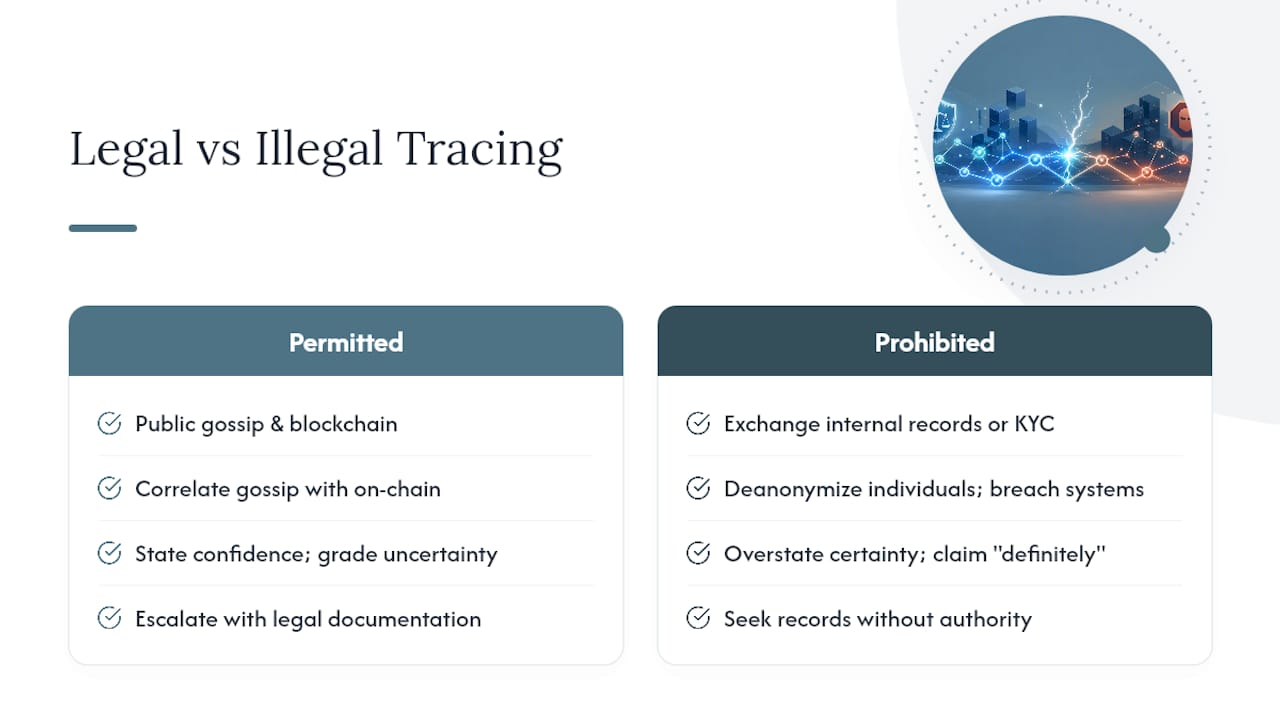
Tracing a public node’s gossip data and correlating it with on-chain transactions is legal. Attempting to deanonymize a specific individual behind that node, or accessing systems and data you have no right to, moves into legally and ethically fraught territory fast.
The core ethical line is straightforward: everything described in this article relies on publicly broadcast gossip messages and public blockchain data. Node aliases, IP hints, and channel announcements are voluntarily published by node operators as part of how the network functions. Using that data to build a case is fundamentally different from attempting to breach an exchange’s internal records or a custodian’s KYC database without legal authority.
Attribution claims carry real weight once a case moves toward legal action, which is exactly why confidence grading matters so much. A report that overstates certainty, claiming a specific individual “definitely” controls a node based on topology alone, creates liability and undermines the case’s credibility with a court or a custodian being asked to cooperate. Legitimate escalation, whether that means requesting records from an exchange through the crypto travel rule framework or pursuing a subpoena, requires documentation that a judge or compliance officer can actually verify. Ethical tracing means being explicit about what the data shows versus what it merely suggests, and being willing to say a lead didn’t pan out rather than force a conclusion the evidence doesn’t support.
An Investigator’s Priority List for Lightning Cases
Anchors come first. Before touching a single gossip snapshot, nail down the funding and closing transaction IDs and build a timeline around them. Everything downstream depends on getting that foundation right.
Automated watchlists and archived gossip snapshots multiply what a single analyst can cover. A withdrawal watchlist that flags a channel-funding transaction within the hour beats any amount of manual node hunting after the fact.
Centrality metrics exist to save time, not to replace judgment. Betweenness and degree calculations tell you which handful of nodes deserve scrutiny first; they don’t tell you who controls them. Treat every centrality-based lead as a starting point that still needs corroboration.
Chain-of-custody discipline should start on day one, not after a case looks promising. Document how each piece of evidence was found and preserved, because a compelling trace narrative is worthless in front of a court or a custodian if the underlying evidence handling can’t be verified later.
— cristian
When DIY Tracing Stalls, Recoveraforensics Picks Up Where It Ends
Watchlists and gossip snapshots get an individual investigator surprisingly far, but building a legally defensible attribution case, one that holds up with an exchange, a custodian, or a court, usually needs resources most victims don’t have on hand. Lightning-related cases typically run through an anchor-first forensic process including on-chain funding and closing transaction analysis, topology reconstruction, watchlist monitoring, and OSINT correlation, with documentation prepared to a standard suitable for legal proceedings.
A typical engagement produces a trace narrative, confidence grading on each finding, exportable forensic artifacts, and a clear recommendation on next steps, whether that’s exchange escalation, chain-of-custody preparation, or coordination with counsel. If you’ve lost funds that moved through a Lightning channel and hit a wall trying to trace them yourself, request an initial case assessment and share your transaction details so the team can tell you honestly whether a full investigation is worth pursuing.
Sources
Cross-check findings across multiple sources before treating any Lightning trace as conclusive.
- The Lightning Network — How private? (Megalithic docs)
- Privacy and topology characteristics of the Lightning Network (PMC article)
- A centrality analysis of the Lightning Network (2023)
- Botlab
This article is general information, not a substitute for advice from a qualified financial advisor. Consult a qualified financial professional about your own circumstances before acting on anything here.
FAQ
Is the Lightning Network Legitimate?
Yes. Lightning is a legitimate, widely used payment layer built on top of Bitcoin to enable faster, cheaper transactions, and its privacy features exist for normal payment confidentiality, not exclusively for illicit use.
Can Law Enforcement Track a Bitcoin Wallet That Uses Lightning?
Investigators can trace on-chain funding and closing transactions tied to a wallet’s channels, and correlate that with gossip data and exchange records, but agencies typically need provider cooperation or legal process to link a channel to a real identity.
Which Bitcoin Wallets Support the Lightning Network?
Several widely used wallets support Lightning payments, including mobile and desktop apps built around Lightning-compatible nodes; specifics vary by app and change over time, so check a wallet’s current documentation before relying on it for a case.
What Is the Lightning Network?
Lightning is a payment layer built on top of Bitcoin that lets users transact off-chain through payment channels, settling only the opening and closing of those channels on the Bitcoin blockchain itself.
Why Can’t Investigators See a Specific Lightning Payment’s Route?
Payments route through encrypted onion layers that hide the full path from every node except the sender and receiver, and private channels never appear in the public gossip data investigators rely on for mapping the network.