A § 1782 subpoena is a U.S. federal court order that lets someone involved in a proceeding abroad compel a person or company in the United States to hand over testimony or documents. In crypto cases, that usually means a U.S. exchange or custodian and the account records it holds. It does not freeze funds and it does not return them. It gets you evidence. What you do with that evidence is a separate legal step.
This guide covers who can use the statute, what a court looks at, what exchange records you can realistically expect, and how blockchain tracing makes the application stronger.
TL;DR
- Section 1782 is for use in a foreign or international proceeding, including a criminal investigation before formal accusation. It is not a tool for an ordinary U.S. lawsuit.
- Applicants must show the target resides or is found in the district, the discovery is for a foreign proceeding, and the applicant is an interested person. Courts then weigh discretionary factors.
- Exchanges can be compelled to produce identity and transaction records. Passwords, private keys and privileged material are off the table.
- The order gives you information. Freezing or recovering assets takes separate relief, such as an injunction.
- A tracing report that links stolen funds to a specific U.S. platform makes the request narrower, more credible and easier to grant.
Table of Contents
- What a § 1782 subpoena is
- Who can apply, and what counts as a foreign proceeding
- What the court checks before granting the order
- What you can ask an exchange for, and what you won’t get
- How the process works
- Why a subpoena is not a freeze
- Where tracing fits
- Perspective: what we see in practice
- Work with Recovera on the evidence side
- FAQ
- Sources
What a § 1782 subpoena is
The statute, 28 U.S.C. § 1782, says a U.S. district court where a person resides or is found may order that person to give testimony or produce documents or other things for use in a foreign or international proceeding. The text expressly includes criminal investigations conducted before formal accusation.
Two features matter for crypto victims.
- The proceeding must be foreign. If your case is a lawsuit in a U.S. court, you use ordinary discovery rules instead. Section 1782 is for people whose case sits in another country, or is reasonably contemplated there.
- The court orders the person in its district. Most large exchanges and custodians have U.S. operations, which is why the statute became attractive for tracing assets that move across borders. One practitioner describes it as a powerful but underused tool for foreign victims trying to follow assets between exchanges and wallets.
If you are a U.S.-based victim with a U.S. case, this statute is probably not your route. You would look instead at a civil complaint, a subpoena issued within that case, or a law enforcement report. Our guide on what to report to trigger a police crypto investigation covers that path.
Who can apply, and what counts as a foreign proceeding
Applications can come from a foreign or international tribunal or from any interested person. In practice, most come from litigants, claimants or their counsel.
The Supreme Court narrowed the field in 2022. In ZF Automotive v. Luxshare, it held that a foreign tribunal must be a governmental or intergovernmental body, which excludes private commercial arbitration panels. If your dispute is headed to a private arbitration, § 1782 is generally unavailable. We explain how that choice affects evidence strategy in arbitration versus litigation for crypto cases.
A proceeding does not have to be underway. It can be contemplated, but it should be real. The Ninth Circuit has said that § 1782 is meant to assist active or contemplated litigation, and not to reopen concluded foreign proceedings.
What the court checks before granting the order
There are two layers: the statutory requirements and the discretionary factors.
The statutory requirements
As described in In re Abraaj Investment Management, you must show:
- the person you are targeting resides or is found in the district;
- the discovery is for use in a foreign proceeding;
- you are an interested person.
The phrase “found in” reaches as far as personal jurisdiction allows under constitutional due process. For an exchange, that often means a court in the district where it has an office, or where it directs substantial activity.
The discretionary factors
Even if the requirements are met, the court may still say no. It weighs whether the target is a participant in the foreign case, how receptive the foreign court is, whether the request tries to dodge foreign proof-gathering rules, and whether it is unduly burdensome. In the Second Circuit, discretion is guided by the statute’s twin aims: efficient assistance to international litigants and encouraging other countries to reciprocate.
A useful way to read this: judges reward focused requests. A sweeping demand for every customer record is disfavored. A request tied to specific addresses, specific transactions and a specific claim is much easier to approve.
What you can ask an exchange for, and what you won’t get
Public filings in U.S. tax summons cases against exchanges show the type of records platforms can produce, even though those cases were not § 1782 matters. An exhibit in the Coinbase and Kraken summons litigation shows the following.
| Category | Typically obtainable | Typically excluded or limited |
|---|---|---|
| Identity | Basic identity and profile information, IP data, funding sources | Copies of ID documents (excluded in the Coinbase order) |
| Activity | Trading, transfer and account-activity records, transaction statements | Passwords, PINs, private keys, security settings, recovery information (excluded from Kraken’s summons) |
| Compliance | KYC and AML records, in the Kraken request | Broad KYC diligence files (excluded in the Coinbase order) |
| Blockchain data | Hash and address information where the platform keeps it | All wallet addresses and public keys (excluded in Coinbase’s order) |
A separate filing in that litigation notes that basic user and ledger data could be retrieved globally, while historical, IP, payment-method, KYC and AML records might need account-by-account searches. Transaction hashes and blockchain addresses were not then available in that exchange’s ledgers. The lesson for an applicant: the more precisely you identify the account, the more likely the platform can answer.
The statute also bars compelled production that would violate a legally applicable privilege, as noted in analysis of § 1782 in international crypto cases. Foreign litigants can seek KYC information through the statute to trace assets and identify potentially liable parties.
If you want to understand what these records tell you once you have them, see our walkthrough on exchange-to-exchange tracing. To check the identity and reputation of a platform before you build an application around it, verifying crypto transactions and communications is a helpful first screen. Exchange KYC records are what ultimately tie an address to a person.
A recent example
In December 2025, the Southern District of New York granted CTS Research leave to serve a first subpoena on Coinbase under § 1782 while denying leave to serve the second. That split outcome is typical: courts will trim a request rather than reject it whole.
How the process works
- Define the foreign proceeding. Identify the court, agency or investigation abroad and your role in it.
- Trace the funds first. Map the path from the victim’s wallet to the platform that holds the destination account. Without this, you cannot name a target or narrow the request.
- File the application. Courts may grant § 1782 applications ex parte, meaning the other side is not heard first.
- Serve the subpoena. If the court authorizes it, you serve the subpoenas on the target.
- Expect objections. Recipients can move to quash under Rule 45, and the court can modify or cut back what you asked for.
- Use what you receive. Records go to your foreign counsel, who decides on claims or filings abroad.
Budget for U.S. counsel. This is motion practice in federal court, and a lawyer admitted there needs to file it. We do not file applications. We build the technical groundwork a lawyer needs.
Why a subpoena is not a freeze
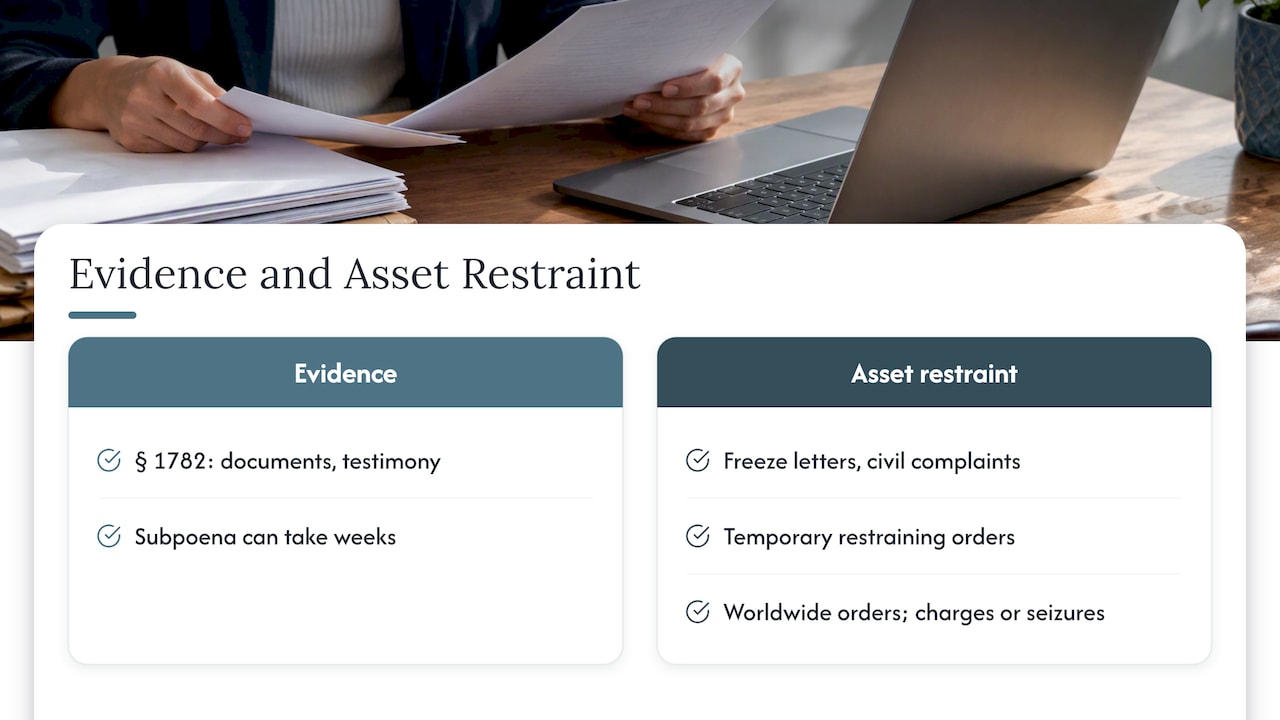
This is the most common misunderstanding. A § 1782 order produces documents and testimony. It does not stop a transfer. Once a litigant has traced stolen assets through that discovery, it could then seek injunctive relief to freeze or secure them.
Civil asset recovery generally draws on several tools together: § 1782 discovery, freeze letters, civil complaints, temporary restraining orders and, in some countries, worldwide freezing and Norwich Pharmacal orders. Victims can also seek government charges or seizures.
Speed matters because crypto moves quickly. The Justice Department’s National Cryptocurrency Enforcement Team has said investigations need two distinct capabilities, rapidly obtaining electronic evidence and rapidly restraining or seizing assets, because transfers can be nearly instant and often irreversible. A subpoena can take weeks. Preserve evidence and trace now, and do not wait for the order. See digital evidence preservation and tracing the flow of funds.
Where tracing fits
A § 1782 application rises or falls on specifics. A judge wants to know why this exchange, why these accounts and why this evidence will matter in the foreign case. A forensic report can answer those questions with transaction hashes, timestamps, address clusters and a clear narrative of where the money went.
Strong reports include:
- the victim’s originating wallet and every transfer out;
- the point at which funds touched a U.S. platform deposit address;
- how mixers, bridges or chain hops were handled, and where the analysis is inference rather than proof;
- a documented chain of custody for the data.
Two related pages go deeper: chain of custody for crypto evidence and forensic affidavits, which are often filed to support applications like this.
Perspective: what we see in practice
Most people who come to us after a scam are not stuck on legal theory. They are stuck on a simple question: who holds the account my money landed in? A subpoena answers that, but only if you aim it correctly.
We see two common mistakes. The first is filing broad requests built on a wallet address nobody has verified. The second is treating the order as the finish line, while funds keep moving. Our approach is to trace first, document everything in a form a court can use, and hand counsel a report that names the platform, the deposit addresses and the transaction path. That also helps with the exclusions above: if you know the exact address, you do not need the exchange to hand over its whole wallet list.
We work with law firms and with individual victims, and we are clear on what we do. We are forensic investigators, not a court and not a law firm. We cannot promise a recovery. We can promise a transparent process and a report built to be read by a judge.
— cristian
Work with Recovera on the evidence side
If you or your counsel are weighing a § 1782 application, the strongest first step is a tracing report. Our cryptocurrency scam investigation and evidence preservation services cover tracing, wallet analysis, OSINT attribution and technical documentation. Law firms can look at our professional office services. Our guide to what to do in the first 48 hours after an exchange subpoena is useful if you are on the receiving side, and admitting blockchain evidence in U.S. court covers how the findings are used afterward.
FAQ
Can a U.S. victim use a 1782 subpoena?
Generally not for a case in a U.S. court. The statute exists for use in foreign or international proceedings. A U.S. victim with a U.S. case would use standard civil discovery, a complaint, or a law enforcement report, and should speak with a U.S. attorney about which fits.
Can I use § 1782 in a private arbitration?
Usually not. After ZF Automotive, the foreign tribunal must be governmental or intergovernmental, so private commercial arbitration panels do not qualify.
Will the exchange give me a person’s name?
Possibly. Exchanges can be compelled to produce identity, KYC and transaction records, subject to what the court allows and any privilege. Private keys, passwords and recovery data are not obtainable.
Does the subpoena freeze the stolen crypto?
No. It produces evidence. Freezing requires a separate request, such as an injunction or restraining order, or action by law enforcement.
Sources
- 28 U.S.C. § 1782
- ZF Automotive US, Inc. v. Luxshare, Ltd., Supreme Court opinion
- Khrapunov v. Prosyankin, Ninth Circuit
- In re Abraaj Investment Management Limited, S.D.N.Y.
- Coinbase and Kraken summons exhibit
- Kraken IRS summons record
- CTS Research v. Coinbase docket
- 28 U.S.C. 1782 for International Crypto Cases
- Innovating traditional asset recovery tools to recover crypto
- DOJ National Cryptocurrency Enforcement Team report
- How to Verify Crypto: Transactions and Communications