Digital evidence preservation is the disciplined process of identifying, collecting, and securing digital data in a way that keeps it unaltered, documented, and reproducible for use in investigations or U.S. court proceedings. Get it right from the first moment of contact, and the evidence can withstand cross-examination. Get it wrong, and a judge may exclude it entirely.
Do this immediately:
- Isolate the device or account from any network that could trigger remote wipe or overwrite
- Capture volatile data first: RAM contents, active network connections, and running processes before powering down
- Compute and record cryptographic hashes (SHA-256 preferred) of every evidence file the moment it is acquired
- Open a chain-of-custody log and record the collector’s name, date, time, tool, and version before touching anything else
- Photograph or screenshot the device state, screen, and physical surroundings as contemporaneous documentation
Do not do this:
- Power-cycle a device unnecessarily; a reboot can overwrite swap files, logs, and volatile memory
- Run non-forensic tools (antivirus scans, system cleaners, backup apps) on an evidence device
- Allow uncontrolled network access to a live evidence machine or cloud account
- Open files on the original media without a write-blocker in place
Standards from NIST IR 8387, SWGDE, the National Institute of Justice (NIJ), and INTERPOL’s first-responder guidelines all converge on the same point: admissibility in U.S. proceedings depends on authentication, integrity, and a documented chain of custody. Recoveraforensics applies these exact principles to blockchain and digital fraud cases where the stakes are high and the evidence is unusually fragile.
Key Takeaways
Proper digital evidence preservation requires hashing at acquisition, a documented chain of custody from first contact through disposition, and validated tools at every stage.
| Point | Details |
|---|---|
| Hash immediately | Compute SHA-256 at acquisition and verify before every transfer; store hashes separately from image files. |
| Chain of custody is non-negotiable | Document every access, transfer, and action with name, date, time, and purpose from first contact through disposition. |
| Volatile data is time-critical | Capture RAM and active network state before any shutdown; lost volatile data cannot be recovered. |
| Validated tools protect admissibility | Use NIST CFTT-tested tools and document tool name, version, and validation status in every acquisition report. |
| Recoveraforensics for complex cases | Engage Recoveraforensics when cases involve blockchain tracing, encryption, large asset values, or litigation requiring expert testimony. |
Table of Contents
- What counts as digital evidence?
- Why preservation integrity determines what courts will accept
- Core principles every investigator must follow
- Step-by-step stages from identification through disposition
- Technical methods and validated tools you should use
- Preserving evidence from mobile devices, cloud, IoT, networks, and blockchain
- U.S. legal considerations for admissibility
- How to organize case folders, reports, and lab intake procedures
- Common preservation challenges and how to handle them
- When to engage a forensic specialist: cryptocurrency and blockchain evidence
- Quick preservation checklist for first responders
- What documentation actually decides in court
- Recoveraforensics: forensic preservation and blockchain tracing for legal proceedings
- Sources
- FAQ
What counts as digital evidence?
Digital evidence is any data stored or transmitted in binary form that an investigator or court can use to establish facts. That definition is broader than most people expect.
Common evidence types include:
- Disk images: Sector-by-sector copies of hard drives, SSDs, or USB media
- Mobile device images: Full file-system or physical extractions from smartphones and tablets
- RAM dumps: Snapshots of volatile memory capturing running processes, encryption keys, and network state
- System and application logs: Windows Event Logs, syslog, authentication records, and audit trails
- Email headers and raw SMTP logs: Two separate evidence objects; the header is a derived artifact, the raw log is the source
- Browser history and cached data: Visited URLs, cookies, session tokens, and cached page content
- Cloud-native exports: API responses, JSON exports, and provider-generated access logs from services like Google Workspace or Microsoft 365
- Network captures: PCAP files from packet capture tools like Wireshark or tcpdump
- CCTV and multimedia files: Video recordings, audio files, and images with embedded EXIF metadata
- Blockchain transaction records: Transaction IDs (TXIDs), block height data, wallet addresses, and raw node or API JSON exports
Derived artifacts deserve special attention. A CSV export of blockchain transactions, a screenshot of a wallet balance, and an analyst’s annotated chart are each a separate evidence object with its own provenance requirements. The screenshot is not a substitute for the raw API response; the analyst’s chart is not a substitute for the underlying CSV. Each artifact needs its own hash, its own chain-of-custody entry, and its own documentation of how it was produced.
Why preservation integrity determines what courts will accept
Integrity and reproducibility are prerequisites for admissibility, not optional extras. A piece of digital evidence that cannot be shown to be unaltered from the moment of collection is vulnerable to exclusion, and the consequences run from weakened expert testimony to full dismissal of the evidence.
Spoliation is the legal term for the destruction, alteration, or failure to preserve evidence. Courts have sanctioned parties for as little as allowing routine log rotation to overwrite relevant records after litigation was reasonably foreseeable. A failed hash comparison, where the hash of a file at trial does not match the hash recorded at acquisition, is a concrete spoliation signal that opposing counsel will exploit. Even an innocent explanation (a file was opened on original media by mistake) can be enough to undermine the examiner’s credibility.
The practical consequence: every action taken on or near evidence must be documented before it happens, not reconstructed afterward. A log entry written three days after the fact is far weaker than one written at the moment of collection.
Pro Tip: Contemporaneous documentation and sealed storage are the two highest-impact defenses against admissibility challenges. Log the tool name, exact version, system clock and timezone, and the collector’s identity at the moment of acquisition. Store hash values in a separate file or log, not embedded in the image itself, so they can be verified independently.
Courts also expect reproducibility. If a second examiner, using the same validated tool on the same forensic image, cannot reproduce the same findings, the original analysis is suspect. That standard applies to blockchain analysis as much as to disk forensics.
Core principles every investigator must follow
These seven principles apply to every evidence type, from a seized laptop to a blockchain export.
-
Minimal handling. Work from forensic copies, never from originals. Every unnecessary interaction with original media is a risk.
-
Documented chain of custody. Every transfer, access, or action involving evidence must be recorded with who, what, when, where, and why. The NIJ manual treats this as the backbone of lab policy.
-
Reproducibility through native formats. Preserve data in its raw or native format (E01, AFF4, raw/dd) before converting or exporting. Converted formats without the original are harder to authenticate.
-
Validated tools only. Use tools that have been validated for forensic tasks, such as those tested by NIST’s Computer Forensics Tool Testing (CFTT) program. Document the tool name, version, and validation status in every acquisition report.
-
Role separation. The person who seals and stores evidence (custodian) should not be the same person who analyzes it (examiner). Separation reduces contamination risk and strengthens testimony.
-
Secure storage. Store originals in a locked, access-controlled environment. Log every entry. ISO/IEC 27037 and SWGDE both specify that storage conditions must prevent unauthorized access and environmental damage.
Step-by-step stages from identification through disposition
Stage 1: Identification and scoping
List every potential evidence source before touching anything. Devices, cloud accounts, email providers, network logs, and third-party platforms are all in scope. Document the scope in writing.
Stage 2: Containment
Isolate evidence sources from networks that could trigger remote wipe, cloud sync, or automated deletion. For live systems, this may mean disabling Wi-Fi and Bluetooth physically rather than through software, which itself writes to disk.
Stage 3: Volatile data capture
Capture RAM, active network connections, running processes, and logged-in user sessions before any shutdown. INTERPOL’s guidelines stress that volatile evidence disappears at power-off and must be prioritized at a live scene. Tools like Magnet RAM Capture or WinPMem are purpose-built for this step.
Stage 4: Forensic imaging
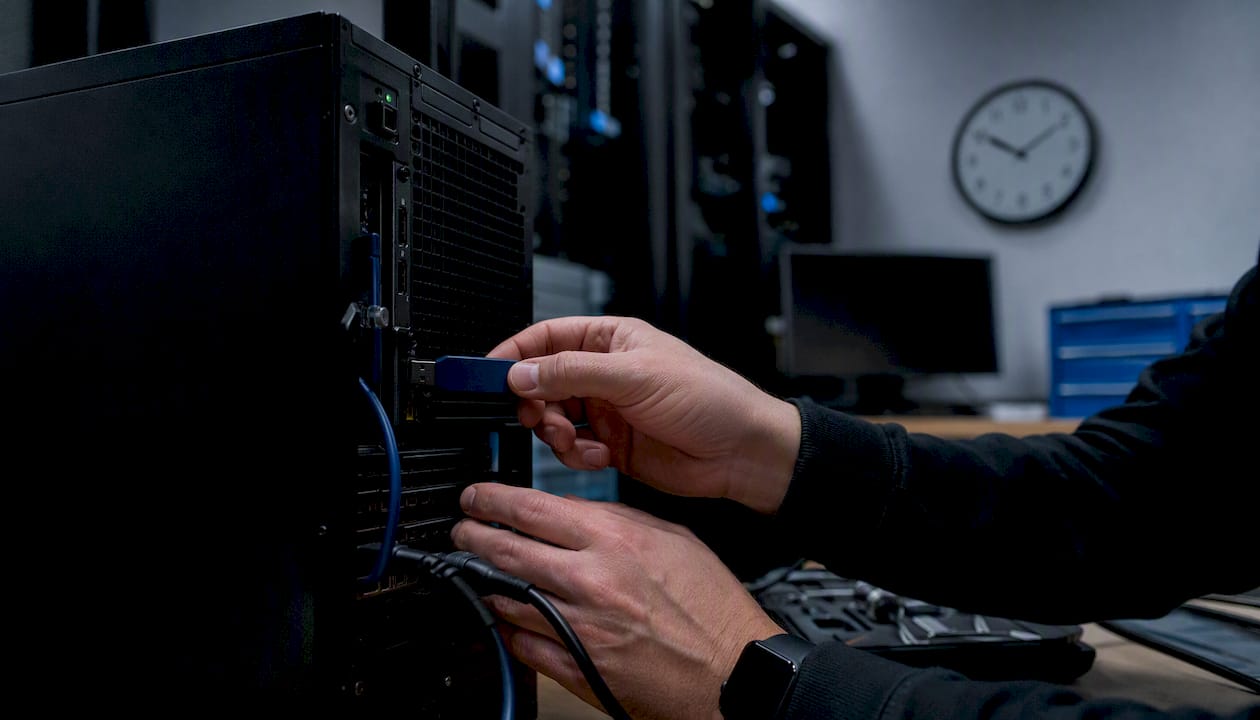
Create a bit-for-bit forensic image of storage media using a hardware or software write-blocker. Common formats: E01 (EnCase), AFF4, or raw/dd. Never image to the same drive being imaged.
Stage 5: Verification
Immediately compute MD5 and SHA-256 hashes of the acquired image and compare them to hashes of the source. Record both values. A match confirms the image is an exact copy.
Stage 6: Secure storage
Seal the original media in an anti-static evidence bag, apply a tamper-evident seal, and log the seal ID. Store in a locked, climate-controlled evidence room with a restricted access log.
Stage 7: Analysis
Work exclusively on verified forensic copies. Log every tool, command, and finding. Never modify a working copy without documenting the reason.
Stage 8: Disposition
Release or archive evidence only with documented authorization (director or case supervisor approval per the NIJ manual). Retain case files per applicable legal hold or retention policy.
Sample chain-of-custody entry fields:
- Case ID / Item ID
- Item description (make, model, serial number, or file name and hash)
- Collector name and role
- Date and time (UTC preferred)
- Action taken (acquired, sealed, transferred, analyzed)
- Hash values (MD5 and SHA-256)
- Storage location and seal ID
- Receiving party signature
Triage criteria for on-scene imaging vs. lab transport:
- Image on-scene when the device cannot be safely transported (server rack, embedded system)
- Transport to lab when the scene is not secure or imaging equipment is unavailable
- Call a specialist when the case involves encryption, cloud-only data, or blockchain tracing
Technical methods and validated tools you should use
Validated imaging, write protection, and immediate hashing are the non-negotiable technical controls of any preservation workflow. Everything else builds on those three.
| Category | Primary Use | Validation / Notes |
|---|---|---|
| Hardware write-blockers | Prevent writes to original media during acquisition | Tableau, WiebeTech; NIST CFTT tested |
| Software write-blockers | Block writes at the OS level when hardware blocker unavailable | Validate against CFTT; document OS version and blocker version |
| Forensic imaging (E01) | Compressed, segmented image with built-in hash and metadata | EnCase format; widely accepted in U.S. courts |
| Forensic imaging (AFF4) | Open-source, extensible; supports logical and physical images | Preferred for large or cloud-linked acquisitions |
| Raw/dd image | Uncompressed bit-for-bit copy | Portable; no proprietary dependency; larger file size |
| MD5 hashing | Legacy verification; fast but cryptographically weak | Use alongside SHA-256; do not use alone for new cases |
| SHA-256 / SHA-512 | Current standard for evidence verification | Recommended by NIST IR 8387 |
| RAM capture tools | Volatile memory acquisition | Magnet RAM Capture, WinPMem; document OS state at time of capture |
| Mobile forensics platforms | Physical/logical extraction from smartphones | Cellebrite UFED, MSAB XRY; document extraction type and version |
The CSRC/NIST glossary defines a write-blocker as a device or software that allows read commands to pass to storage media while blocking write commands, making it the primary control for preserving original media integrity during acquisition.
Pro Tip: Record the tool name, vendor, exact version number, the command or GUI steps used, the system clock and timezone at the time of acquisition, and the machine used to compute hashes. Store hash values in a separate log file, not only inside the image container, so they can be verified without opening the image.
NIST’s CFTT program publishes test reports for forensic tools. Referencing a tool’s CFTT report in your acquisition documentation is one of the strongest foundations for admissibility arguments.
Preserving evidence from mobile devices, cloud, IoT, networks, and blockchain
Each context has unique volatility, legal process requirements, and technical steps. The core principles stay the same; the execution differs.
Mobile devices:
- Enable airplane mode immediately (physically, not through the touchscreen if possible) to prevent remote wipe
- Place in a Faraday bag if the device must be transported before imaging
- Document the device state (locked/unlocked, screen content, battery level) before any action
- Use a validated mobile forensics tool; document the extraction type (physical, file-system, logical) and version
Cloud services:
- Issue a preservation letter to the provider immediately; most U.S. providers retain data for a legally specified period under 18 U.S.C. § 2703(f) upon request
- Follow with a subpoena or court order for production
- For cross-border data, consider Mutual Legal Assistance Treaty (MLAT) processes or the CLOUD Act framework
- Preserve provider metadata such as access logs, API responses, and account activity records alongside content
IoT devices:
- Document the device’s network connections and firmware version before isolation
- Preserve data from companion apps and cloud back-ends, not only the device itself
- Log the physical location and configuration of the device at the scene
Network captures:
- Use tcpdump or Wireshark to capture traffic; document the capture interface, filter applied, and system time
- Preserve PCAP files with hashes; note that network captures may contain third-party data requiring legal review before use
CCTV and multimedia:
- Export in native format with embedded metadata intact; do not transcode or compress
- Document the recording system’s clock offset from a reliable time source
- Hash the exported file immediately
Blockchain evidence:
As AMLBot’s guidance makes clear, blockchain immutability does not guarantee evidence-file integrity. The ledger is immutable, but the files you export from it are not. Preserve raw node or API JSON responses, not just screenshots. Record the transaction ID, block height, and the timestamp of your query. Hash every exported file. Screenshots alone are insufficient for court purposes.
U.S. legal considerations for admissibility
Admissibility depends on authentication, relevance, and reliability, all of which are built through disciplined documentation and reproducible methods. No amount of technical sophistication compensates for a broken chain of custody.
Legal steps to preserve admissibility:
- Secure a warrant or documented consent before accessing any device or account; warrantless access can render evidence inadmissible under the Fourth Amendment
- Open a chain-of-custody log at first contact and maintain it through disposition
- Hash evidence at acquisition and verify hashes before and after every transfer
- Document tool names, versions, and validation status in every acquisition report
- Preserve metadata (file timestamps, access logs, provider records) alongside content
- For provider records used as business records, prepare a foundation under Federal Rules of Evidence 803(6) and 902(11) or 902(13)
Key evidentiary rules investigators and counsel should know:
- FRE 901: Authentication requirement; the proponent must show the evidence is what it claims to be
- FRE 902(13) and 902(14): Self-authentication for certified records of regularly conducted activity and certified data copied from electronic devices
- FRE 702: Expert testimony standard; the expert’s methodology must be reliable and applied reliably to the facts
- FRE 803(6): Business records exception to hearsay; provider logs qualify when properly certified
Checklist for working with legal counsel:
- Issue a litigation hold or preservation notice immediately upon reasonable anticipation of litigation
- Send preservation letters to third-party providers promptly after identifying relevant accounts
- Maintain separate copies for discovery production; never produce originals
- Prepare expert affidavits documenting methodology, tool validation, and chain of custody before trial
Failure to document handling, system settings, and software versions can lead to evidence dismissal in U.S. proceedings. That is not a theoretical risk; it is a recurring outcome in cases where investigators treated documentation as an afterthought.
How to organize case folders, reports, and lab intake procedures
Consistent case folders and naming conventions materially raise the odds of admissible, reproducible evidence. An examiner who inherits a case six months later, or a second expert retained for trial, should be able to reconstruct every step from the folder alone.
Example folder structure:
CASE-2026-001/
├── 00_CaseInfo/         (intake form, legal hold notice, scope memo)
├── 01_OriginalEvidence/ (sealed images, hash logs, chain-of-custody forms)
├── 02_WorkingCopies/    (verified copies used for analysis)
├── 03_Exports/          (CSV, JSON, PCAP, and other derived artifacts)
├── 04_Reports/          (draft and final forensic reports)
└── 05_Correspondence/   (preservation letters, subpoenas, provider responses)
Naming convention: CASEID_EVIDID_YYYYMMDD_TOOL_VERSION (e.g., C2026001_E01_20260315_FTK_7.6.0)
Intake-to-release steps:
- Assign a unique evidence item number at intake and affix a tamper-evident seal
- Log the seal ID, intake date, collector, and storage location in the evidence management system
- Create two verified forensic copies: one working copy, one backup stored separately
- Restrict access to originals; log every access with name, date, time, and purpose
- Require director or supervisor approval for any release, destruction, or transfer per the NIJ manual
- Apply retention rules per applicable legal hold, statute, or agency policy
Forensic report minimum content:
| Report Section | Required Content |
|---|---|
| Acquisition metadata | Device description, serial number, acquisition date/time, examiner |
| Tool and version log | Tool name, vendor, version, validation reference |
| Hash log | MD5 and SHA-256 for each evidence item, pre- and post-acquisition |
| Chain of custody | Full transfer and access history with signatures |
| Analyst steps | Commands, GUI actions, and findings in chronological order |
| Limitations | Known gaps, encrypted partitions, unacquired data, and reasons |
| Exhibits | Each exhibit labeled with hash value, timestamp, and source reference |
NIST’s guidance on archival media and format longevity also recommends refreshing storage media periodically for long-term cases, since magnetic and optical media degrade over time.
Common preservation challenges and how to handle them
Most preservation failures are avoidable with basic triage, documentation, and clear escalation rules. The challenge is usually not technical; it is procedural.
Challenge → Mitigation pairs:
- Volatile data loss: Capture RAM and active network state before any shutdown; treat volatile capture as Stage 1, not an afterthought
- Encryption: Document the encryption state (full-disk, file-level, or unknown) and the decisions made; do not attempt to break encryption without authorization; preserve the encrypted image intact
- Provider delays: Send a preservation letter within 24–48 hours; follow with a subpoena; document every communication with the provider and its timestamps
- Large data volumes: Use selective imaging with a written, documented rationale for what was included and excluded; courts accept triage when it is transparent
- Anti-forensics (log wiping, timestamp manipulation, steganography): Preserve the evidence of anti-forensics activity itself; document anomalies (missing log sequences, impossible timestamps) in the report; do not attempt to “fix” artifacts
- Cross-border data: Identify the applicable legal framework (MLAT, CLOUD Act) early; involve legal counsel before issuing requests to foreign providers
- Cloud account access: Preserve API responses and access logs alongside content; provider portals often overwrite access records on short cycles
Pro Tip: Document every triage decision in writing at the time you make it: what you chose to image, what you deferred, and why. A written contemporaneous rationale for prioritized imaging is far more defensible under cross-examination than a verbal explanation offered months later at trial.
When anti-forensics activity is suspected, the goal is to preserve the evidence of that activity, not to reverse it. A wiped log is itself evidence of intent if the wiping can be documented.
When to engage a forensic specialist: cryptocurrency and blockchain evidence
A crypto fraud case illustrates the limits of informal preservation. Imagine a victim who captures screenshots of a fraudulent wallet’s transaction history and saves them to a personal Google Drive. The on-chain records exist and are immutable. But the screenshots carry no hash, no acquisition timestamp, no tool documentation, and no chain-of-custody entry. An opposing expert can argue the screenshots were edited, the wallet addresses were misread, or the timeline was fabricated. The on-chain data survives; the evidentiary value of the collected artifacts does not.
Specialists add value at exactly this point. A forensic investigator working a blockchain fraud case will:
- Pull raw node or API JSON responses for every relevant transaction and block
- Hash each exported file immediately and record the hash alongside the query timestamp and tool version
- Link on-chain activity to off-chain records (exchange KYC data, IP logs, email headers) through documented OSINT methods
- Produce a court-ready forensic report with full chain-of-custody documentation and exhibit hashes
- Prepare an expert affidavit or testimony foundation that satisfies FRE 702
Criteria that justify engaging a specialist:
- The case involves complex cross-chain tracing or mixing services
- Asset value is significant enough to warrant expert testimony
- Provider cooperation (exchange, custodian, or cloud provider) is required
- Evidence is encrypted, partially wiped, or involves anti-forensics activity
- The matter is likely to proceed to litigation in a U.S. court
- Multi-jurisdictional data sources are involved
Numbered checklist for engaging a specialist:
- Preserve what you can immediately using the steps in this guide; do not wait for a specialist to start documentation
- Do not share original evidence files with anyone until the specialist has reviewed the chain of custody
- Consult legal counsel before disclosing preserved evidence to any third party
- Brief the specialist on the full scope of the incident, including any actions already taken on the evidence
- Request a written scope of work and confirm the specialist’s methodology aligns with NIST, SWGDE, and ISO/IEC 27037 standards
Recoveraforensics provides forensic investigation and blockchain tracing services that cover the full chain from raw evidence collection through court-ready reporting, including chain-of-custody documentation and expert support for legal proceedings.
Quick preservation checklist for first responders
Use this in the first minutes after discovering potential digital evidence.
Do:
- Photograph the scene, device state, and screen before touching anything
- Isolate the device from Wi-Fi, Bluetooth, and cellular immediately
- Capture volatile data (RAM, active connections) if the device is live and you have the tools
- Compute and record SHA-256 hashes of every file or image acquired
- Open a chain-of-custody log with your name, date, time, and device description
- Seal original media in a tamper-evident evidence bag and sign the seal
- Contact a forensic lab or legal counsel before proceeding further
Do not:
- Power-cycle the device unless volatile data has been captured or the device is already off
- Open, copy, or move files on original media without a write-blocker
- Run antivirus, backup, or sync software on an evidence device
- Allow the device to connect to any network
- Delete or overwrite anything, even if it appears irrelevant
Conditional guidance on mobile devices: If a phone is on and you cannot image it immediately, enabling airplane mode (physically, via the hardware switch if available) is preferable to powering it off, because powering off may trigger encryption that locks the device. If the phone is already off, leave it off.
For paid specialist help with digital fraud or cryptocurrency evidence, contact Recoveraforensics to report your case and discuss next steps.
What documentation actually decides in court
The most consistent pattern in digital evidence cases that fall apart at trial is not bad forensics. It is incomplete paperwork. An examiner who ran every step correctly but logged nothing contemporaneously is in nearly the same position as one who made mistakes. The documentation is the evidence of the evidence.
One pattern worth noting: cases involving blockchain or cryptocurrency fraud often arrive at litigation with strong on-chain data and weak off-chain documentation. The transaction history is immutable and traceable. But the files collected to support that trace, the API exports, the wallet screenshots, the analyst annotations, frequently lack hashes, acquisition timestamps, or any chain-of-custody record. That gap is where admissibility challenges land. The fix is not more sophisticated tools; it is applying the same documentation discipline to blockchain artifacts that any competent lab applies to a seized hard drive.
Transparency about methodology is equally important. An expert who can explain exactly what tool was used, at what version, on what date, and what the hash values were before and after, is a credible witness. One who says “I used standard blockchain analysis software” is not. Courts have grown more sophisticated about digital evidence, and so have opposing experts.
If you are facing a case with multi-jurisdictional data, encrypted devices, or blockchain-linked fraud, the time to engage a specialist is before you touch the evidence, not after the chain of custody has been compromised.
Recoveraforensics: forensic preservation and blockchain tracing for legal proceedings
When a fraud case involves stolen cryptocurrency, complex wallet networks, or evidence scattered across providers and jurisdictions, the gap between what you can preserve informally and what a court will accept is significant. Recoveraforensics closes that gap.
The firm provides end-to-end forensic services: evidence preservation with full chain-of-custody documentation, blockchain tracing across public ledgers, OSINT investigation linking on-chain activity to real-world actors, and forensic reports built to satisfy FRE 702 and FRE 901 authentication requirements. For law firms, Recoveraforensics also offers technical support for legal proceedings, including expert affidavit preparation and testimony support.
The right time to call is when asset value is high, evidence is encrypted or partially wiped, provider cooperation is required, or litigation is likely. Start with a case consultation at Recoveraforensics or submit your case details directly through the contact and recovery page.
Sources
These are the primary standards and guidance documents to consult when building preservation policies and procedures.
- Digital Evidence Policies and Procedures Manual (NIJ)
- Guidelines for Digital Forensics First Responders (INTERPOL)
- NIST evidence management (forensic-science topic page)
- CSRC/NIST glossary: write_blocker
- How to Preserve Blockchain Evidence for Legal Cases (AMLBot blog)
FAQ
What is digital evidence preservation?
Digital evidence preservation is the process of collecting and securing digital data in a way that keeps it unaltered, documented, and reproducible for use in investigations or court proceedings. It requires hashing, chain-of-custody documentation, and validated tools from the moment of first contact.
How do you prove digital evidence has not been tampered with?
Compute a cryptographic hash (SHA-256) at acquisition and verify it matches before every subsequent use. A consistent hash across the chain of custody, documented with tool versions and timestamps, is the standard method courts accept for authentication under FRE 901.
What happens if digital evidence is not properly preserved?
Improperly preserved evidence can be excluded under spoliation doctrine or fail authentication requirements under FRE 901. Courts have sanctioned parties for allowing routine log rotation to overwrite relevant records after litigation was reasonably foreseeable.
Does blockchain immutability make preservation easier?
Not for the evidence files themselves. The ledger is immutable, but the exports, API responses, and analyst artifacts you collect from it are not. As AMLBot’s guidance notes, investigators must hash every exported file and document collection timestamps and tool settings separately from the on-chain record.
When should you hire a forensic specialist for digital evidence?
Engage a specialist when the case involves blockchain tracing, encryption, large asset values, multi-jurisdictional data, or likely expert testimony. Recoveraforensics handles these cases with full chain-of-custody documentation and court-ready forensic reports.