

In this guide, “crypto travel rule” means blockchain forensic tracing of stolen cryptocurrency: following transactions across public ledgers, linking wallets to real-world identities, and building legal-grade reports that support asset recovery. If funds were taken from you or your client, three things need to happen immediately:
-
Preserve every transaction record now. Copy all transaction hashes (TXIDs), wallet addresses, amounts, and timestamps before anything else. IC3 recommends victims document these details immediately, noting that TXIDs are typically 64-character hexadecimal strings.
-
Contact a qualified forensic investigator or litigation counsel. Exchanges can freeze accounts within hours of a properly documented request, but only if someone asks.
-
Do not pay any upfront fee to a “recovery service” that contacts you unsolicited. Lexology warns that recovery scammers often charge upfront fees and may be connected to the original fraud.
Key Takeaways
Blockchain forensic tracing of stolen cryptocurrency requires immediate evidence preservation, rapid exchange notification, and a qualified investigator who can deliver court-ready reports that survive Daubert scrutiny.
| Point | Details |
|---|---|
| Preserve evidence immediately | Copy all TXIDs, wallet addresses, amounts, and UTC timestamps before anything else. |
| Speed determines recovery odds | Exchange freezes are possible within hours; the Colonial Pipeline case recovered $2.3 million through rapid tracing. |
| Exchange touchpoints are the chokepoint | KYC records at regulated exchanges are where forensic traces convert into legal freezes and seizures. |
| Vet investigators for courtroom readiness | Require documented methodology, Daubert-ready reports, and references from law firms or law enforcement. |
| Recoveraforensics delivers litigation-grade results | Forensic tracing, chain-of-custody documentation, exchange liaison, and expert testimony for U.S. cases. |
Table of Contents
-
Why speed and evidence preservation increase your odds of recovery
-
What victims and counsel should collect before the investigation starts
What is blockchain forensic tracing, and how does it work?
Blockchain forensic tracing is the disciplined analysis of on-chain transaction data to produce legally admissible findings. Chainalysis defines the forensic workflow as a sequence of stages: data collection, address clustering, entity attribution, transaction-graph analysis, cross-chain tracing, and evidence documentation. That is distinct from general blockchain monitoring, which flags suspicious activity without building the chain-of-custody record courts require.
The public ledger is the investigator’s starting point. Every confirmed transaction is permanently recorded, timestamped, and linkable. What makes forensic tracing different from simply reading a block explorer is the attribution layer: connecting pseudonymous addresses to named entities, usually by identifying where funds touched a regulated exchange with KYC requirements.
| Concept | What it means in practice |
|---|---|
| Address clustering | Grouping wallets controlled by the same entity using common-input heuristics |
| Entity attribution | Linking a cluster to a named exchange, service, or individual |
| Cross-chain tracing | Following funds across Bitcoin, Ethereum, and other networks via bridges or swaps |
| DEX reconstruction | Rebuilding trades through decentralized protocols where no custodian holds records |
| Chain of custody | Documented, reproducible steps that survive a Daubert challenge in U.S. federal court |
Privacy tools like mixers and privacy coins raise the complexity. They do not make tracing impossible. The decisive chokepoint is almost always cash-out at a regulated exchange, where KYC records exist and legal process can compel disclosure.
Why speed and evidence preservation increase your odds of recovery
Stolen cryptocurrency moves fast. Funds can pass through multiple wallets within minutes of a theft, and each hop adds complexity. The window for a simple exchange freeze, where an alert arrives before the thief withdraws, can close in hours.
Forbes reported that FBI investigators recovered about $2.3 million of the $4.4 million Colonial Pipeline ransom precisely because rapid forensic tracing enabled exchange cooperation before funds dispersed further. That case illustrates the leverage early action creates.
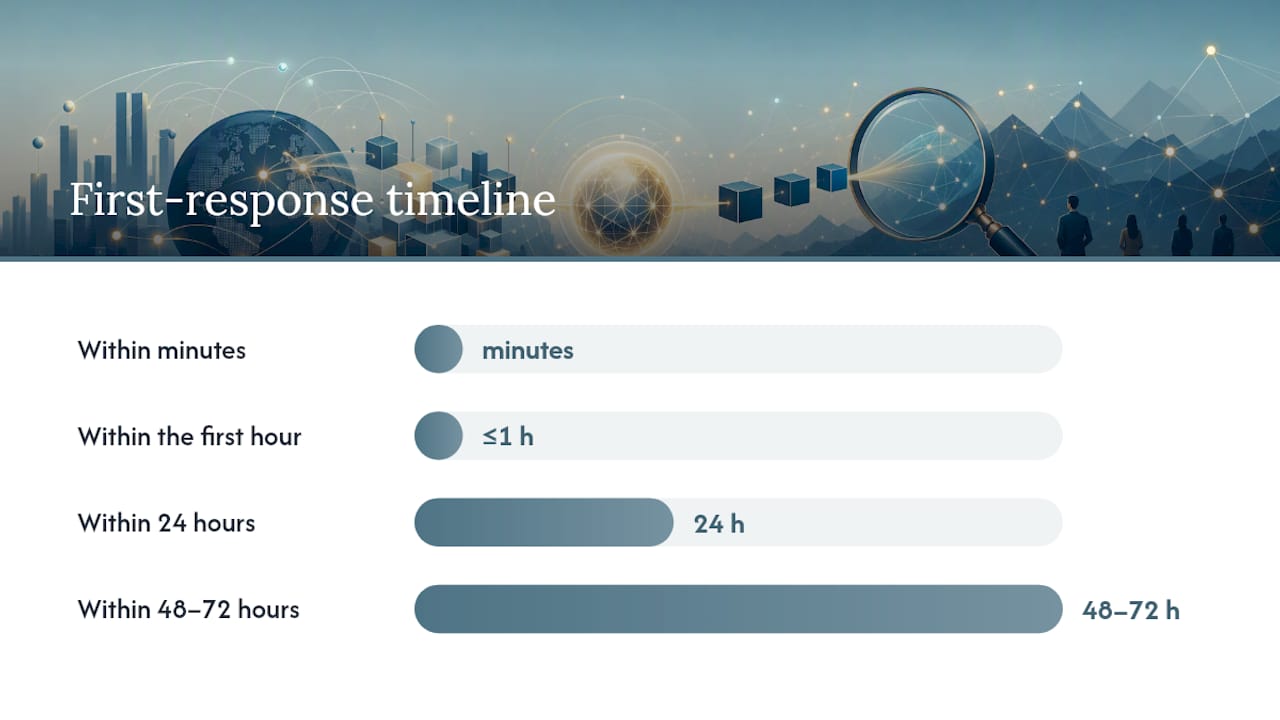
A practical first-response timeline:
-
Within minutes: Stop any further transfers from compromised wallets. Screenshot the theft transaction in a block explorer.
-
Within the first hour: Copy all TXIDs, sending and receiving addresses, and timestamps. Export message logs and email headers from any communications with the fraudster.
-
Within 24 hours: File a report with IC3 and your local law enforcement. Notify the exchange where funds landed, attaching transaction evidence and requesting an emergency freeze.
-
Within 48–72 hours: Engage a forensic investigator and litigation counsel to formalize the freeze request and begin tracing.
Pro Tip: File the IC3 report before contacting the exchange. Exchanges respond faster to freeze requests that reference an active law-enforcement filing number.
Core forensic techniques investigators use
HKA describes the advanced toolkit investigators deploy: address clustering using machine learning, transaction graph analysis, cross-chain tracing across bridges and wrapped assets, and DEX/smart-contract reconstruction for funds routed through decentralized protocols.
The practical sequence looks like this:
-
Data collection: Pull the full transaction history for every address the victim identifies, plus any addresses those wallets interacted with.
-
Clustering: Group wallets likely controlled by the same actor using common-input and change-address heuristics.
-
Attribution: Match clusters to known exchange deposit addresses, flagged services, or previously identified fraud networks.
-
Graph analysis: Map the full fund flow visually, showing every hop, amount, and timestamp.
-
Cross-chain and DEX tracing: Follow funds through bridges (e.g., from Ethereum to Bitcoin) and reconstruct DEX swaps where no custodian holds a record.
-
Alerts and monitoring: Set live alerts on destination addresses so investigators know the moment funds move toward a cash-out point.
Exchange touchpoints are where identity linkage happens. When traced funds land at a regulated exchange, that exchange holds KYC records tied to the deposit address. That is the moment legal process becomes decisive.
Pro Tip: Automated tooling covers the bulk of clustering and graph work, but manual OSINT, including domain registration records, IP logs from phishing sites, and social-media footprints, often closes the attribution gap that algorithms miss.
What victims and counsel should collect before the investigation starts
LegalClarity’s victim workflow and IC3 guidance align on the same core list. Gather these before contacting anyone:
-
Every TXID (transaction hash) associated with the theft. Open a block explorer such as Etherscan or Blockchain.com, search the address, and copy the full 64-character hexadecimal string for each relevant transaction, as recommended by IC3 guidance.
-
All sending and receiving wallet addresses, including any intermediate hops you can identify.
-
Exact amounts and asset types (BTC, ETH, USDC, etc.) with UTC timestamps.
-
Exchange account IDs or usernames on any platform the funds touched.
-
Bank or payment-rail records if fiat was involved at any stage.
-
Complete message logs: text threads, Telegram/WhatsApp exports, Discord histories, and email headers (not just the body text).
-
Domain names, URLs, and screenshots of any websites or apps used by the fraudster.
-
Your own police report number and IC3 complaint confirmation.
Security warning: Never send funds to a party claiming they need a “test transaction” to verify your wallet. Do not expose private keys to anyone. Where possible, preserve a forensic image of any device used during the fraud before wiping or resetting it.
How forensic findings become legal recovery actions
The legal pathway from a traced wallet to a frozen account follows a predictable sequence, though it is rarely fast or guaranteed:
-
Tracing identifies the exchange touchpoint. Once funds land at a custodial exchange, the investigator documents the deposit address and the transaction path leading to it.
-
Legal notice or subpoena compels disclosure. Counsel sends an emergency preservation letter or obtains a subpoena for KYC records tied to the deposit address. U.S.-based exchanges generally comply; offshore exchanges vary significantly.
-
Account freeze or asset seizure follows. With identity confirmed, counsel can seek a temporary restraining order or work with law enforcement toward criminal forfeiture.
-
Parallel criminal referral. A well-documented forensic report supports an FBI or Secret Service referral, which can unlock additional legal tools unavailable in civil proceedings.
The jurisdictional reality is blunt: funds routed to exchanges in weak-regulation jurisdictions may be traceable but not legally reachable without international cooperation, which adds months and cost. Civil remedies and criminal forfeiture follow different procedural tracks, and counsel needs to choose the right one early.
HKA notes that timeline analysis, matching blockchain timestamps to corporate or litigation events, can also demonstrate intentional concealment, strengthening fiduciary breach or fraud claims beyond simple asset recovery.
What realistic timelines and costs look like
| Case type | Typical timeframe | Key cost drivers |
|---|---|---|
| Simple theft to single exchange deposit | Days to 2 weeks | Minimal hops; one subpoena |
| Multi-hop, cross-chain, no mixer | 2–6 weeks | Cross-chain tooling; multiple exchange subpoenas |
| Mixer or privacy-coin obfuscation | 1–4 months | Manual OSINT; probabilistic attribution |
| Cold-storage or long-dormant funds | Months to years | Monitoring; legal coordination across jurisdictions |
The Bitfinex case illustrates the long end: investigators traced 119,756 stolen bitcoin across thousands of transactions over several years before a DOJ seizure became possible. The Colonial Pipeline recovery, by contrast, took weeks because funds moved to a U.S.-accessible exchange quickly.
Full recovery is possible. It is not guaranteed. Obfuscation tools, offshore exchanges, and jurisdictional gaps all reduce the probability. Expect forensic fees to scale with complexity, and budget separately for legal costs including subpoenas, emergency civil process, and expert witness preparation.
How to choose a qualified crypto forensic investigator
Evaluation checklist:
-
Documented case experience with theft and fraud matters, not just compliance work
-
Courtroom and Daubert readiness: can they produce reproducible methodology and testify as an expert witness?
-
Multi-chain expertise covering Bitcoin, Ethereum, and relevant altcoins
-
Clear chain-of-custody procedures from intake through report delivery
-
References from law firms or law enforcement who have used their reports in litigation
Questions to ask during intake:
-
What tools and platforms do you use for clustering and attribution?
-
Have your reports been admitted in U.S. federal or state court? Under what standard?
-
Can you provide a sample redacted report or deliverable outline?
-
What is your estimated timeline and fee structure for a case of this complexity?
-
How do you handle cross-chain tracing and DEX reconstruction?
Red flags that signal a recovery scam rather than a legitimate investigator: demands for a large upfront fee before any work begins, guarantees of full recovery, no written engagement letter or methodology documentation, and refusal to provide references from counsel or law enforcement. Recovera Forensics specifically advises victims on how to identify and report fraudulent recovery operators.
What a court-ready forensic report must include
Counsel should insist on these deliverables before signing any engagement:
-
Documented methodology: A written description of every analytical step, tool used, and decision made, sufficient for an opposing expert to replicate or challenge.
-
Raw exported blockchain data: The underlying transaction records, not just a summary.
-
Transaction graphs: Visual maps of fund flows with labeled addresses, amounts, and timestamps.
-
Address clusters with attribution confidence levels: Each cluster labeled with the entity it is attributed to and the confidence basis for that attribution.
-
Chain-of-custody log: A timestamped record of when data was collected, by whom, and how it was stored.
-
Expert declaration: A signed statement by the investigator attesting to methodology and findings, formatted for use in U.S. court filings.
Chainalysis confirms that court-readiness requires reproducible steps, known error-rate statements where applicable, and an auditable chain of custody to satisfy Daubert-style challenges in U.S. federal courts.
The Recovera Forensics approach to rapid-response tracing
When a matter comes in, the first priority is triage: identify the theft transaction, map the immediate fund flow, and alert any exchange touchpoints within hours. Evidence preservation runs in parallel from minute one, because chain-of-custody documentation cannot be reconstructed after the fact.
The engagement workflow moves from intake and evidence collection through live tracing and exchange alerting, then into legal escalation, whether that means supporting counsel on a subpoena, preparing an emergency civil process filing, or drafting an expert declaration for court. Every step is logged with timestamps and methodology notes.
Recovera Forensics also documents the chain of custody in a format designed to meet Daubert requirements, so the forensic report arrives ready for litigation, not as a starting point for further preparation. Avoiding recovery-scam traps is part of the intake conversation: Recovera will not ask for funds before work begins, and every engagement starts with a written scope and methodology agreement.
Recovera Forensics is ready to start your case now
When stolen crypto is involved, the gap between a traceable asset and an unrecoverable one is often measured in hours. Recoveraforensics provides forensic tracing, legal-grade reporting, exchange liaison, and expert testimony for individuals and law firms across the United States.
To start, send your TXIDs, wallet addresses, screenshots of the theft transaction, and your IC3 or police report number. Recoveraforensics responds to new matters promptly, treats all case details as confidential, and provides a written engagement letter before any work begins. Contact the team directly at Recoveraforensics or submit your case details through the recovery reporting page.
Sources
-
What Is Blockchain Forensics? Definition, Process & Daubert Standard – Chainalysis
-
How Crypto Forensics Uncovers Hidden Assets, Fraud & Digital Evidence
-
U.S. reportedly recoups millions in cryptocurrency ransom paid to Colonial Pipeline hackers – Forbes
-
How to Report Stolen Cryptocurrency to the FBI and FTC – LegalClarity
This article is general information, not a substitute for advice from a qualified financial advisor. Consult a qualified financial professional about your own circumstances before acting on anything here.
FAQ
What does “crypto travel rule” mean in a recovery context?
In asset-recovery practice, “crypto travel rule” refers to blockchain forensic tracing: following stolen funds across public ledgers, linking wallets to identities, and producing court-ready evidence for legal action.
How quickly can a forensic investigator trace stolen cryptocurrency?
Simple cases involving a direct exchange deposit can yield traceable results within days; cases involving mixers or cross-chain hops typically take weeks to months.
What is the most important thing to do immediately after crypto theft?
Preserve every TXID, wallet address, and timestamp, then file an IC3 report and notify the relevant exchange with that transaction evidence to request an emergency freeze.
Can privacy coins or mixers prevent forensic tracing?
They raise complexity significantly but rarely make tracing impossible. Investigators focus on cash-out points at regulated exchanges, where KYC records exist regardless of the obfuscation path taken before arrival.
How does Recoveraforensics support law firms specifically?
Recoveraforensics delivers chain-of-custody documentation, Daubert-ready expert declarations, and exchange liaison support so litigation counsel can move directly from forensic findings to legal action without additional preparation.